

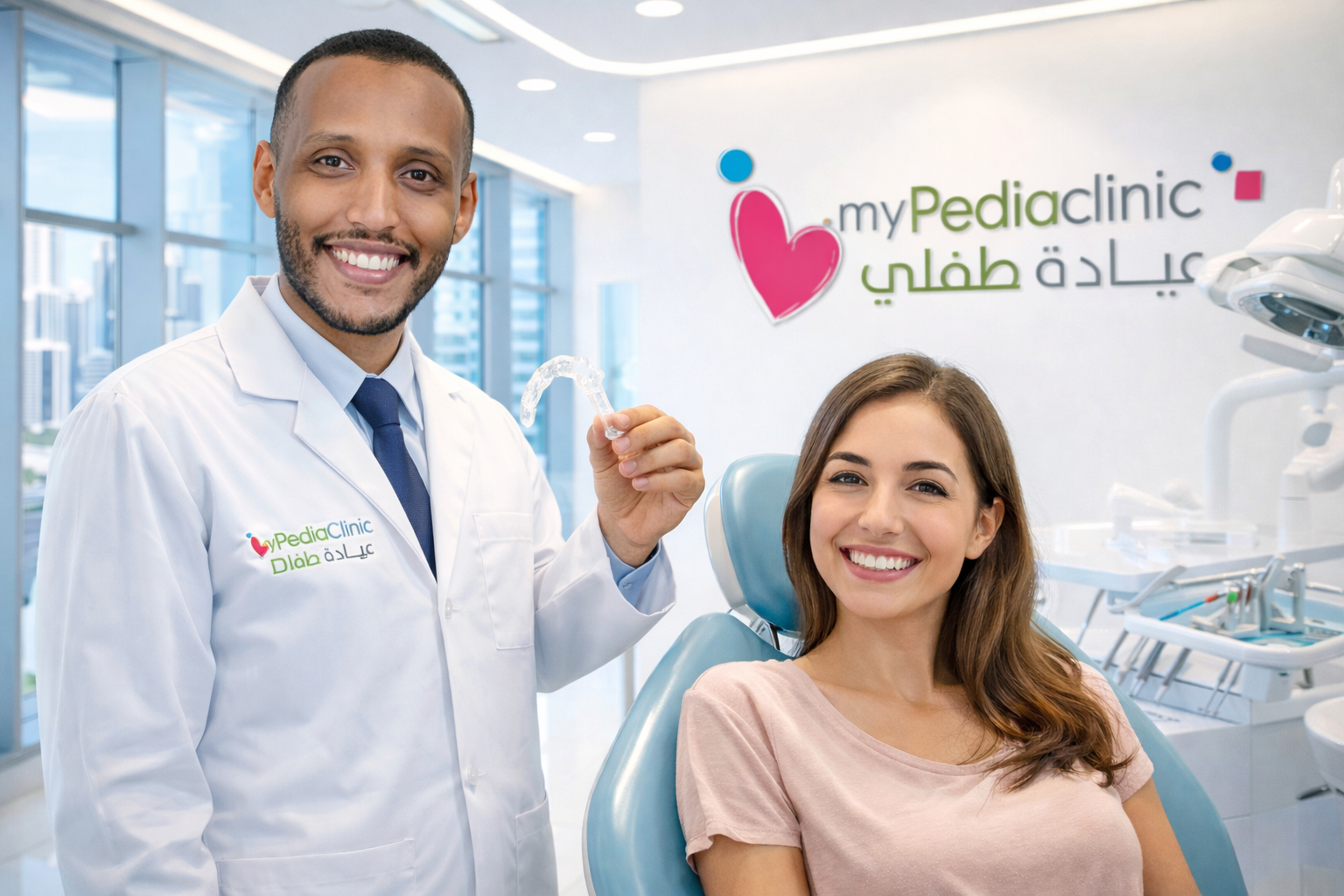
Are you tired of hiding your smile? Invisalign clear aligners have revolutionized orthodontic treatment in Dubai, offering a discreet, comfortable alternative to traditional metal braces. Whether you’re a busy professional who needs confidence in the boardroom, a teenager navigating school life, or a parent seeking the best orthodontic care for your child, Invisalign provides a modern solution that fits seamlessly into your lifestyle.
At myPediaClinic in Dubai Healthcare City, we specialize in authentic Invisalign treatment for both children and adults. Led by our expert orthodontist Dr. Mohamed Hasab, we’ve helped hundreds of Dubai families achieve the smile they’ve always wanted—without the metal brackets, dietary restrictions, or social discomfort of traditional braces.
In this comprehensive guide, you’ll discover everything you need to know about Invisalign in Dubai: how it works, who it’s suitable for, what it costs, and critically—how to ensure you’re getting genuine Invisalign treatment (not cheaper alternatives marketed as “Invisalign”). With transparent pricing starting at AED 15,000 and a team that understands both pediatric and adult orthodontics, myPediaClinic is your trusted partner for authentic Invisalign treatment in Dubai.
What is Invisalign? Understanding Clear Aligner Technology
Invisalign is the world’s most advanced clear aligner system, using patented SmartTrack material and precision 3D technology to straighten teeth without metal brackets or wires. Unlike generic “invisible aligners” or cheaper alternatives, Invisalign is a registered medical device with over 25 years of research, 14 million patients treated worldwide, and continuous innovation backed by clinical studies.
The Invisalign system works through a series of custom-made, removable clear aligners that gradually shift your teeth into their ideal position. Each aligner is worn for 1-2 weeks before moving to the next in the series. The aligners are made from a proprietary thermoplastic material called SmartTrack, which provides gentle, consistent pressure that’s more comfortable and predictable than other clear aligner materials.
How Invisalign Differs from Other Clear Aligners
Dubai’s orthodontic market is flooded with alternatives claiming to be “just like Invisalign” at lower prices. Here’s what makes authentic Invisalign different:
Proprietary SmartTrack Material: Invisalign’s exclusive material provides 75% more predictable tooth movement compared to other clear aligner materials. This means your treatment stays on track and delivers the results your orthodontist planned.
ClinCheck Technology: Invisalign’s digital treatment planning software allows Dr. Mohamed Hasab to map out your entire treatment journey before you even start. You can see a 3D simulation of how your teeth will move at each stage and preview your final smile before committing to treatment.
Precision Attachments: Invisalign uses small, tooth-colored “buttons” bonded to specific teeth to help the aligners grip and apply the right force in the right direction. These attachments are engineered based on decades of research into tooth movement biomechanics.
Continuous Innovation: Invisalign invests millions in research and development. Recent innovations include SmartForce features, improved aligner trimlines, and specialized systems like Invisalign Teen (with compliance indicators) and Invisalign First (for younger children aged 6-10).
Quality Control: Every Invisalign aligner is manufactured at Align Technology’s state-of-the-art facilities with rigorous quality standards. Each aligner has a unique serial number, batch code, and authentication features.
Who Can Benefit from Invisalign in Dubai?
One of Invisalign’s greatest advantages is its versatility. At myPediaClinic, we provide Invisalign treatment for a wide range of patients:
Invisalign for Adults in Dubai
Adults choose Invisalign for professional, social, and lifestyle reasons. If you’re working in Dubai’s corporate sector—finance, healthcare, hospitality, or any client-facing role—the discretion of Invisalign aligners means you can straighten your teeth without the appearance concerns of metal braces.
Common adult cases we treat:
Crowded Teeth: Years of jaw growth, wisdom teeth eruption, or teeth shifting after previous orthodontic treatment can cause crowding. Invisalign creates the space needed for proper alignment.
Spacing Issues: Gaps between teeth can be closed predictably with Invisalign, improving both aesthetics and oral health (gaps trap food and bacteria).
Overbite/Overjet: When upper teeth protrude too far over lower teeth, it can cause jaw pain, wear patterns, and aesthetic concerns. Invisalign can correct mild to moderate overbites.
Underbite: Less common but treatable, underbites occur when lower teeth sit in front of upper teeth. Invisalign with precision attachments can address this in suitable cases.
Crossbite: When some upper teeth sit inside lower teeth (instead of outside), it can cause uneven wear and jaw issues. Invisalign effectively corrects crossbites.
Open Bite: When upper and lower teeth don’t meet when biting down, it affects chewing and speech. Invisalign with elastics can treat open bites in many cases.
Adults appreciate Invisalign’s removability for important meetings, social events, and special occasions. You can eat whatever you want (remove aligners for meals), maintain perfect oral hygiene (brush and floss normally), and avoid the dietary restrictions and cleaning challenges of traditional braces.
Invisalign for Teenagers in Dubai
Teenage years are when most orthodontic treatment occurs—and also when self-consciousness peaks. Invisalign Teen is specifically designed for adolescent patients, with features that address the unique needs of this age group.
Invisalign Teen Advantages:
Social Confidence: Teenagers at schools across Dubai—JESS, GEMS, Dubai College, ASD—can straighten their teeth without the “metal mouth” appearance that causes social anxiety during these formative years.
Compliance Indicators: Invisalign Teen aligners include small blue dots that fade with wear. This helps parents and orthodontists monitor whether the teen is wearing aligners for the recommended 20-22 hours daily.
Eruption Compensation: Invisalign Teen includes space for teeth still erupting (like second molars), allowing treatment to begin even if not all permanent teeth are fully grown.
Replacement Aligners: Because teenagers sometimes lose things, Invisalign Teen treatment includes 6 free replacement aligners—providing peace of mind for parents.
Sports-Friendly: Unlike braces that can cause mouth injuries during contact sports, Invisalign aligners are removed for sports activities. Teens involved in football, basketball, martial arts, or swimming at Dubai clubs can participate safely.
Dr. Mohamed Hasab works closely with teenage patients and their families to ensure compliance, track progress, and achieve excellent results. Regular check-ins every 6-8 weeks keep treatment on track.
Invisalign for Children (Ages 6-12)
Early orthodontic intervention can prevent more serious problems later. myPediaClinic offers Invisalign First for children aged 6-10 and standard Invisalign for older children (10-12 years).
Why Early Treatment? Phase 1 orthodontics addresses issues like narrow jaws, crowding, crossbites, and harmful oral habits while a child’s jaw is still growing. Expanding the palate and creating space for permanent teeth can reduce or eliminate the need for tooth extractions later.
Invisalign First Benefits:
Designed specifically for growing smiles, Invisalign First aligners accommodate mixed dentition (both baby and permanent teeth). The system creates arch expansion to allow permanent teeth to erupt properly, reduces crowding, and corrects bite issues early.
Children respond well to the “cool tech” aspect of Invisalign—seeing their 3D smile simulation and tracking their progress motivates compliance. Parents appreciate the easier oral hygiene (no brackets to brush around) and reduced risk of white spots or cavities that can occur with traditional braces.
The Invisalign Treatment Process at myPediaClinic Dubai
Understanding what to expect makes your Invisalign journey smoother and less stressful. Here’s exactly how treatment works at myPediaClinic:
Step 1: Comprehensive Consultation with Dr. Mohamed Hasab
Your journey begins with a thorough orthodontic consultation. Dr. Mohamed Hasab examines your teeth, bite, and jaw relationship, discusses your smile goals, and determines if Invisalign is the right treatment option for your case.
During this consultation, we use advanced diagnostic tools including digital X-rays and intraoral photography to assess your dental health. Dr. Mohamed Hasab explains what Invisalign can achieve for your specific case, estimated treatment duration, and transparent pricing.
Not every case is suitable for Invisalign. Severe crowding, complex bite issues, or certain jaw discrepancies may require traditional braces or combined orthodontic-surgical treatment. Dr. Mohamed Hasab provides honest, expert guidance on the best treatment approach for your needs.
Step 2: Digital 3D Scanning (No Messy Impressions)
If you proceed with Invisalign treatment, we capture a precise digital scan of your teeth using our iTero scanner. This advanced technology creates a detailed 3D model of your teeth in minutes—no goopy impression trays, no gagging, no discomfort.
The digital scan is incredibly accurate, capturing every surface and contour of your teeth. This data is sent securely to Invisalign’s treatment planning team, where it becomes the foundation of your personalized treatment plan.
Step 3: ClinCheck Treatment Planning
Using the 3D scan, Dr. Mohamed Hasab works with Invisalign’s software to create your custom ClinCheck treatment plan. This digital simulation shows exactly how your teeth will move at each stage of treatment, from your current smile to your ideal final result.
During your next appointment, Dr. Mohamed Hasab presents your ClinCheck plan on screen. You’ll see a 3D animation of your treatment, understand how long it will take (typically 6-18 months depending on complexity), and preview your future smile. If you’d like any adjustments to the final tooth positions, Dr. Mohamed Hasab can refine the plan before approving it.
This technology provides transparency and confidence that you rarely get with traditional braces—you know exactly where you’re headed before treatment even begins.
Step 4: Custom Aligner Manufacturing
Once Dr. Mohamed Hasab approves your ClinCheck plan, your custom aligners are manufactured at Align Technology’s facility. Using advanced 3D printing and thermoforming technology, your complete series of aligners (typically 20-50 depending on your case) are produced to exact specifications.
Each aligner is individually designed to move specific teeth by specific amounts—typically 0.25mm per aligner. This precise, gradual movement is more comfortable than the larger adjustments made with traditional braces.
Manufacturing and shipping typically takes 2-3 weeks. Your full set of aligners arrives at myPediaClinic, each numbered sequentially and packaged with instructions.
Step 5: Fitting Your First Aligners and Attachments
When your aligners arrive, you return to myPediaClinic for your fitting appointment. Dr. Mohamed Hasab places small tooth-colored attachments on specific teeth (if your treatment plan requires them). These attachments are composite bonding material shaped like small bumps or ridges—they help aligners grip teeth and apply the right forces.
You’ll receive your first few sets of aligners (typically 3-4 sets, covering 6-8 weeks) and detailed instructions on:
Wear Schedule: Aligners must be worn 20-22 hours daily, removing only for eating, drinking anything other than water, and oral hygiene.
Aligner Changes: Most patients change to the next aligner every 1-2 weeks. Dr. Mohamed Hasab provides your specific schedule.
Cleaning: Aligners should be brushed gently with a soft toothbrush and rinsed with cool water. Avoid hot water (can warp aligners) and colored or sugary drinks while wearing aligners.
Storage: Always store removed aligners in their case to prevent loss or damage. Never wrap them in napkins (a common way people accidentally throw away aligners).
Comfort: The first few days with each new aligner may feel tight—this is normal and indicates the aligners are working. Any discomfort typically subsides within 2-3 days.
Step 6: Progress Check-ins Every 6-8 Weeks
Unlike traditional braces requiring monthly tightening appointments, Invisalign check-ins are typically scheduled every 6-8 weeks. These brief appointments allow Dr. Mohamed Hasab to:
Monitor your progress and ensure teeth are tracking according to the ClinCheck plan. Provide your next sets of aligners (usually 3-4 sets per visit). Check attachment integrity and replace any that have come loose. Address any concerns or questions you have about treatment. Make minor adjustments if needed (like interproximal reduction—gently contouring teeth to create space).
These appointments are usually quick (15-20 minutes), scheduled during lunch breaks or after school for teens—minimal disruption to your busy Dubai lifestyle.
Step 7: Mid-Course Corrections (If Needed)
In some cases, teeth don’t track perfectly according to the original plan. This is normal—every patient’s biology is slightly different. If Dr. Mohamed Hasab identifies tracking issues, we can order “refinement aligners.”
Refinement involves taking a new scan, creating an updated ClinCheck plan to address any discrepancies, and manufacturing additional aligners to get your treatment back on track. This is included in your treatment cost at myPediaClinic—no surprise charges.
Step 8: Treatment Completion and Retention
When you’ve worn your final aligner and achieved your ideal smile, your active treatment phase is complete. However, orthodontic treatment doesn’t end here—retention is critical to maintaining your results.
Teeth have a natural tendency to shift back toward their original positions (called relapse). To prevent this, you’ll wear retainers that hold teeth in their new positions while surrounding bone and tissues stabilize.
myPediaClinic provides Vivera retainers—Invisalign’s proprietary retainer system made from the same durable material as the aligners. You’ll receive multiple sets of retainers (typically 3-4 sets) to last several years.
Retention Protocol: Wear retainers full-time (22 hours daily) for the first 3-6 months after treatment. Transition to night-time only wear (every night) indefinitely. Replace retainers every 1-2 years as they wear out.
Dr. Mohamed Hasab schedules follow-up appointments at 3 months, 6 months, and 12 months post-treatment to monitor stability and ensure you’re maintaining your beautiful new smile.
Invisalign Cost in Dubai: Transparent Pricing at myPediaClinic
One of the biggest frustrations patients express about orthodontic care in Dubai is pricing opacity. Many clinics advertise low prices to get you in the door, only to reveal much higher costs once you’re committed. At myPediaClinic, we believe in complete transparency from your first consultation.
Our Invisalign Pricing: Starting at AED 15,000
Invisalign treatment at myPediaClinic starts at AED 15,000 for straightforward cases. This pricing includes:
Comprehensive orthodontic consultation and diagnostic records (X-rays, photos, 3D scan). ClinCheck digital treatment planning with Dr. Mohamed Hasab. Your complete series of custom Invisalign aligners. All attachments and aligner accessories. Progress check-in appointments throughout treatment (every 6-8 weeks). Refinement aligners if needed to perfect results. Vivera retainer sets (3-4 sets) upon completion.
More complex cases requiring longer treatment duration or additional orthodontic procedures may cost AED 18,000-22,000. Dr. Mohamed Hasab provides an exact quote during your consultation based on your specific treatment needs—no surprises, no hidden fees.
Why Invisalign Pricing Varies Across Dubai
If you research Invisalign costs in Dubai, you’ll find a wide range—from AED 5,000 to AED 24,000 or more. Understanding why prices vary helps you make informed decisions:
Treatment Complexity: Simple cases (minor crowding or spacing) require fewer aligners and shorter treatment time, hence lower cost. Complex cases (significant crowding, bite correction, rotated teeth) require more aligners, longer treatment, and more orthodontist expertise.
Provider Experience: Orthodontists with specialized training and extensive Invisalign experience (like Dr. Mohamed Hasab) charge appropriately for their expertise. General dentists offering Invisalign may charge less but may lack specialized orthodontic training.
Clinic Location and Overhead: Premium locations like Dubai Healthcare City have higher operating costs reflected in pricing, but also provide convenience, modern facilities, and regulatory oversight.
What’s Included: Some clinics advertise low prices but charge separately for consultations, retainers, refinements, or follow-up visits. Always ask what’s included in the quoted price.
Treatment Quality: This is critical—some ultra-low-priced “Invisalign” treatment isn’t actually Invisalign at all (more on this below).
Payment Plans and Insurance Coverage
myPediaClinic offers flexible payment plans to make Invisalign treatment accessible for Dubai families. We accept:
Interest-free installment plans (pay over 6-12 months). Major credit cards (Visa, Mastercard, American Express). Health insurance (we work with major UAE insurers—check your orthodontic coverage). Company health benefits (many Dubai employers offer dental/orthodontic benefits).
Our team assists with insurance claims and benefit verification to maximize your coverage. Many insurance plans cover 25-50% of orthodontic treatment costs up to a lifetime maximum (typically AED 5,000-10,000).
Why Choose myPediaClinic for Invisalign Treatment in Dubai?
Dubai has no shortage of clinics offering Invisalign. Here’s why myPediaClinic stands out:
Specialized Orthodontic Expertise: Dr. Mohamed Hasab
Dr. Mohamed Hasab is a certified orthodontist with extensive training in tooth movement, facial growth, and bite correction. Unlike general dentists who offer Invisalign as one of many services, orthodontics is Dr. Mohamed Hasab’s sole focus and passion.
Dr. Mohamed Hasab has completed hundreds of Invisalign cases across all age groups—from Invisalign First for young children to complex adult cases. This experience translates to more accurate treatment planning, better progress monitoring, and superior final results.
Pediatric and Family-Focused Care
As Dubai’s leading pediatric clinic, myPediaClinic understands children’s unique needs—developmentally, psychologically, and medically. If you’re seeking Invisalign for your child or teen, our pediatric expertise ensures age-appropriate communication, anxiety management, and family-centered care.
Many families choose myPediaClinic because parents and children can receive orthodontic care in the same practice. Coordinating family appointments is easier, and younger siblings can see older siblings’ treatment success—building confidence for their own future orthodontic needs.
Authentic Invisalign, Guaranteed
myPediaClinic is a certified Invisalign provider, meaning we maintain partnership standards with Align Technology, receive ongoing training on the latest Invisalign innovations, and provide only genuine Invisalign aligners—never cheaper alternatives or knock-offs.
Every aligner you receive has Invisalign authentication features: the Invisalign logo printed on each aligner, unique aligner numbers and batch codes, and the distinctive starflower pattern when held up to light (more on how to verify authenticity below).
State-of-the-Art Technology
myPediaClinic invests in the latest orthodontic technology to enhance your experience and results:
iTero Digital Scanner: Comfortable, accurate 3D scanning without messy impressions. ClinCheck Software: Visualize your treatment journey before starting. Digital Radiography: Low-radiation X-rays with instant results. Intraoral Cameras: See what Dr. Mohamed Hasab sees during examinations. Patient Portal: Track your progress, schedule appointments, and access treatment information online.
Convenient Dubai Healthcare City Location
myPediaClinic’s location in Dubai Healthcare City offers:
Easy access from Sheikh Zayed Road and Al Khail Road. Ample parking for families. Proximity to Dubai’s major residential areas (Downtown, Business Bay, Jumeirah, JLT). Professional medical environment with regulatory oversight. Close to schools for after-school appointments.
Our clinic hours accommodate working parents and school schedules, with early morning, evening, and weekend appointments available.
Transparent Communication and Education
We believe informed patients achieve better results. Dr. Mohamed Hasab takes time to explain your treatment, answer questions, and provide resources for success. You’ll never feel rushed or pressured.
Our team follows up regularly via WhatsApp (preferred communication method for most Dubai patients) to check progress, send reminders, and provide support between appointments.
CRITICAL: Not All “Invisalign” in Dubai is Real Invisalign
Here’s something every prospective Invisalign patient in Dubai needs to know: there’s a significant problem with cheaper clear aligner systems being marketed as “Invisalign” when they’re not.
This isn’t just misleading marketing—it’s fundamentally deceptive. Patients believe they’re receiving premium Invisalign treatment, pay Invisalign prices, but receive inferior generic aligners. The consequences include poor results, longer treatment times, and wasted money.
Common Invisalign Alternatives Sold as “Invisalign”
The clear aligner market has exploded with alternatives to Invisalign, some legitimate but lower-cost options, others outright copies. Common alternatives you might encounter in Dubai:
ClearCorrect: A legitimate clear aligner brand, ClearCorrect is often marketed as “just like Invisalign” at prices around AED 8,000-12,000. While ClearCorrect is FDA-approved and can deliver good results, it’s not Invisalign—different material, different manufacturing, less research backing, and generally used for simpler cases.
K Line Clear Aligners: Popular in Dubai clinics advertising Invisalign-style treatment starting at AED 4,999-8,000. K Line is a generic Korean aligner system with minimal research, less precise manufacturing, and no proprietary technology like ClinCheck or SmartTrack material.
Generic “Invisible Braces” or “Clear Aligners”: Many Dubai clinics advertise “invisible braces in Dubai” or “clear aligners starting AED 2,999” without specifying the brand. These are often Chinese-manufactured generic systems with no quality control, no clinical research, and unpredictable results.
3D-Printed In-House Aligners: Some clinics now own 3D printers and create their own aligners in-house. While this sounds innovative, it bypasses decades of Invisalign’s research into material science, tooth movement biomechanics, and manufacturing precision. Results are highly variable.
How the Deception Happens
Unethical clinics use several tactics to make patients believe they’re getting Invisalign:
Ambiguous Advertising: Ads show pictures of clear aligners (which all look similar) with text like “Get Invisalign-style treatment” or “Invisible braces in Dubai from AED 5,000.” The word “Invisalign” appears in the ad, but technically they’re not claiming to provide Invisalign—just “Invisalign-style” treatment.
Bait and Switch: You call asking about Invisalign pricing. The clinic quotes AED 10,000 for “clear aligner treatment.” You assume it’s Invisalign. During your appointment, you’re told they use “the same technology as Invisalign” or “our aligners work just like Invisalign.” You proceed thinking it’s Invisalign, only discovering later it’s a different system.
No Brand Disclosure: Your aligners arrive in generic packaging or branded with the clinic’s name, not “Invisalign.” You’ve paid Invisalign prices but received a generic alternative.
Mixing Systems: Some clinics start treatment with a few genuine Invisalign aligners, then switch to cheaper alternatives mid-treatment, hoping you won’t notice.
Why This Matters: Real Consequences
You might think, “If the aligners work, does it matter what brand they are?” Here’s why it absolutely matters:
Material Quality: Invisalign’s SmartTrack material is engineered for optimal force delivery and comfort. Generic aligner materials are often rigid, uncomfortable, crack easily, or don’t maintain their shape—leading to unpredictable tooth movement.
Treatment Predictability: Invisalign’s ClinCheck planning is backed by 14 million patient cases and AI-driven algorithms that predict how teeth respond to forces. Generic systems lack this data, leading to poor planning and results that don’t match the digital simulation.
Safety and Testing: Invisalign aligners undergo rigorous biocompatibility testing to ensure they’re safe for continuous oral wear. Generic aligners from unknown manufacturers may contain materials that cause allergic reactions, oral irritation, or long-term health risks.
Quality Control: Every Invisalign aligner is manufactured to precise tolerances with quality checks at multiple stages. Generic aligners have inconsistent fit, thickness variations, and rough edges that irritate gums.
Warranty and Support: Invisalign treatment includes refinement aligners if your teeth don’t track perfectly. Generic systems often don’t—if treatment fails, you’re left with partial results and no recourse.
Professional Liability: Dentists and orthodontists providing generic aligners while claiming they’re “the same as Invisalign” are being deceptive. This raises questions about their overall ethics and patient care standards.
How to Verify You’re Getting Authentic Invisalign in Dubai
Protecting yourself from Invisalign substitution requires due diligence. Here’s how to ensure you receive genuine Invisalign treatment:
1. Ask Direct Questions Before Starting Treatment
Don’t assume. Ask explicitly:
“Will I be receiving genuine Invisalign aligners manufactured by Align Technology?” “Is this clinic a certified Invisalign provider?” “Will my aligners have the Invisalign logo and branding?” “Can I see my ClinCheck treatment plan in the official Invisalign software?”
Legitimate Invisalign providers will answer “yes” to all questions without hesitation. Evasive answers like “we use the same technology” or “our system is equivalent to Invisalign” are red flags.
2. Verify the Provider on Invisalign’s Website
Align Technology maintains a provider locator on their website. Search for your clinic/doctor to confirm they’re a certified Invisalign provider. This verification proves they’ve completed Invisalign training and maintain active status.
If your doctor doesn’t appear in the provider directory, they may be using alternative systems.
3. Check Your Treatment Plan: ClinCheck Digital Simulation
Genuine Invisalign treatment includes ClinCheck digital planning. Your orthodontist should show you your ClinCheck treatment plan on screen—a detailed 3D simulation with the Invisalign logo.
If you’re shown a generic animation or static images without the ClinCheck interface, it’s likely not Invisalign. Ask to see the official ClinCheck plan with Invisalign branding.
4. Inspect Your Aligners: Authentication Features
When you receive your aligners, check for these authentication features present on every genuine Invisalign aligner:
Invisalign Logo: The word “Invisalign” is printed on the outside of each aligner near the molars (back teeth). It’s small but visible.
Aligner Number: Each aligner is numbered sequentially (e.g., “U1” for upper aligner #1, “L1” for lower aligner #1). Numbers are printed on the aligner.
Batch Code: A unique batch/lot code identifies when and where your aligners were manufactured. This is printed near the aligner number.
Starflower Pattern: Hold your aligner up to bright light and look closely. Genuine Invisalign aligners have a distinctive “starflower” or dotted pattern visible throughout the material—this is a proprietary anti-counterfeiting feature. Generic aligners don’t have this pattern.
Smooth Edges: Invisalign aligners have precisely trimmed, smooth edges that sit comfortably at the gumline. Generic aligners often have rough edges or inconsistent trimming.
If your aligners lack these features, they’re not Invisalign. Raise this immediately with your provider.
5. Check the Packaging
Genuine Invisalign aligners arrive in branded Invisalign packaging—sleek bags or boxes with the Invisalign logo, clear labeling, and instructions. Each aligner pair comes in a separate packet labeled with the aligner numbers.
If your aligners arrive in generic bags, plain packaging, or packaging branded with the clinic’s name instead of Invisalign, it’s a strong indication you’re not receiving genuine Invisalign.
6. Review Your Contract and Payment Receipts
Your treatment contract should explicitly state “Invisalign treatment” or reference Align Technology as the aligner manufacturer. Payment receipts should indicate you’re paying for Invisalign specifically.
If the contract vaguely references “clear aligner treatment” without mentioning Invisalign by name, ask for clarification before signing.
7. Trust Your Instincts: If the Price Seems Too Low, Investigate
Invisalign treatment in Dubai from reputable providers typically costs AED 12,000-24,000 depending on case complexity. If a clinic offers “Invisalign” for AED 5,000-8,000, it’s almost certainly a generic alternative.
While lower prices are tempting, orthodontic treatment is a significant investment in your health and appearance. Choosing cheap alternatives can lead to poor results, additional costs to fix problems, and wasted time—false economy.
Invisalign Lifestyle: What to Expect During Treatment
Beyond the clinical aspects, understanding day-to-day life with Invisalign helps you prepare for success:
Eating and Drinking
One of Invisalign’s biggest advantages: no dietary restrictions. Remove aligners before eating or drinking anything other than water. This means you can enjoy all your favorite foods—crunchy vegetables, nuts, corn on the cob, sticky candy—things that are off-limits with traditional braces.
However, you must remove aligners for all meals and snacks. Eating with aligners in can damage them, trap food particles, and increase cavity risk. After eating, brush your teeth before reinserting aligners (or at minimum, rinse thoroughly).
For Dubai’s coffee culture: you can drink water with aligners in, but coffee, tea, or any colored beverage should be consumed with aligners removed (or they’ll stain). Many patients carry a small brush kit for post-meal cleaning.
Oral Hygiene
Maintaining excellent oral hygiene is critical during Invisalign treatment. Brush and floss after every meal before reinserting aligners. Aligners trap anything on your teeth against the enamel, increasing cavity risk if you wear them over unbrushed teeth.
Clean your aligners daily by brushing them gently with a soft toothbrush and rinsing with cool water. Some patients use retainer cleaning tablets once daily for deeper cleaning. Avoid hot water (it can warp the aligners’ shape) and toothpaste (it can scratch/cloud the aligner material, making them less clear).
Speech and Comfort
Most patients experience minor speech changes for the first few days with new aligners—a slight lisp or thickness feeling. This typically resolves within 2-3 days as your tongue adapts. Practicing speaking aloud helps speed adjustment.
Each new aligner feels tight for the first 1-3 days—this is the aligner working to move your teeth. Any discomfort is typically mild (unlike the soreness from braces tightening) and subsides as teeth begin moving. Over-the-counter pain relief can help if needed, though most patients don’t require it.
Social Situations
Invisalign’s discretion is unmatched. Most people won’t notice you’re wearing aligners unless you mention it. The clear material blends with teeth, and the thin profile is far less noticeable than metal brackets and wires.
For important events—weddings, photos, presentations—you can remove aligners for a few hours without derailing treatment. Just ensure you’re wearing them 20-22 hours daily overall. The flexibility to remove aligners for special occasions is a significant advantage over non-removable braces.
Travel and Busy Lifestyles
Invisalign fits seamlessly into busy Dubai lifestyles. Business travelers can continue treatment without frequent appointments (you receive several sets of aligners to use while traveling). The aligner case fits easily in a purse or briefcase.
If you lose or damage an aligner while traveling, protocols exist: if you’re only a few days from changing to the next aligner, Dr. Mohamed Hasab may advise moving forward. If it’s early in the aligner’s wear period, you might revert to the previous aligner until a replacement arrives.
Frequently Asked Questions About Invisalign in Dubai
How long does Invisalign treatment take?
Treatment duration varies based on case complexity. Simple cases (minor crowding or spacing) may take 6-12 months. Moderate cases (significant crowding, rotations, or bite correction) typically require 12-18 months. Complex cases can take 18-24 months or longer. Dr. Mohamed Hasab provides an accurate timeline during your consultation based on your specific case and ClinCheck plan.
Does Invisalign hurt?
Invisalign is generally more comfortable than traditional braces. Each new aligner feels tight for the first 1-3 days as it begins moving your teeth—this is normal and indicates the aligner is working. The tightness is typically described as pressure rather than pain. Most patients don’t need pain medication, though over-the-counter options like ibuprofen can help if discomfort occurs.
Can I eat and drink with Invisalign aligners in?
You should remove aligners for all eating and drinking except water. Eating with aligners in can damage them and trap food against teeth, increasing cavity risk. Drinking colored beverages (coffee, tea, soda, juice) with aligners in will stain them. After eating or drinking, brush your teeth (or at minimum rinse thoroughly) before reinserting aligners.
How many hours per day must I wear Invisalign aligners?
Aligners must be worn 20-22 hours daily for optimal results. This means removing them only for meals, snacks, and oral hygiene—approximately 2-4 hours daily total. Consistent wear is critical. If you don’t wear aligners as prescribed, teeth won’t move according to the treatment plan, extending treatment time or compromising results.
Will people notice I’m wearing Invisalign?
Most people won’t notice unless they’re looking closely. Invisalign’s clear material blends with tooth enamel, making aligners much less noticeable than metal braces. Small attachments (tooth-colored bumps) are sometimes visible up close but blend well. Overall, Invisalign is far more discreet than any other orthodontic option.
Can I remove Invisalign aligners for special occasions?
Yes, you can remove aligners for a few hours for important events, photos, or presentations without derailing treatment—as long as you’re still wearing them 20-22 hours daily overall. This flexibility is a major advantage over braces. However, removing aligners frequently or for extended periods will slow treatment progress.
What happens if I lose or break an Invisalign aligner?
Contact myPediaClinic immediately if you lose or damage an aligner. Depending on where you are in the aligner’s wear cycle, Dr. Mohamed Hasab may advise: moving forward to the next aligner if you’re within a few days of changing anyway; reverting to the previous aligner until a replacement arrives; or ordering a replacement aligner (small fee may apply). Invisalign Teen includes 6 free replacement aligners for this reason.
Can Invisalign fix my specific orthodontic problem?
Invisalign can treat a wide range of orthodontic issues including crowded teeth, gaps/spacing, overbite, underbite, crossbite, and open bite. However, very severe cases, complex jaw discrepancies, or certain tooth movements may still require traditional braces. Dr. Mohamed Hasab evaluates your specific case during consultation and provides honest guidance on whether Invisalign is appropriate or if alternative treatment is better suited.
Is Invisalign safe for children and teenagers?
Yes, Invisalign is safe for patients as young as 6 years old. Invisalign First is designed specifically for children aged 6-10 with developing dentition. Invisalign Teen is tailored for adolescents aged 11-19 with features like compliance indicators and eruption compensation. Both systems are extensively tested for safety and have been used successfully in millions of young patients.
How much does Invisalign cost in Dubai?
At myPediaClinic, Invisalign treatment starts at AED 15,000 for straightforward cases, with more complex cases ranging up to AED 22,000. This includes consultation, digital scanning, all aligners, check-in appointments, refinement aligners if needed, and retainers. We offer flexible payment plans and work with insurance providers to maximize your benefits. Exact pricing depends on your specific case complexity—Dr. Mohamed Hasab provides a transparent quote during consultation.
Does insurance cover Invisalign in Dubai?
Many UAE health insurance plans include orthodontic coverage—typically 25-50% of treatment costs up to a lifetime maximum (often AED 5,000-10,000). Coverage varies by plan and provider. myPediaClinic’s team assists with insurance verification and claims processing to help maximize your benefits. Even with partial insurance coverage, payment plans can make remaining costs manageable.
What’s the difference between Invisalign and generic clear aligners?
Invisalign is the original, most researched, and most advanced clear aligner system with proprietary technology including SmartTrack material, ClinCheck treatment planning, precision attachments, and rigorous quality control. Generic clear aligners (like ClearCorrect, K Line, or unbranded systems) lack this proprietary technology, use different materials, have less precise manufacturing, and aren’t backed by the same clinical research. Results with generic aligners are less predictable, and treatment quality depends heavily on the provider’s experience.
How do I know I’m getting real Invisalign and not a cheaper alternative?
Verify authenticity by: asking explicitly if you’re receiving genuine Invisalign before starting treatment; confirming your provider appears in Invisalign’s official provider locator; viewing your ClinCheck treatment plan with Invisalign branding; and inspecting your aligners for authentication features (Invisalign logo, aligner numbers, starflower pattern when held to light, and official Invisalign packaging). If any of these are missing, you may not be receiving genuine Invisalign.
Can I switch from braces to Invisalign mid-treatment?
In some cases, yes. If you’ve started traditional braces but are unhappy with the appearance or lifestyle impact, Dr. Mohamed Hasab can evaluate whether transitioning to Invisalign is possible. This depends on your current progress, remaining tooth movements needed, and case complexity. A new treatment plan would be created to complete your orthodontic goals with Invisalign.
What happens after Invisalign treatment is complete?
Retention is critical to maintain your results. You’ll receive Vivera retainers (Invisalign’s proprietary retainer system) to wear full-time for the first 3-6 months, then transition to night-time only wear indefinitely. Teeth naturally tend to shift over time, so long-term retainer wear prevents relapse. Dr. Mohamed Hasab schedules follow-up appointments to monitor stability and ensure your smile stays beautiful.
Can I whiten my teeth while wearing Invisalign?
Yes, Invisalign aligners can double as whitening trays. You can apply professional whitening gel inside your aligners and wear them as prescribed—whitening while straightening. Discuss this with Dr. Mohamed Hasab if you’re interested. Many patients appreciate addressing both alignment and color simultaneously for a complete smile transformation.
Is Invisalign suitable for adults over 40 or 50?
Absolutely. There’s no age limit for Invisalign. Adults of all ages—including those in their 40s, 50s, 60s, and beyond—successfully complete Invisalign treatment. As long as your teeth and gums are healthy, orthodontic treatment can improve your smile and oral health at any age. Many mature adults choose Invisalign specifically for its discretion, fitting seamlessly into professional and social lives.
Does Invisalign affect speech?
Most patients experience minor speech changes (slight lisp or thickness feeling) for the first 2-3 days with aligners. This resolves quickly as your tongue adapts to the aligners’ presence. Practicing speaking aloud accelerates adjustment. Within a week, most patients speak completely normally with aligners in—far less speech impact than traditional braces.
Can I smoke or vape while wearing Invisalign?
Smoking or vaping with aligners in will stain them yellow/brown, making them highly visible—defeating the purpose of clear aligners. Additionally, heat from smoking can warp aligner material. If you smoke or vape, remove aligners first. However, this reduces wear time and may slow treatment progress. Invisalign treatment is an excellent motivation to quit smoking—many patients use it as an opportunity to improve overall health.
What if I’m not happy with my Invisalign results?
At myPediaClinic, we’re committed to your satisfaction. If you’re not satisfied with results, Dr. Mohamed Hasab will work with you to address concerns—this may involve refinement aligners to fine-tune tooth positions. Open communication throughout treatment ensures we identify and address any issues early. Your treatment includes refinement aligners at no extra cost if needed to achieve the planned result.
Can Invisalign be combined with other dental treatments?
Yes, Invisalign can often be coordinated with other treatments like veneers, crowns, or implants. In some cases, orthodontic treatment is performed first to properly position teeth before restorative work. In other cases, treatments are sequenced differently based on your specific needs. Dr. Mohamed Hasab coordinates with other dental specialists to create a comprehensive treatment plan that addresses all your dental goals efficiently.
Take the First Step Toward Your Dream Smile Today
Your smile is one of your most important assets—it affects your confidence, your first impressions, your professional success, and your daily happiness. If you’ve been hiding your smile due to crooked, crowded, or gapped teeth, Invisalign can help you achieve the beautiful, straight smile you deserve.
At myPediaClinic in Dubai Healthcare City, Dr. Mohamed Hasab and our team are ready to guide you through every step of your Invisalign journey—from your initial consultation through the day you see your final, stunning result.
We’re committed to:
Authentic Invisalign treatment—never cheaper substitutes marketed as “the same.” Transparent pricing starting at AED 15,000 with no hidden fees. Expert orthodontic care from a certified specialist. Family-friendly service for children, teens, and adults. Convenient scheduling that respects your busy Dubai lifestyle. Ongoing support throughout your treatment journey.
Don’t spend another day feeling self-conscious about your smile. The technology exists to straighten your teeth comfortably, discreetly, and predictably—and the time to start is now.
Schedule your complimentary Invisalign consultation today:
Call us: +971-4-430-5926
Visit us: myPediaClinic, Dubai Healthcare City
WhatsApp: +971-4-430-5926
Website: mypediaclinic.com
Dr. Mohamed Hasab will evaluate your smile, answer all your questions, show you what Invisalign can achieve for your specific case, and provide transparent pricing—no pressure, just expert guidance to help you make an informed decision.
Your dream smile is closer than you think. Let’s make it happen together.