

Fillings, white crowns & root canal treatment
A pediatric dentist can assess your child’s teeth and explain appropriate restorative treatment options.
When decay has gone past what a toothbrush can undo, a pediatric dentist restores the tooth rather than removing it. That means a filling, a crown in stainless steel or tooth-coloured zirconia, or pulp therapy — a baby-tooth root canal — depending on how deep the decay has reached and how long that tooth still has to serve.
Is this your child?
Early decay is silent, which is why six-monthly checks find it first. Book sooner if you notice:
- Pain that arrives on its own, rather than only with something cold
- A child who wakes in the night holding their face
- Chewing that has quietly moved to one side of the mouth
- A dark spot, a hole, or a tooth that has chipped or broken
- A bubble or swelling on the gum above a tooth
- A newly erupted molar or front tooth that came through creamy, yellow-brown or rough
- A tooth that has darkened weeks or months after a knock
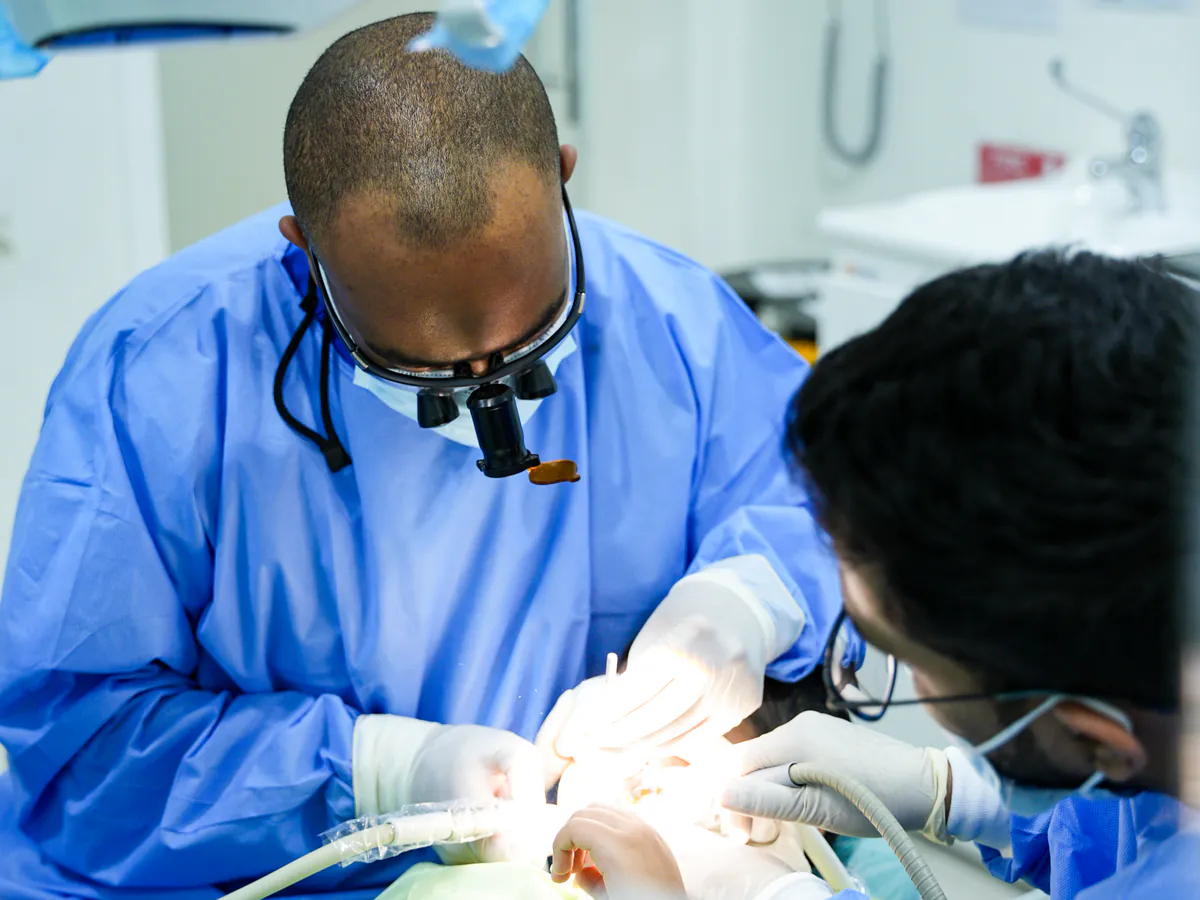
What the appointment involves
- 01The look, and the x-rayDecay between teeth and under the gum does not show from outside. A small digital x-ray settles how deep it has gone before anything is decided.
- 02NumbingLocal anaesthetic first. If your child is anxious, nitrous oxide can go on before the injection rather than after it.
- 03Decay out, tooth rebuiltA thin rubber sheet isolates the tooth — most children find it reassuring once it is on. The decayed structure is removed and the tooth restored with a filling, a crown, or pulp therapy and a crown, depending on what is underneath.
- 04The bite checkThe restoration is adjusted until your child bites down normally, and an x-ray confirms the result where one is needed.
Filling, crown, or pulp therapy
Which one a tooth needs depends on how far the decay has reached.
- Filling A tooth-coloured filling is enough while there is sound tooth left to hold it. It is usually done in one short visit.
- Crown Once decay has taken more than about a third of the tooth or several surfaces, or the tooth has broken, a crown holds better than a filling.
- Steel or tooth-coloured A stainless steel crown is fitted in one visit and very rarely fails. A zirconia crown is tooth-coloured but needs more of the tooth reduced and longer in the chair, so it is usually kept for front teeth. Many children have one of each.
- Pulp therapy When decay reaches the nerve, a pulpotomy removes the inflamed pulp from the crown of the tooth and a pulpectomy removes all of it. The tooth is then capped, and it still falls out on schedule.
How long it takes
Most single treatments take under an hour. Several teeth at once usually means sedation rather than one very long sitting.
- 20–30 minutes A filling.
- 30–40 minutes A stainless steel crown.
- 50–70 minutes A zirconia crown.
- 45–60 minutes Pulp therapy on one tooth.
The tooth is reviewed four to six weeks afterwards, then at the usual six-month checks. Success means the tooth works without pain or infection until it falls out on its own.
The first day or two
Most of this is about the hours while the numbness wears off.
Who you would see
 Dr. Mustafa AbdallaSpecialist Pediatric Dentist & Director of the Dental Department
 Dr. Shaima BuhamerSpecialist Pediatric Dentist
 Dr. Sharifa AlHajSpecialist Pediatric Dentist
 Dr. Sara Atif MustafaSpecialist Pediatric Dentist
Every doctor consults in English and Arabic.
Why treat a baby tooth that is going to fall out anyway?
Because it is not going anywhere soon. Lower front teeth go at six or seven, upper front at seven or eight, but the back molars — the ones that get most of the cavities — stay until ten, eleven, sometimes twelve. A cavity in a baby molar at four means that tooth still has six to eight years of work ahead of it, holding the space for the permanent tooth behind it.
Will a silver crown show when my child smiles?
On a back molar, no — nobody sees a second molar. On a front tooth, yes, and that is exactly when a tooth-coloured zirconia crown is worth the extra preparation and chair time.
Can a crown damage the permanent tooth underneath?
No. The crown is cemented to the baby tooth only; the permanent tooth forming below is separate and untouched. When it is ready it dissolves the baby tooth’s roots as normal, and the baby tooth comes out with the crown still on it. Leaving decay untreated is the thing that can damage a permanent tooth, through infection reaching the tooth bud.
My child’s new molar came through yellow-brown. Is that a cavity?
It may be MIH — molar incisor hypomineralisation — a developmental defect where the enamel forms with too little mineral in it. Global estimates put it at 14 to 20 per cent of children, roughly one in six. It is not caused by hygiene or diet, and it matters because standard fillings do not bond well to hypomineralised enamel and can fail within weeks. It is treated differently. Dr. Sharifa AlHaj holds MIH Masterclass certification and it is a focus of her practice here.
Is there a way to treat a cavity without a drill?
Sometimes. Silver diamine fluoride is painted onto the cavity, kills the bacteria and hardens the softened tooth, taking one to three minutes per tooth with no injection and no drilling. It arrests 60 to 90 per cent of active cavities. It does not suit every case — not where infection has reached the nerve, and not where the tooth is broken, because it does not rebuild structure — and it turns the treated area permanently dark.
What if my child cannot manage the appointment?
That changes the plan rather than ending it. Nitrous oxide leaves your child awake and calmer; treatment under general anaesthesia in hospital completes everything in one session. We would start with the least invasive of those that will actually work.
What will this cost?
Tell reception your insurer when you book. We hold direct billing agreements with fifteen insurers, and cover differs between the pediatric and dental departments, so we check your eligibility before the appointment rather than at the desk. Anything not covered can be split into four payments with Tabby.
Your next step
Start with a conversation.
Tell us what is on your mind and reception will confirm the right specialist and a time.
- Opening hours
- Sat-Thu: 9AM - 7PM
- Insurance
- Direct billing with 15 insurers. Check yours
- Find us
- Al Razi Building 64, Block B
Dubai Healthcare City