

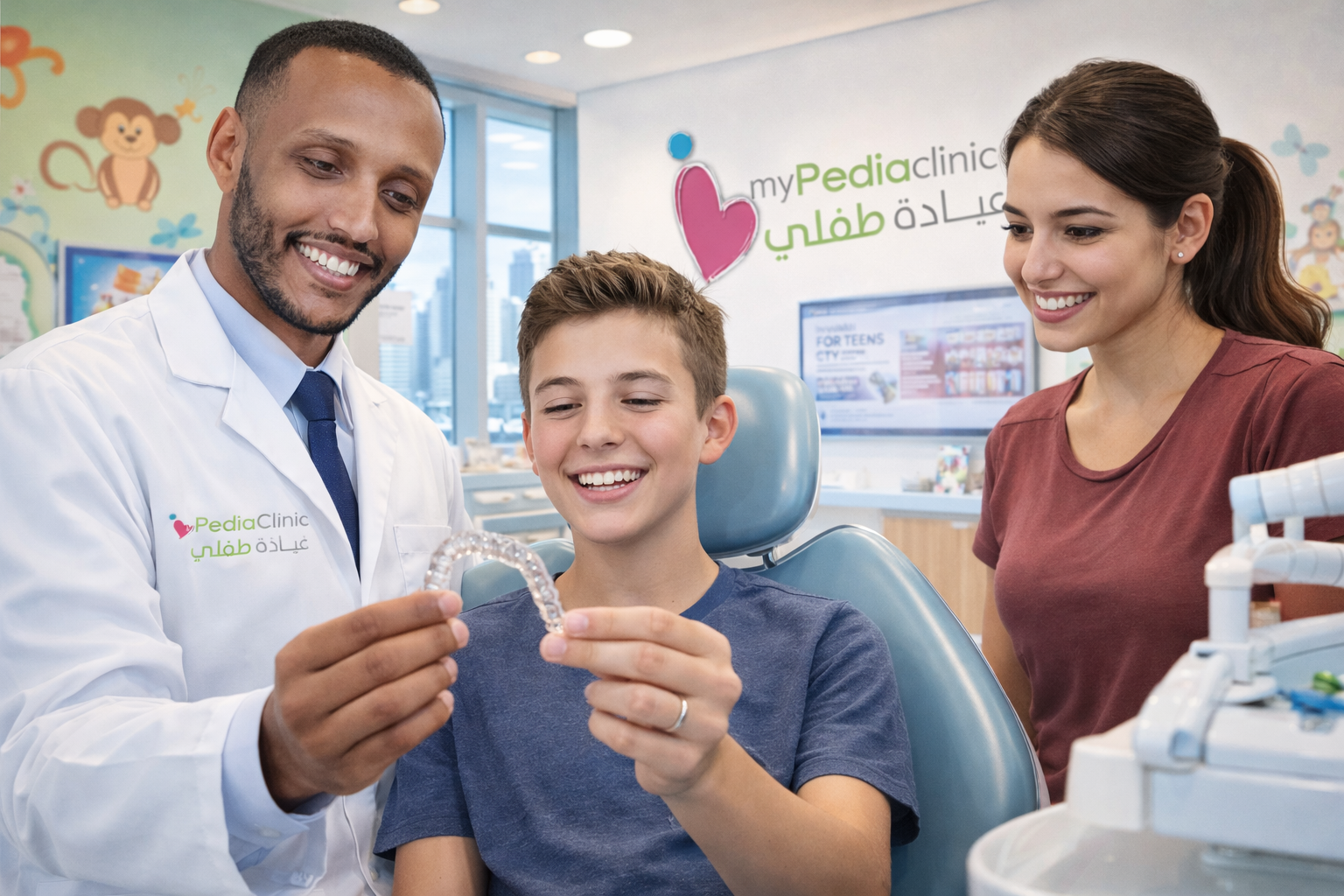
Fatima was terrified when her dentist mentioned braces. At 14, she’d seen classmates at her Dubai school with metal brackets covering their teeth—the teasing, the discomfort, the food restrictions. She couldn’t imagine enduring two years of “metal mouth” during the most socially important years of her life.
Then her parents brought her to myPediaClinic and introduced her to Dr. Mohamed Hasab. When Dr. Mohamed Hasab showed Fatima Invisalign Teen—clear, removable aligners that her friends wouldn’t even notice—everything changed. Fatima’s anxiety disappeared. She was actually excited about straightening her teeth.
Eighteen months later, Fatima’s smile transformation is complete. Throughout treatment, her classmates never noticed she was wearing aligners. She played basketball without mouth injuries. She ate whatever she wanted. And now, just in time for her graduation photos, she has the confident, straight smile she always wanted.
If you’re a parent in Dubai considering orthodontic treatment for your child or teenager, Invisalign offers a modern solution that addresses both the clinical needs and the emotional concerns of young patients. This comprehensive guide explores why Invisalign Teen and Invisalign First are ideal for Dubai’s young generation, what makes them different from traditional braces, and how to get started at myPediaClinic.
Why Invisalign is Perfect for Teenagers in Dubai
Teenage years are formative—socially, emotionally, and developmentally. Traditional metal braces can negatively impact self-esteem during these critical years. Invisalign Teen addresses these concerns while delivering excellent orthodontic results.
Social Confidence: No “Metal Mouth” Stigma
Teenagers at schools across Dubai—JESS, GEMS, Dubai College, ASD, DAIS, Jumeirah College—face intense social pressure. Appearance matters deeply at this age. Traditional braces can cause teasing, embarrassment, and social anxiety.
Invisalign’s clear aligners are virtually invisible. Your teen can straighten their teeth without drawing attention to orthodontic treatment. Friends often don’t notice aligners unless your teen mentions them. This discretion preserves social confidence during these vulnerable years.
Dr. Mohamed Hasab at myPediaClinic sees the dramatic difference Invisalign makes in teenagers’ confidence—they smile freely in photos, speak up in class presentations, and participate socially without self-consciousness about their braces.
Sports and Activities: Stay Active Without Restrictions
Dubai teens are active in sports—football at Dubai Sports City, swimming at club pools, basketball at school, martial arts, dance, tennis. Traditional braces pose risks during contact sports: brackets can cut lips and cheeks during impacts, and special mouthguards are needed (but don’t fit properly over braces).
Invisalign aligners are simply removed for sports. Your teen plays without orthodontic appliances in their mouth—no injury risk, no special equipment needed. After practice or competition, they rinse and reinsert aligners. Simple and safe.
Swimming is particularly easy with Invisalign—no metal brackets to corrode from chlorine or salt water. Many competitive swimmers at Dubai clubs choose Invisalign specifically for this reason.
No Dietary Restrictions: Eat What You Want
Traditional braces come with extensive food restrictions: no sticky candy, no popcorn, no chips, no whole apples, no corn on the cob, no nuts. For teenagers who love snacks and socializing around food, these restrictions feel punishing.
Invisalign eliminates dietary restrictions entirely. Aligners are removed before eating, so your teen can enjoy any food—shawarma after school, pizza with friends, caramel popcorn at movies, birthday cake at parties. Nothing is off-limits.
This freedom matters enormously to teenagers whose social lives revolve around food. They don’t feel different or restricted compared to their peers.
Easier Oral Hygiene: Healthier Teeth
Teenagers aren’t always diligent about oral hygiene (let’s be honest). Traditional braces make brushing and flossing even more challenging—food traps around brackets, plaque accumulates, white spots (early cavities) develop.
Invisalign aligners are removed for brushing and flossing. Your teen brushes and flosses normally—no special tools, no 20-minute sessions trying to clean around brackets. This simplicity increases compliance and reduces the risk of cavities, white spots, and gum problems during treatment.
Perfect for School and Social Events
School photos, graduation pictures, friend group photos—teenagers document their lives constantly on social media. Traditional braces dominate these photos, and many teens avoid smiling genuinely because they’re self-conscious about metal brackets.
With Invisalign, your teen smiles confidently. Aligners don’t show in photos. For ultra-important events—prom, graduation ceremony, special performances—aligners can be removed for a few hours without derailing treatment.
This flexibility respects the reality of teenage life while still delivering orthodontic results.
Invisalign Teen: Designed Specifically for Adolescent Patients
Invisalign Teen isn’t just regular Invisalign marketed to teenagers—it’s a specialized system with features addressing the unique needs of adolescent patients:
Compliance Indicators: Helping Teens Stay on Track
The biggest concern parents have about Invisalign for teens: “Will my child actually wear them?” Unlike braces (which are fixed in place), Invisalign requires patient compliance—wearing aligners 20-22 hours daily.
Invisalign Teen aligners include small blue compliance indicators—dots that fade from blue to clear with wear. These provide visual feedback showing whether your teen is wearing aligners as prescribed.
Dr. Mohamed Hasab checks these indicators at each appointment. If they haven’t faded, it signals your teen needs to increase wear time. If they’ve faded completely, compliance is excellent. This objective measure takes the guesswork out of monitoring adherence.
Parents appreciate this accountability, and surprisingly, many teens find the indicators motivating—they want to see progress and don’t want to disappoint Dr. Mohamed Hasab.
Eruption Compensation: Accommodating Growing Mouths
Teenagers often still have teeth erupting—particularly second molars. Traditional Invisalign wouldn’t fit properly if new teeth come in during treatment.
Invisalign Teen includes eruption tabs—spaces in the aligners that accommodate teeth still coming in. Treatment can begin even if not all permanent teeth have fully erupted, expanding the window of when treatment can start.
Free Replacement Aligners: Peace of Mind for Parents
Teenagers lose things. It’s a fact of life. With traditional braces, this isn’t a concern—they’re glued to teeth. But removable aligners can be misplaced, thrown away accidentally (wrapped in a napkin at lunch), or damaged.
Invisalign Teen includes 6 free replacement aligners over the course of treatment. If your teen loses or breaks an aligner, replacement is covered—no additional cost, no treatment delay, no stress.
This insurance provides peace of mind for parents and reduces anxiety for teens who worry about losing their aligners.
Powerful Enough for Complex Teen Cases
Some parents assume Invisalign is only for minor orthodontic issues. This is outdated thinking. Invisalign Teen can treat a wide range of teenage orthodontic problems:
Severe crowding requiring tooth extraction (extractions are performed, then Invisalign closes spaces and aligns remaining teeth)
Significant overbite or underbite correction using precision attachments and elastics
Impacted or blocked-out teeth (teeth that can’t erupt properly due to crowding)
Complex rotations (twisted teeth requiring significant movement)
Bite correction (crossbites, open bites, deep bites)
Dr. Mohamed Hasab evaluates your teen’s specific case and provides honest guidance on whether Invisalign Teen is appropriate or if traditional braces are better suited for their needs.
Invisalign First: Early Intervention for Children (Ages 6-10)
While most orthodontic treatment occurs during teenage years, some children benefit from early intervention—Phase 1 orthodontics addressing problems while the jaw is still growing.
Why Early Orthodontic Treatment?
Certain orthodontic issues are easier to correct during childhood when jaws are still developing:
Narrow Jaws: Creating space through palatal expansion is easier in young children. Waiting until teenage years may require more invasive procedures.
Severe Crowding: Expanding arches early can reduce or eliminate the need for tooth extractions later.
Crossbites: Correcting crossbites early prevents uneven jaw growth and tooth wear patterns.
Harmful Oral Habits: Thumb-sucking or tongue thrust habits can be addressed before they cause severe orthodontic problems.
Early Loss of Baby Teeth: Space maintainers or early intervention can prevent neighboring teeth from shifting into gaps, blocking permanent teeth from erupting.
The American Association of Orthodontists recommends children have an orthodontic evaluation by age 7. This doesn’t mean treatment starts at 7—but early assessment identifies problems that benefit from timely intervention.
How Invisalign First Works
Invisalign First is specifically designed for children aged 6-10 with mixed dentition (both baby and permanent teeth present). The system creates arch expansion to allow permanent teeth to erupt properly, reduces crowding, and corrects bite issues while the jaw is still growing.
Key features of Invisalign First:
Phase 1 Treatment: Typically 12-18 months, addressing specific developmental concerns before all permanent teeth erupt.
Arch Expansion: Creates space by gradually widening the upper and lower jaws—reducing future crowding.
Comfortable for Young Children: Clear aligners are more comfortable than bulky palatal expanders or other Phase 1 appliances.
Easy Hygiene: Parents can supervise brushing and flossing without navigating fixed appliances.
Positive Experience: Children respond well to the “cool technology” aspect—seeing their 3D treatment simulation and tracking progress.
Many children who complete Invisalign First require shorter Phase 2 treatment (or no Phase 2 at all) when they’re teenagers because early intervention solved the major problems.
Is Your Child a Candidate for Invisalign First?
Dr. Mohamed Hasab evaluates children for early intervention based on:
Presence of crossbites, severe crowding, or significant bite issues. Jaw growth patterns indicating developmental concerns. Oral habits (thumb-sucking, mouth breathing) affecting dental development. Space deficiency indicating future eruption problems.
Not every child needs Phase 1 treatment. Some cases are better addressed with a single Phase 2 treatment during teenage years. Dr. Mohamed Hasab provides honest guidance on whether early intervention benefits your child or if watchful waiting is appropriate.
The Invisalign Journey for Your Teen or Child at myPediaClinic
Understanding what to expect helps prepare your family for successful treatment:
Step 1: Consultation with Dr. Mohamed Hasab
Your journey begins with a comprehensive orthodontic consultation. For teenage patients, Dr. Mohamed Hasab speaks directly to the teen (not just parents)—respecting their autonomy and getting their input on treatment goals.
The consultation includes:
Orthodontic Examination: Dr. Mohamed Hasab examines teeth, bite, jaw relationship, and oral health. Digital X-rays and photos document current conditions.
Discussion of Concerns: What bothers your teen about their smile? Are they self-conscious about specific teeth? Dr. Mohamed Hasab listens to both parent and teen concerns.
Treatment Options: Dr. Mohamed Hasab explains whether Invisalign Teen/First is appropriate for your child’s case, or if alternative treatments are better. Honest guidance ensures you choose the right option.
Timeline and Expectations: How long will treatment take? What results can you expect? What’s required of the patient? Clear answers set realistic expectations.
Transparent Pricing: You’ll receive a clear quote—starting at AED 15,000 for straightforward cases, with complex treatments up to AED 22,000. Includes all aligners, appointments, refinements, and retainers.
Most importantly, your teen leaves the consultation feeling heard, informed, and (usually) excited rather than anxious about treatment.
Step 2: Digital 3D Scanning (No Goop!)
If you proceed with Invisalign, myPediaClinic uses the iTero digital scanner to capture a precise 3D model of your child’s teeth. This modern technology replaces messy impression trays that cause gagging—a huge relief for children and teens who dread “the goop.”
The scanner wand captures thousands of images in minutes, creating a detailed digital model. Kids find the process interesting (it’s high-tech and visual on screen), and it’s completely comfortable.
Step 3: ClinCheck Preview: Seeing the Future Smile
Using the 3D scan, Dr. Mohamed Hasab creates a ClinCheck digital treatment plan. This software simulates your child’s entire treatment—showing how teeth will move at each stage from their current smile to their final result.
At the next appointment, your family views the 3D animation together. This is often the moment teens get truly excited—seeing their future straight smile makes treatment feel real and worthwhile.
If your teen wants any adjustments to the planned tooth positions, Dr. Mohamed Hasab can refine the plan before approving it. This collaborative approach ensures your teen feels invested in their treatment.
Step 4: Aligner Fitting and Starting Treatment
Custom aligners are manufactured and arrive at myPediaClinic in 2-3 weeks. At the fitting appointment:
Dr. Mohamed Hasab places small tooth-colored attachments (if needed). These composite bumps help aligners grip teeth—they’re barely noticeable and removed at treatment’s end.
Your teen receives their first aligner sets with detailed instructions on:
Wear Schedule: 20-22 hours daily (removing only for eating, drinking non-water beverages, and brushing)
Aligner Changes: New aligner every 1-2 weeks (Dr. Mohamed Hasab provides specific schedule)
Cleaning: Brush aligners gently and rinse with cool water; avoid hot water (warps plastic)
Storage: Always keep removed aligners in their case (not wrapped in napkins!)
Dr. Mohamed Hasab demonstrates insertion and removal, answers questions, and ensures your teen feels comfortable managing their aligners independently.
Step 5: Progress Check-ins Every 6-8 Weeks
Unlike traditional braces requiring monthly tightening, Invisalign check-ins occur every 6-8 weeks. These brief appointments (15-20 minutes) allow Dr. Mohamed Hasab to:
Monitor progress and ensure teeth are tracking according to the ClinCheck plan. Check compliance indicators to verify your teen is wearing aligners as prescribed. Provide the next sets of aligners (typically 3-4 sets per visit). Address any concerns or questions. Make minor adjustments if needed.
Appointments are scheduled around school schedules—after school, early evening, or weekend slots available. Most teens can attend appointments independently or with minimal parent involvement (fosters responsibility).
Step 6: Completion and Retention
When your teen completes their final aligner and achieves their ideal smile, active treatment ends. However, retention is critical—without retainers, teeth will shift back toward original positions.
Your teen receives Vivera retainers (Invisalign’s retention system) to wear full-time for 3-6 months, then night-time only indefinitely. Retainers protect the investment you’ve made in your child’s smile and ensure results last a lifetime.
Common Concerns Parents Have About Invisalign for Teens
“Will My Teen Actually Wear the Aligners?”
This is the top concern, and it’s valid. Success requires compliance—wearing aligners 20-22 hours daily.
Here’s what helps:
Motivation: Teens who want straight teeth are self-motivated. The ClinCheck preview showing their future smile is powerful motivation.
Compliance Indicators: The blue dots provide accountability. Teens know Dr. Mohamed Hasab will check, and most don’t want to admit non-compliance.
Routine: Wearing becomes habitual quickly—within 2 weeks, it’s automatic.
Results: Once teens start seeing tooth movement (usually by aligner 3-4), they’re hooked—progress motivates continued compliance.
Peer Influence: Many Dubai schools now have multiple students with Invisalign. It’s normalized, even considered “cool” compared to traditional braces.
Dr. Mohamed Hasab finds that well-motivated teens are highly compliant. Those who truly don’t want treatment (forced by parents) struggle with any orthodontic option—Invisalign or braces.
“What If They Lose the Aligners?”
Invisalign Teen includes 6 free replacements for this reason. If your teen loses an aligner, it’s not a crisis—replacement is covered.
Most teens are careful because they’re invested in their treatment. The aligner case becomes part of their routine (like keeping track of their phone). Loss is less common than parents fear.
“Is Invisalign as Effective as Braces for Teens?”
For the vast majority of teenage orthodontic cases, yes—Invisalign Teen delivers results equivalent to traditional braces. The technology has advanced dramatically and can treat complex cases including extractions, significant rotations, and bite corrections.
There are still edge cases where traditional braces are more appropriate (severe skeletal discrepancies, certain complex movements). Dr. Mohamed Hasab provides honest guidance—if braces are better for your teen’s specific case, she’ll tell you.
“Won’t It Be More Expensive?”
At myPediaClinic, Invisalign Teen and traditional braces cost approximately the same—starting at AED 15,000 for straightforward cases. You’re not paying a premium for Invisalign; you’re choosing the treatment approach that best fits your teen’s needs and lifestyle.
Success Stories: Dubai Teens Thriving with Invisalign
Dr. Mohamed Hasab regularly sees teenagers transformed by Invisalign treatment:
Omar, 15, football player: Severe crowding required extraction of two premolars. Omar was devastated at the thought of braces limiting his football involvement. Invisalign allowed him to continue playing without worry. Treatment was completed in 18 months with excellent results—straight smile, perfect bite, no sports interruption.
Layla, 13, competitive swimmer: Significant overbite and spacing issues. Layla was concerned traditional braces would corrode from pool chlorine. Invisalign solved this—removed for swimming practice, no metal to corrode, no impact on her training schedule. Her smile transformation boosted her confidence in and out of the pool.
Ahmed, 16, preparing for university: Moderate crowding bothered Ahmed as he approached university applications (photos, interviews, social networking). Started Invisalign in his sophomore year, completed treatment by senior year. His graduation photos showcase a confident, straight smile—perfect timing for this important milestone.
These stories reflect what Dr. Mohamed Hasab sees consistently: teenagers who complete Invisalign treatment experience not just straighter teeth, but increased confidence, social comfort, and pride in their smile.
Why myPediaClinic is Dubai’s Top Choice for Invisalign Teen
Parents choose myPediaClinic for their children’s Invisalign treatment because:
Pediatric Expertise Combined with Orthodontic Specialty
myPediaClinic is Dubai’s leading pediatric healthcare provider. We understand children and teenagers—developmentally, psychologically, medically. Dr. Mohamed Hasab combines orthodontic specialty training with pediatric expertise, creating an approach that respects your child’s age, maturity level, and unique needs.
We speak to teens respectfully (not condescendingly), involve them in treatment decisions, and foster their independence throughout the process.
Certified Invisalign Provider: Authentic Treatment Only
myPediaClinic provides only genuine Invisalign aligners—never cheaper alternatives or imitations. Every aligner includes Invisalign authentication features (logo, aligner numbers, starflower pattern) and is manufactured by Align Technology to exact specifications.
Some Dubai clinics advertise “Invisalign-style” or “clear aligners” for teens at lower prices—these are generic systems that lack Invisalign’s research, material quality, and predictable results. Don’t compromise on your child’s orthodontic treatment.
Family-Friendly Environment
Our clinic is designed for children and families. Appointments are scheduled around school schedules, siblings can be seen together, and our team creates a welcoming, comfortable environment that puts young patients at ease.
Convenient Dubai Healthcare City Location
Easy access from major Dubai areas—close to schools, near Sheikh Zayed Road, ample parking. After-school and weekend appointments accommodate family schedules.
Transparent Communication with Parents and Teens
We keep both parents and teens informed throughout treatment. Regular updates via WhatsApp (preferred by Dubai families), clear explanations at each appointment, and open communication ensure everyone understands progress and expectations.
Frequently Asked Questions: Invisalign for Teens and Kids in Dubai
What age can my child start Invisalign?
Invisalign First is designed for children as young as 6-10 years old with mixed dentition (baby and permanent teeth). Invisalign Teen is appropriate for adolescents typically aged 11-19 once most permanent teeth have erupted. The ideal age depends on your child’s specific dental development—Dr. Mohamed Hasab evaluates this during consultation.
How do we ensure our teen wears aligners 20-22 hours daily?
Motivation is key. Teens who genuinely want straight teeth are self-motivated. The compliance indicators provide accountability. Establishing a routine (aligners go in after brushing in the morning and out only for meals/brushing) helps wear time become automatic. Most motivated teens are highly compliant once they see initial progress.
Can my teen play sports with Invisalign?
Yes. Aligners are simply removed for sports activities—no injury risk, no special mouthguards needed. After practice or competition, teens rinse and reinsert aligners. This is a major advantage over traditional braces which can cause mouth injuries during contact sports.
What happens if my teen loses or breaks an aligner?
Invisalign Teen includes 6 free replacement aligners specifically for this reason. Contact myPediaClinic immediately if an aligner is lost or damaged. Depending on timing, Dr. Mohamed Hasab may advise moving forward to the next aligner, reverting to the previous one, or ordering a replacement. Treatment delay is minimal.
Can my teen still eat their favorite foods?
Yes. Aligners are removed for all eating and drinking (except water). There are no dietary restrictions—candy, popcorn, chips, nuts, sticky foods—everything is allowed. This freedom is a huge advantage over traditional braces and makes teen compliance much easier.
Will people at school notice the aligners?
Most people won’t notice unless your teen mentions it. Invisalign aligners are clear and blend with tooth enamel. Small tooth-colored attachments may be visible up close but aren’t obvious in normal conversation. Many teens report classmates being surprised when they mention they’re straightening their teeth—the aligners are that discreet.
How long does Invisalign Teen treatment take?
Treatment duration depends on case complexity. Simple alignment cases may take 12-15 months. Moderate crowding, spacing, or bite correction typically requires 15-20 months. Complex cases can extend to 20-24 months. Dr. Mohamed Hasab provides an accurate timeline during consultation based on your teen’s specific needs.
Is Invisalign Teen painful?
Each new aligner feels tight for 1-3 days as it begins moving teeth—teens describe this as pressure, not sharp pain. Most don’t need pain medication, though over-the-counter options like ibuprofen help if discomfort occurs. Invisalign is generally much more comfortable than traditional braces with no sharp brackets or wires irritating the mouth.
What if my teen needs teeth extracted?
Invisalign can work with extraction cases. If crowding is severe and extraction is the best treatment approach, teeth are extracted first, then Invisalign closes the spaces and aligns remaining teeth. Dr. Mohamed Hasab coordinates extractions with an oral surgeon and times Invisalign treatment appropriately.
Can my teen whiten their teeth during Invisalign treatment?
Yes. Invisalign aligners can double as whitening trays. Professional whitening gel can be applied inside aligners, allowing teens to straighten and whiten simultaneously—a complete smile transformation. Discuss this with Dr. Mohamed Hasab if interested. Many teens appreciate addressing both alignment and tooth color for maximum confidence.
How much does Invisalign Teen cost in Dubai?
At myPediaClinic, Invisalign Teen treatment starts at AED 15,000 for straightforward cases, with complex treatments up to AED 22,000. This includes consultation, digital scanning, all aligners, progress appointments, refinement aligners if needed, and retainers. We offer flexible payment plans and work with insurance providers. Exact pricing depends on your teen’s case complexity—Dr. Mohamed Hasab provides a transparent quote during consultation.
Does insurance cover Invisalign for teenagers?
Many UAE health insurance plans include orthodontic coverage for children and teenagers—typically 25-50% of treatment costs up to a lifetime maximum (commonly AED 5,000-10,000). Coverage varies by plan. Our team assists with insurance verification and claims processing to maximize your benefits.
What if my teen isn’t compliant and doesn’t wear aligners enough?
Non-compliance affects results. If compliance indicators show your teen isn’t wearing aligners as prescribed, Dr. Mohamed Hasab addresses this directly with the teen. If compliance doesn’t improve, treatment won’t progress as planned—teeth won’t track, timeline extends, and final results may be compromised. In rare cases of persistent non-compliance, transitioning to traditional braces (not removable) may be necessary.
Can Invisalign fix my child’s severe crowding or bite problems?
Invisalign Teen can treat a wide range of orthodontic issues including severe crowding, significant bite problems, rotations, and extractions. However, some complex cases may still be better suited to traditional braces. Dr. Mohamed Hasab evaluates your child’s specific situation and provides honest guidance on whether Invisalign is appropriate or if braces will deliver better results.
Will my teen need to wear retainers after Invisalign?
Yes. All orthodontic treatment requires retention. Your teen will receive Vivera retainers to wear full-time for 3-6 months post-treatment, then transition to night-time only wear indefinitely. This protects the investment you’ve made and ensures the straight smile lasts a lifetime. Retention is not unique to Invisalign—even traditional braces require lifelong retainer wear.
What if my teen has a school photo or important event during treatment?
Aligners can be removed for a few hours for important events—school photos, graduation, performances, special occasions. As long as your teen wears them 20-22 hours daily overall, occasional removal for events won’t derail treatment. This flexibility is a major advantage of Invisalign.
Can younger children (under 11) get Invisalign?
Yes. Invisalign First is designed for children aged 6-10 with mixed dentition. This Phase 1 treatment addresses specific developmental concerns like narrow jaws, severe crowding, crossbites, or space deficiency while the jaw is still growing. Not every child needs Phase 1 treatment—Dr. Mohamed Hasab evaluates whether early intervention benefits your child or if waiting for Phase 2 treatment during teenage years is more appropriate.
How often does my teen need appointments during Invisalign treatment?
Check-in appointments occur every 6-8 weeks (not monthly like traditional braces). These brief visits (15-20 minutes) allow Dr. Mohamed Hasab to monitor progress and provide the next aligner sets. With approximately 8-10 appointments over 18 months of treatment, Invisalign requires minimal time away from school—ideal for busy teen schedules.
Can my teen switch from braces to Invisalign mid-treatment?
In some cases, yes. If your teen started traditional braces elsewhere but is unhappy with the experience, Dr. Mohamed Hasab can evaluate whether transitioning to Invisalign is possible. This depends on current progress, remaining tooth movements needed, and case complexity. A new treatment plan would be created to complete orthodontic goals with Invisalign.
What’s included in the Invisalign Teen treatment cost?
The quoted price at myPediaClinic includes everything: comprehensive consultation and diagnostic records, 3D digital scanning, ClinCheck treatment planning, all custom Invisalign Teen aligners (including 6 free replacements), all progress check-in appointments throughout treatment, refinement aligners if needed, and Vivera retainer sets upon completion. No hidden fees or surprise charges.
How do we get started with Invisalign Teen at myPediaClinic?
Schedule a consultation with Dr. Mohamed Hasab. During this appointment, we’ll evaluate your teen’s smile, discuss their concerns and goals, explain treatment options, and provide transparent pricing. Your teen will be involved in the discussion—we respect their input and ensure they feel comfortable with the treatment plan. If you decide to proceed, we’ll schedule the digital scan and begin creating the custom treatment plan. Most patients start active treatment within 3-4 weeks of initial consultation.
Give Your Teen the Gift of a Confident Smile
Teenage years are transformative—identity forms, confidence develops, and social experiences shape who your child becomes. A straight, beautiful smile impacts how they see themselves and how they navigate these critical years.
Invisalign Teen allows your child to straighten their teeth without the social discomfort, appearance concerns, and lifestyle restrictions of traditional braces. They can smile freely, participate in sports, eat what they want, and feel confident during these important years.
At myPediaClinic Dubai, Dr. Mohamed Hasab specializes in Invisalign treatment for children and teenagers. We combine orthodontic expertise with pediatric understanding, creating an experience that respects your child’s unique needs while delivering exceptional results.
Don’t let orthodontic concerns hold your teen back. Give them the confidence that comes with a straight smile—and the modern treatment approach that fits their lifestyle.
Schedule your teen’s complimentary Invisalign consultation today:
Call: +971-4-430-5926
WhatsApp: +971-4-430-5926
Visit: myPediaClinic, Dubai Healthcare City
Website: mypediaclinic.com
Dr. Mohamed Hasab will evaluate your teen’s smile, discuss their goals, explain treatment options, and provide transparent pricing—no pressure, just expert guidance to help your family make the best decision.
Your teen’s dream smile is within reach. Let’s make it happen together.