

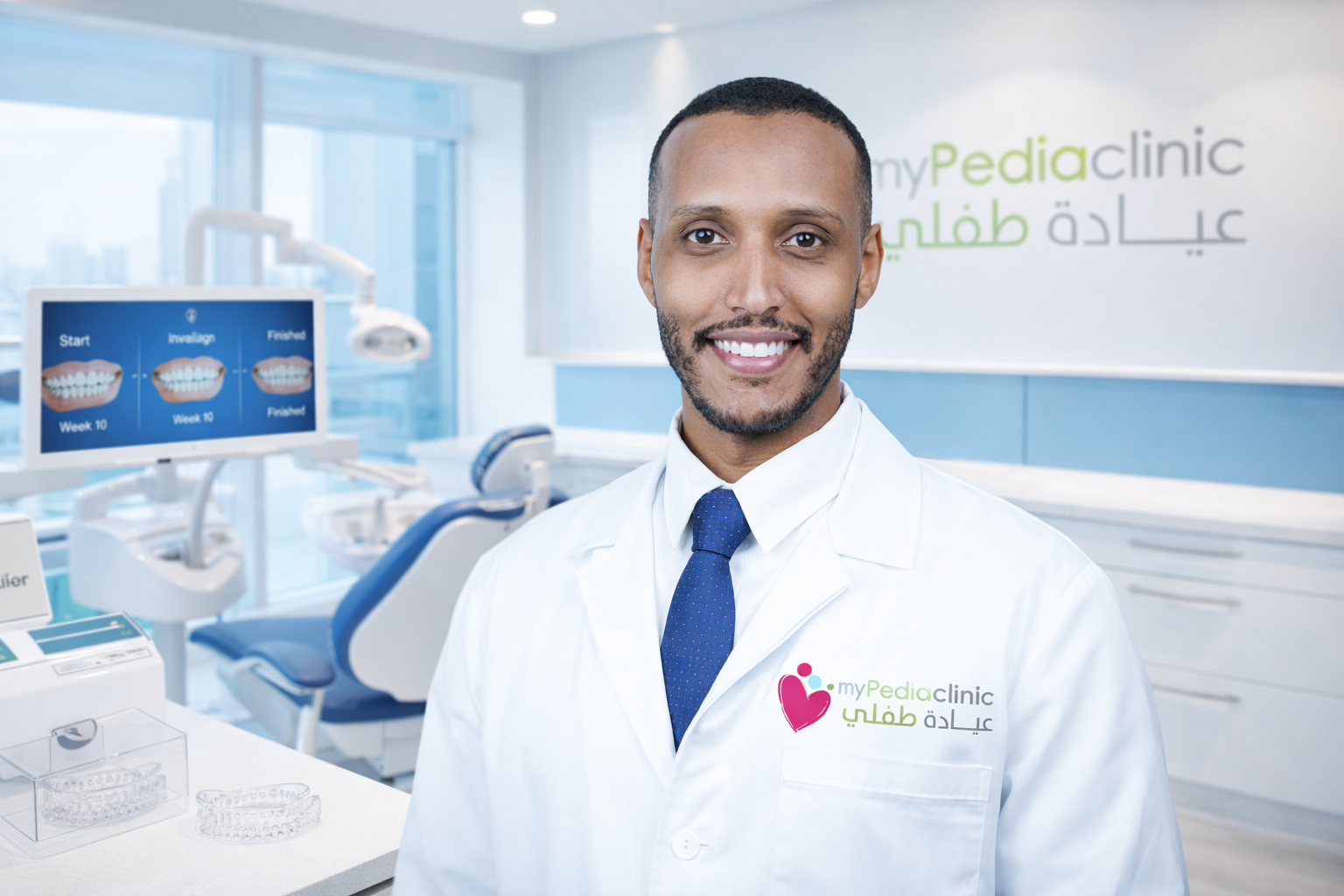
Starting Invisalign treatment is exciting—you’re taking a transformative step toward the smile you’ve always wanted. But what actually happens during those 9-18 months of treatment? What should you expect at each stage? How will your teeth feel, and what challenges might you face?
At myPediaClinic in Dubai Healthcare City, Dr. Mohamed Hasab has guided hundreds of patients through their Invisalign journey. Drawing on his experience as an Invisalign Diamond Provider with over 500 successful cases, this guide walks you through every stage of your treatment—from your first consultation to your final reveal—so you know exactly what to expect and how to get the best possible results.
Whether you’re about to start treatment, considering Invisalign, or already wearing aligners and wondering what comes next, this month-by-month timeline will help you navigate your journey with confidence. You’ll learn what sensations are normal, when you’ll start seeing changes, how to handle common challenges, and insider tips for staying on track to achieve your dream smile in Dubai.
Before Treatment Begins: Your Consultation and Planning Phase
Initial Consultation at myPediaClinic Dubai
Your Invisalign journey begins with a comprehensive orthodontic consultation. At myPediaClinic in Dubai Healthcare City, Dr. Mohamed Hasab conducts a thorough assessment that typically takes 45-60 minutes and includes several key components.
Clinical Examination: Dr. Hasab examines your teeth, gums, jaw alignment, and bite relationship. He checks for any dental issues that need addressing before Invisalign treatment begins—such as cavities, gum disease, or missing teeth. Invisalign works best when your oral health is optimal, so any necessary dental work is completed first.
3D iTero Scanning: Gone are the days of uncomfortable putty impressions. MyPediaClinic uses the iTero digital scanner, which captures a precise 3D image of your teeth in minutes. The wand-like scanner is moved around your mouth, creating a detailed digital model without gagging or discomfort. Many patients, especially children and those with sensitive gag reflexes, greatly prefer this technology.
Photographs and X-rays: Comprehensive documentation includes facial photographs from multiple angles and dental X-rays (panoramic and cephalometric if needed). These images help Dr. Hasab analyze your jaw structure, root positions, and overall facial proportions to plan optimal tooth movements.
Treatment Discussion: Dr. Hasab discusses your concerns, goals, and expectations. Are you bothered by crooked front teeth? Gaps? An overbite? Do you have an important event coming up—a wedding, graduation, job interview? Understanding your priorities helps customize your treatment plan.
Suitability Assessment: While Invisalign treats a wide range of cases, some complex situations may require traditional braces or a hybrid approach. Dr. Hasab will honestly assess whether Invisalign is the best option for your specific case. At myPediaClinic, we prioritize treatment success over simply selling Invisalign to everyone who asks.
ClinCheck Digital Treatment Planning
After your consultation, your case data—3D scans, photos, X-rays, and Dr. Hasab’s clinical notes—are sent to Align Technology (Invisalign’s manufacturer). Within 1-2 weeks, you’ll return to myPediaClinic for a remarkable experience: seeing your future smile before treatment even starts.
The ClinCheck Software: This proprietary 3D treatment planning tool creates a virtual simulation of your entire treatment journey. You’ll watch a digital animation showing how your teeth will move at each stage—week by week, month by month—until they reach their final, ideal positions.
Refinements and Adjustments: Dr. Hasab reviews the initial ClinCheck proposal carefully. If he sees opportunities for improvement—perhaps a tooth needs more rotation, or the final positions could be optimized—he requests modifications from Align Technology. This back-and-forth ensures your treatment plan is perfect before manufacturing begins.
Setting Expectations: During your ClinCheck review appointment, Dr. Hasab shows you:
- Your current tooth positions (the “before”)
- How teeth will move at key milestones (months 3, 6, 9, etc.)
- Your predicted final result (the “after”)
- Total number of aligners needed
- Estimated treatment duration (typically 9-18 months for most cases)
- Whether attachments or elastics will be needed
Treatment Agreement: Once you approve the ClinCheck plan and understand the timeline, costs, and commitment required, treatment officially begins. MyPediaClinic offers flexible payment plans to make authentic Invisalign accessible to Dubai families—typically starting at AED 15,000 with options for 0% interest installments over 12-24 months.
Manufacturing Your Custom Aligners
After final approval, your case is sent to Align Technology’s manufacturing facility. Your entire series of custom aligners—anywhere from 12 to 50+ sets depending on complexity—are manufactured using advanced 3D printing technology and SmartTrack material.
Manufacturing typically takes 2-3 weeks. Each aligner is precisely engineered to move your teeth by 0.25mm in specific directions. The aligners arrive at myPediaClinic in Dubai in a sealed package, individually numbered and ready for your treatment journey to begin.
Month 1: Starting Treatment and Initial Adjustments
Your First Aligner Fitting Appointment
This appointment, typically lasting 60-90 minutes, is when your Invisalign treatment officially begins. Dr. Hasab and his team at myPediaClinic ensure you’re fully prepared for success.
Attachment Placement: Most Invisalign cases require small, tooth-colored “attachments” (also called “buttons”) bonded to specific teeth. These tiny composite resin bumps—usually 2-3mm in size—help the aligners grip and apply force in precise directions. Dr. Hasab uses a special template to position attachments exactly as planned in your ClinCheck. The process is painless and takes about 20-30 minutes. Attachments are strategically placed on teeth that need rotation, extrusion, or intrusion movements that aligners alone cannot achieve.
Interproximal Reduction (IPR): Some cases require IPR, also called “slenderizing” or “stripping.” Dr. Hasab uses a specialized tool to remove tiny amounts of enamel (0.2-0.5mm) between certain teeth to create space for movement. This sounds alarming but is completely safe—teeth have several millimeters of enamel, and removing such small amounts doesn’t increase cavity risk or cause sensitivity. IPR is typically needed when teeth are crowded and there isn’t enough space in the jaw for proper alignment.
First Aligner Insertion: Dr. Hasab places your first aligner (aligner #1) and shows you how it should fit snugly over your teeth and attachments. You’ll learn the proper technique for removing and inserting aligners—starting from the back teeth and working forward when removing, and pressing firmly on all teeth when inserting to ensure proper seating.
Using Chewies: You’ll receive Chewies—small cylindrical cushions made of soft plastic. Biting down on Chewies for 5-10 minutes after inserting aligners helps them seat properly and ensures the attachments engage correctly. This is especially important with new aligners.
Care Instructions: The myPediaClinic team provides detailed guidance on aligner care, oral hygiene, eating and drinking protocols, and what to do if problems arise. You’ll receive a starter kit including an aligner case, Chewies, and cleaning instructions.
First Set of Aligners: You’ll typically leave with your first 3-5 sets of aligners. Dr. Hasab instructs you to change to the next aligner every 7-14 days (most commonly every 10 days for Dubai patients). You’ll return for a check-up in 6-8 weeks.
The First Week: What to Expect
Pressure and Tightness: When you first insert aligner #1, you’ll feel pressure on your teeth—this is the aligners doing their job. The sensation is strongest in the first 24-48 hours and gradually decreases. Most patients describe it as a “tight” feeling rather than pain, though some teeth may be tender when chewing. Over-the-counter pain relievers like paracetamol or ibuprofen can help if needed, but most Dubai patients find the discomfort manageable without medication.
Speech Changes: Your speech may sound slightly different for the first 2-3 days as your tongue adjusts to the aligners. Some patients notice a slight lisp, especially with “s” sounds. This is temporary—your tongue quickly adapts, and within a few days, you’ll speak normally. Practicing by reading aloud or having conversations helps speed the adjustment.
Increased Saliva Production: Your mouth may produce more saliva initially as it perceives the aligners as a foreign object. This is normal and typically resolves within a few days as your mouth becomes accustomed to the aligners.
Aligner Visibility: You might be surprised by how discreet Invisalign really is. While you’re acutely aware of wearing aligners, most people won’t notice them unless they’re looking closely at your teeth. The attachments are tooth-colored and blend in remarkably well, especially on Dubai’s diverse population with varying tooth shades.
Removal Challenges: Removing aligners can be tricky at first, especially with attachments creating extra grip. Use your fingernails to gently pry from the back inside of the lower aligner first, then work your way forward. Never use sharp objects or excessive force. With practice, removal becomes quick and easy—most patients master the technique within a week.
Adapting Your Routine
Meal Times: You must remove aligners before eating or drinking anything except water. This means meal planning becomes more structured. Many Dubai professionals find they naturally reduce snacking (a bonus weight-loss effect!) because removing aligners, eating, brushing, and reinserting takes time. Plan for 20-22 hours of daily aligner wear, leaving 2-4 hours for meals and oral hygiene.
Oral Hygiene Intensifies: Brush and floss after every meal before reinserting aligners. This is critical—trapped food particles and bacteria between teeth and aligners create a breeding ground for cavities and gum disease. Carry a travel toothbrush and paste in your bag for meals away from home. Many Dubai patients keep oral hygiene kits in their office desk, car, and purse.
Aligner Cleaning: Clean aligners twice daily with a soft toothbrush and clear, antibacterial soap or Invisalign cleaning crystals. Avoid toothpaste (its abrasiveness can scratch and cloud aligners) and hot water (heat can warp the plastic). Some patients use effervescent denture cleaners occasionally for deep cleaning.
Social Adjustments: Dining out requires discretion when removing aligners. Most Dubai patients excuse themselves to the restroom to remove aligners privately before meals. If you’re at a business lunch or social gathering, a quick, discreet removal at the table is acceptable—just use a napkin to shield the action. Store removed aligners in their case, never in a napkin (a common way aligners get accidentally thrown away!).
Week 2: Changing to Aligner #2
After 10-14 days (following Dr. Hasab’s specific guidance), you’ll switch to aligner #2. This is when you fully understand the treatment rhythm.
The Change-Over Process: Change aligners in the evening before bed. The first few hours with a new aligner involve the most pressure, so sleeping through this period is ideal. By morning, the tightness has significantly decreased.
Tracking Progress: With aligner #2, you might start noticing subtle changes—perhaps a slight shift in a crooked front tooth or a small gap closing. These early visual confirmations are exciting and motivating.
Compliance Tracking: For teens, Invisalign Teen aligners have small blue Compliance Indicators that fade from blue to clear based on wear time. This helps parents and orthodontists monitor whether the patient is wearing aligners consistently. Adult aligners don’t have these indicators, but Dr. Hasab can tell from tooth movement whether wear time is adequate.
Months 2-3: Settling Into Your Routine
Aligner Wear Becomes Second Nature
By month 2, wearing aligners feels completely normal. Most Dubai patients report they barely think about their aligners throughout the day—insertion, removal, and care become automatic habits. Friends and colleagues who haven’t been told about your treatment often remain unaware you’re wearing anything.
Speech Normalization: Any initial speech changes are completely resolved. You’ll speak clearly in meetings, phone calls, and social situations without any aligner-related issues.
Eating Routine Established: You’ve developed an efficient system for meal times. Quick meals at Dubai’s many dining options become manageable—remove aligners, eat, rinse mouth or brush quickly, reinsert aligners. Total time: 20-30 minutes.
Social Confidence: The initial self-consciousness fades. You’re comfortable removing aligners when needed and managing them discreetly in public settings. Many patients report feeling empowered by taking control of their orthodontic treatment.
First Progress Check at myPediaClinic
Around week 6-8, you’ll return to myPediaClinic Dubai for your first progress appointment. These check-ups typically last 15-20 minutes and involve several key assessments.
Tracking Evaluation: Dr. Hasab examines how well your teeth are “tracking”—meaning whether they’re moving according to the ClinCheck prediction. He checks each tooth’s position against the expected position at this stage. Proper tracking is essential for treatment success.
Attachment Check: Attachments occasionally fall off due to eating hard foods or improper aligner removal. Dr. Hasab replaces any missing attachments during these appointments.
IPR if Needed: Additional interproximal reduction might be performed if more space is needed for upcoming movements. This is planned in advance but executed at specific stages when teeth are in the right positions.
Aligner Fit Assessment: Dr. Hasab ensures current aligners fit properly—they should be snug with no gaps between aligner edges and gums. Gaps indicate poor tracking or insufficient wear time.
Next Aligner Distribution: You’ll receive your next batch of aligners (typically 5-10 sets) to take home. Dr. Hasab may adjust the wear schedule based on how your teeth are responding—some patients can change aligners every 7 days instead of 10 if tracking is excellent.
Q&A and Troubleshooting: This is your opportunity to ask questions, report any issues, and get guidance on challenges. Common topics include managing discomfort, improving aligner fit, or adapting routines while traveling.
Visible Changes Begin to Appear
Months 2-3 are when most patients start seeing obvious changes. That crowded front tooth is straightening. The gap you’ve had since childhood is closing. Your bite feels different when chewing.
Motivation Boost: These visible changes provide powerful motivation to stay compliant with your 22-hour daily wear requirement. You can see the investment paying off, which makes brushing after every meal and avoiding extended aligner removal easier to accept.
Before-and-After Comparisons: Take monthly progress photos (or use the myPediaClinic app if available) to compare your smile now versus when you started. The changes that accumulate gradually become dramatic when compared side-by-side.
Feedback from Others: People who see you regularly might comment that your smile looks different or ask if you’ve done something to your teeth. This external validation is encouraging—your transformation is becoming noticeable to others.
Months 4-6: The Middle Phase and Significant Progress
Major Tooth Movements Underway
The middle months of treatment involve the most dramatic tooth movements. This is when rotations, large gap closures, and bite corrections happen.
Increased Pressure: You might notice that aligners during this phase feel tighter than earlier ones. This is normal—middle-stage aligners often move teeth more aggressively than initial or final aligners. The first 2-3 days with each new aligner may involve more pressure, but it remains manageable.
Attachment Adjustments: Dr. Hasab may add new attachments or remove certain ones that have served their purpose. Attachment placement is strategic and changes based on which teeth need to move at each stage.
Elastics Introduction: Some cases require elastics (small rubber bands) during certain phases to correct bite issues like overbites, underbites, or midline shifts. If your treatment plan includes elastics, Dr. Hasab will show you how to attach them to small hooks on specific aligners. Elastics are typically worn 22 hours daily, like aligners, and changed daily.
Maintaining Compliance During Busy Dubai Life
Dubai’s fast-paced lifestyle—business meetings, social events, family gatherings, travel—can challenge aligner compliance. Months 4-6 test your commitment.
Travel Strategies: Business trips and vacations require planning. Pack extra aligners, your aligner case, travel toothbrush, and a backup case. If traveling during an aligner change, bring both the current aligner and the next one. If you lose an aligner while abroad, wear the previous one until you can contact myPediaClinic for guidance—don’t skip ahead to the next aligner without approval.
Ramadan Considerations: For Muslim patients observing Ramadan in Dubai, Invisalign treatment continues smoothly. Aligners can be worn during fasting hours (they don’t break the fast as they’re not food or drink). Remove aligners for Iftar and Suhoor meals, maintain oral hygiene, and reinsert for the remainder of fasting hours. Dr. Hasab often schedules appointments around Ramadan to accommodate patients’ routines.
Special Events: Dubai’s social calendar includes weddings, gala dinners, and celebrations. It’s okay to remove aligners for a few hours for important events, but aim to reach 20-22 hours daily wear overall. One evening without aligners won’t derail treatment, but frequent extended removals will.
Dubai’s Dining Culture: Dubai’s diverse culinary scene is a highlight of living here. You can fully enjoy dining experiences—just remove aligners before eating. Fine dining restaurants, food festivals, brunches—all remain accessible. The key is reinserting aligners promptly after meals and maintaining oral hygiene.
Mid-Treatment Progress Check
Around month 5-6, you’ll have a comprehensive mid-treatment evaluation at myPediaClinic. Dr. Hasab performs a detailed assessment to ensure treatment is progressing optimally.
New iTero Scan: A fresh 3D scan is taken and compared to your starting scan and the ClinCheck prediction. This shows how closely actual tooth positions match the planned positions.
ClinCheck Review: If tracking is perfect, treatment continues as planned. If some teeth haven’t moved as expected, Dr. Hasab may order “mid-course corrections”—a revised ClinCheck with additional aligners to get teeth back on track. This is common and normal—about 70% of cases need some refinement.
Refinement Aligners: If mid-course corrections are needed, a new set of aligners (typically 10-20 additional) is manufactured based on your current tooth positions. These refinement aligners continue moving teeth toward the final goal. There’s no additional cost for refinements at myPediaClinic—they’re included in your original treatment package.
Months 7-9: Approaching the Final Stages
Fine-Tuning and Detail Work
The final months of your initial aligner series focus on perfecting tooth positions. Movements are smaller and more precise—rotating a canine that last few degrees, closing tiny spaces, or perfecting the midline alignment.
Less Pressure: Aligners during this phase typically feel gentler than mid-treatment aligners. The big movements are complete; now it’s about refinement and detailing.
Bite Refinement: Dr. Hasab pays special attention to how your teeth come together when biting (your occlusion). Even if teeth look straight, the bite must function properly for long-term stability and jaw health. This might involve elastics, bite ramps built into aligners, or specific tooth movements to optimize contact points.
Anticipation Builds: As you approach the end of your initial aligner series, excitement builds. You can see your smile transforming into the predicted ClinCheck result. The finish line is in sight.
Last Few Aligners of Initial Series
When you’re on your final few aligners (say, aligners #43-45 of a 45-aligner series), Dr. Hasab schedules an assessment appointment to evaluate whether you’re ready for the finishing stage or need refinements.
The 80/20 Rule: Many patients reach about 80-90% of the final result with their initial aligner series. The last 10-20% often requires refinement aligners to perfect details. This is completely normal and expected in comprehensive orthodontic treatment.
Refinement Decision: Dr. Hasab examines your teeth carefully and asks about your satisfaction with the results. If there are aspects you want improved—perhaps one tooth is slightly rotated, or a small space remains—he orders refinements. If you’re happy and the bite is functional, you move to the retention phase.
Months 9-12+: Refinements and Perfection
Understanding Refinements
Refinement aligners are additional aligners created to perfect your smile after the initial series is complete. At myPediaClinic, refinements are unlimited and included in your treatment cost—Dr. Hasab continues refining until both you and he are satisfied with the result.
Why Refinements Are Needed: Teeth don’t always move exactly as predicted. Biology varies—some patients’ teeth move faster, others slower. Attachments might not grip perfectly, or wear time might occasionally fall below ideal. Refinements account for these variables and ensure optimal results.
The Refinement Process: A new iTero scan is taken of your current tooth positions. Dr. Hasab creates a new ClinCheck showing the remaining movements needed. This new treatment plan might involve 5-30 additional aligners depending on how much adjustment is needed. The aligners are manufactured and delivered to myPediaClinic within 2-3 weeks.
Multiple Refinement Rounds: Some complex cases require 2-3 rounds of refinements. Each round fine-tunes the result further. While this extends total treatment time beyond the original estimate, the goal is achieving your best possible smile—Dr. Hasab’s commitment is to results, not rushing to finish.
Staying Motivated During Refinements
Refinements can test patience, especially if you’ve been in treatment for 12-15 months and thought you were done. Here’s how to stay motivated:
Remember the Goal: You’ve invested time and money into achieving your ideal smile. A few extra months of refinements perfects the result for a lifetime benefit.
Compare to Traditional Braces: Braces patients also undergo finishing phases that can extend treatment. Invisalign’s refinement process is actually more precise because each adjustment is based on current tooth positions, not a best-guess wire adjustment.
Visible Progress: Even during refinements, you’ll see teeth moving toward their final positions. The changes might be subtle—a slight rotation, a tiny space closing—but they add up to a noticeably better final result.
Stay Compliant: Maintain your 22-hour daily wear. Refinements work faster when compliance is high. Skipping aligner wear now only prolongs the refinement phase.
Final Approval and Treatment Completion
After refinements, Dr. Hasab performs a final evaluation. He checks tooth positions, bite function, and aesthetic appearance from all angles. You’ll review your smile together—looking at your teeth from the front, sides, and how your upper and lower teeth fit together.
Your Input Matters: This is when you provide final feedback. If there’s anything that bothers you—even small details like one tooth being slightly higher than you’d like—communicate this to Dr. Hasab. It’s better to perfect everything now than regret not speaking up later.
The “Are We Done?” Conversation: Dr. Hasab will ask if you’re happy with the result. If you are, and he’s satisfied from a clinical perspective, treatment is officially complete. If either of you sees room for improvement, another refinement round is ordered.
Attachment Removal: Once treatment is approved as complete, all attachments are removed using a gentle polishing procedure. This takes about 15-20 minutes and is completely painless. Your teeth are then polished to remove any residual bonding material, leaving them smooth and clean.
Final Photos and Documentation: myPediaClinic takes final photographs and 3D scans for your records. These “after” images are compared to your “before” images, showing the remarkable transformation you’ve achieved.
Retention Phase: Protecting Your Investment
Why Retention is Critical
Orthodontic treatment doesn’t end when active tooth movement stops. Retention is essential to maintain your results for life. Teeth have a natural tendency to shift back toward their original positions (called “relapse”) if not held in place.
Immediate Retention: Your last aligner acts as a temporary retainer while your permanent retainers are being made. Wear this final aligner full-time (22 hours daily) until you receive your retainers.
Types of Retainers: Dr. Hasab typically recommends Vivera retainers (made by Invisalign’s manufacturer) for Dubai patients. Vivera retainers are clear, removable retainers similar to aligners but made from thicker, more durable material designed to maintain positions rather than move teeth. You’ll receive 3-4 sets of Vivera retainers that should last several years.
Fixed Retainers: For some cases, especially those involving significant rotation corrections or adult patients with previous orthodontic relapse, Dr. Hasab may recommend bonded (fixed) retainers—thin wires bonded behind the front teeth. These provide 24/7 retention with no compliance required. Fixed retainers can be combined with removable retainers for maximum stability.
Retainer Wearing Schedule
First 3-6 Months (Full-Time Wear): Wear retainers 22 hours daily, just like you did with aligners. Teeth need time to stabilize in their new positions. The bone and gums surrounding teeth remodel during this period—full-time retention ensures teeth don’t shift during this critical stabilization phase.
6-12 Months (Nighttime Wear Transition): After Dr. Hasab’s approval (typically after a 6-month check), you transition to nighttime-only wear. Wear retainers every night while sleeping (8-10 hours). This maintains your results while allowing daytime freedom from wearing anything.
Long-Term Maintenance (Indefinite Nighttime Wear): For the best long-term stability, wear retainers every night indefinitely. This might sound daunting, but wearing retainers while sleeping becomes a effortless habit—most patients report they feel strange sleeping without their retainers after a few months.
Alternative Long-Term Schedules: Some patients transition to wearing retainers 3-4 nights per week after the first year. This works for many cases, but teeth do shift gradually over time without consistent retention. Dr. Hasab provides personalized guidance based on your specific case—patients who had severely rotated teeth or large gaps typically need more consistent retention than those with minor crowding.
Retainer Care and Maintenance
Daily Cleaning: Clean retainers every morning using a soft toothbrush and antibacterial soap or Invisalign cleaning crystals. Rinse thoroughly before storing in the provided case.
Weekly Deep Cleaning: Soak retainers weekly in a cleaning solution (effervescent denture cleaners work well) to remove accumulated plaque and prevent discoloration.
Storage: When not wearing retainers, store them in their case. Leaving retainers on bathroom counters or nightstands is a common way they get broken, lost, or become a chew toy for pets.
Avoiding Damage: Never expose retainers to heat—no hot water, dishwashers, or leaving them in hot cars in Dubai’s intense summer temperatures. Heat warps the plastic, making retainers unusable.
Replacement Protocol: Vivera retainers typically last 1-2 years with proper care. When one set wears out, starts cracking, or becomes too loose, switch to your next set. Order replacement sets from myPediaClinic before running out of retainers—don’t risk going weeks without retention, as teeth can shift quickly.
Retention Check-Ups at myPediaClinic
Schedule retention check-ups with Dr. Hasab every 6-12 months. These appointments are quick (15 minutes) but important for monitoring long-term stability.
Stability Assessment: Dr. Hasab checks for any tooth movement and ensures retainers still fit properly. If minor relapse has occurred, wearing retainers more frequently often corrects it. Significant relapse might require a short course of Invisalign refinement aligners.
Retainer Fit Check: Retainers that become too loose lose effectiveness. Dr. Hasab evaluates fit and advises if replacement is needed.
Oral Health Screening: These appointments also serve as oral health check-ups. Dr. Hasab examines for cavities, gum disease, or other issues—catching problems early prevents complications.
Frequently Asked Questions About the Invisalign Journey
How much does my smile actually change month by month?
The pace of change varies by individual and case complexity. Most patients notice subtle changes by week 4-6, obvious changes by month 3, and dramatic transformation by month 6. Major movements (closing large gaps, correcting rotations) happen in months 3-8. The final months involve refinement and perfection of details. Taking monthly progress photos helps you appreciate the cumulative changes—what seems slow day-to-day becomes remarkable when compared to your starting point.
Can I speed up treatment by changing aligners more frequently?
Only change aligners according to Dr. Hasab’s instructions. Most patients change aligners every 10-14 days, but some with excellent tracking can reduce this to 7-day changes. Never change aligners early without approval—doing so risks poor tracking because teeth haven’t moved enough for the next aligner to fit properly. If you want to explore faster changes, discuss this at your check-up. Dr. Hasab can evaluate whether your teeth are moving fast enough to support accelerated changes.
What happens if I miss wearing my aligners for a day or two?
Occasional missed wear (like forgetting aligners during a busy day) won’t catastrophically derail treatment, but it does slow progress. Teeth begin shifting back toward original positions within hours of aligner removal. If you miss significant wear time, your current aligner may feel tight when you reinsert it—this is teeth shifting back. If you miss more than 48 hours of wear, contact myPediaClinic for guidance. You might need to extend wear time with the current aligner before progressing to the next one.
How do I handle aligner discomfort during important events?
Plan ahead for important events like presentations, weddings, or long flights. Take over-the-counter pain reliever 1-2 hours before inserting a new aligner if you know the first day involves discomfort. Consider changing to new aligners on days when you’ll be home and can rest if needed. For events during mid-aligner wear (days 5-10), discomfort should be minimal. If you have a major event during the first 2-3 days of a new aligner, you can stay on the previous aligner a few extra days, then change after the event—but consult Dr. Hasab first.
Will I need to wear elastics, and how do they work?
Approximately 30-40% of Invisalign cases require elastics at some point during treatment. Elastics correct bite issues that aligners alone can’t address—primarily overbites, underbites, and midline corrections. If your ClinCheck plan includes elastics, Dr. Hasab will demonstrate proper placement at the appropriate appointment. You’ll attach elastics to small hooks on specific aligners, typically connecting an upper tooth to a lower tooth. Elastics are worn 22 hours daily and changed daily (they lose elasticity with time). Compliance with elastics is crucial—inconsistent wear significantly extends treatment time.
Can I switch to a different orthodontist mid-treatment if I move away from Dubai?
Yes, Invisalign treatment is transferable, but there are considerations. Your ClinCheck treatment plan and remaining aligners belong to you. If you relocate, contact a new Invisalign provider in your new city with your case details. The new orthodontist can access your treatment plan through Align Technology and continue care. However, many providers charge a transfer fee and may not include refinements. At myPediaClinic, Dr. Hasab has continued care for several patients who moved temporarily—sending aligners internationally and conducting virtual check-ups. Discuss your situation with the myPediaClinic team if relocation is a possibility.
What should I do if an aligner cracks or breaks?
Contact myPediaClinic immediately. Don’t continue wearing a broken aligner—sharp edges can cut your gums or tongue. The solution depends on when the break occurs: If you’re within 2-3 days of changing to the next aligner anyway, Dr. Hasab may advise moving to the next aligner early. If you just started the aligner, you may need to revert to the previous aligner while a replacement is ordered. Keep all your old aligners for this reason—don’t throw them away until treatment is completely finished. Aligner replacements can be ordered from Align Technology but take 2-3 weeks to arrive.
How do I maintain oral hygiene with attachments and aligners?
Attachments create small areas where plaque accumulates more easily, so meticulous oral hygiene is essential. Brush at least twice daily (ideally after every meal) using a soft-bristled toothbrush. Angle bristles toward the gumline and around attachments. Floss daily—use floss threaders or a water flosser to clean between teeth and around attachments. Clean aligners twice daily with antibacterial soap and a soft brush. Never brush aligners with toothpaste (it’s abrasive and scratches them). Rinse your mouth or brush after sugary drinks or snacks before reinserting aligners. Regular dental cleanings every 6 months (or more frequently if recommended) help prevent cavities and gum disease during treatment.
Is it normal for some teeth to hurt more than others during treatment?
Yes, completely normal. Each aligner moves different teeth by different amounts. An aligner might focus primarily on rotating your upper canines while barely moving other teeth—those canines will feel pressure while other teeth feel fine. The next aligner might shift focus to lower incisors. This targeted movement is what makes Invisalign precise and efficient. If pain is severe or persists beyond 3-4 days, contact myPediaClinic. Extreme pain can indicate the aligner isn’t tracking properly or is moving teeth too aggressively.
Can I drink coffee, tea, or other beverages with aligners in?
Water is the only beverage safe to drink with aligners in. Coffee, tea, red wine, and colored drinks can stain aligners, turning them yellow or brown. Even clear beverages like sparkling water can be problematic—acidic drinks trapped between aligners and teeth increase cavity risk. Hot drinks can warp aligners. If you’re a coffee lover, remove aligners, drink your coffee, rinse your mouth thoroughly (or brush if possible), then reinsert aligners. Many Dubai patients find this routine manageable—coffee breaks become mini-aligner breaks. Some patients drink cold beverages through a straw with aligners in occasionally, but this isn’t ideal for oral health.
What happens if I lose an aligner while traveling?
Lost aligners are a common issue, especially during travel. Here’s what to do: If you lose your current aligner and you’re within a few days of changing to the next one, move to the next aligner early. If you just started the aligner, go back to the previous aligner (reason to keep old aligners!). Contact myPediaClinic immediately so Dr. Hasab can advise the best approach. If you’re far from Dubai, the clinic can coordinate remote guidance via WhatsApp or video call. Replacement aligners can be ordered but take weeks to arrive—maintaining wear time with a backup aligner prevents significant setbacks. Pro tip: when traveling, pack both your current aligner and the previous one as backup.
Will my final result look exactly like the ClinCheck prediction?
ClinCheck predictions are remarkably accurate, but biology has variables. Most patients achieve results that closely match their ClinCheck, typically 90-95% similarity. Factors affecting accuracy include patient compliance (less than 22 hours daily wear reduces accuracy), tooth anatomy (some tooth shapes make movements harder), and bone density (teeth in denser bone move slower). This is why refinements exist—to close the gap between the predicted result and actual outcome. Dr. Hasab’s goal is to give you a result you’re thrilled with, even if it takes a few extra months of refinement to match or exceed the ClinCheck simulation.
Can I whiten my teeth during Invisalign treatment?
Yes, but timing matters. Your aligners can double as whitening trays. Dr. Hasab can provide professional whitening gel that you apply inside aligners and wear for specified times. However, most orthodontists recommend waiting until after active treatment to whiten comprehensively. Reasons: attachments block whitening gel contact, creating uneven coloring; teeth may be temporarily more sensitive during treatment; and your final tooth positions aren’t yet set. The ideal time to whiten is during the retention phase after attachments are removed. You’ll have Vivera retainers that work perfectly as whitening trays, and you can whiten evenly across all tooth surfaces.
How long until people stop noticing I’m wearing aligners?
Most people don’t notice you’re wearing aligners at all unless you tell them or they look very closely at your teeth. Attachments are tooth-colored and blend in remarkably well. By week 2-3, you’ll stop being self-conscious about aligners because you realize others truly can’t see them. Close family and friends who know you’re in treatment might spot aligners occasionally, but colleagues, acquaintances, and strangers typically don’t notice. Invisalign’s discretion is one of its biggest advantages for Dubai professionals who interact with clients, appear in photos/videos, or simply prefer privacy about their orthodontic treatment.
What’s the most common mistake patients make during treatment?
Inconsistent wear time is the most common mistake. Life gets busy—long business lunches, social events, travel—and aligners stay out longer than intended. Remember: teeth begin shifting back toward original positions within hours of aligner removal. Each hour below 22 daily hours reduces treatment effectiveness. Set phone reminders to reinsert aligners after meals. Keep a spare aligner case in your bag, car, and office so you always have a place to store removed aligners safely. Track your wear time with an app if needed. Consistent compliance is the single biggest factor in achieving fast, successful results.
Can I do Invisalign if I have gum disease or cavities?
Not until these issues are resolved. Invisalign treatment should only begin when your oral health is optimal. Gum disease (periodontitis) weakens the bone supporting teeth—moving teeth in this condition can cause bone loss and tooth mobility. Cavities must be treated before Invisalign because aligners can trap bacteria against teeth, worsening decay. At myPediaClinic, Dr. Hasab conducts a comprehensive exam before treatment and coordinates with general dentists to address any oral health issues. Once your teeth and gums are healthy, Invisalign treatment can begin safely. The good news: Invisalign can actually improve gum health for some patients because straighter teeth are easier to clean, reducing plaque accumulation.
Conclusion: Your Journey to Your Dream Smile in Dubai
The Invisalign journey is a partnership between you, Dr. Mohamed Hasab, and the advanced technology of the Invisalign system. Success requires commitment—to wearing aligners 22 hours daily, maintaining excellent oral hygiene, attending check-ups, and trusting the process even when progress seems slow.
What you’re investing in extends far beyond straightening teeth. You’re investing in confidence—the ability to smile freely in photos, business meetings, and social situations without self-consciousness. You’re investing in oral health—straighter teeth are easier to clean and less prone to cavities and gum disease. You’re investing in function—a properly aligned bite reduces jaw pain, prevents uneven tooth wear, and improves chewing efficiency.
Every Invisalign patient at myPediaClinic in Dubai Healthcare City has a unique journey. Your timeline, challenges, and results will differ from others, but the destination is the same: a smile you’re proud to show the world. Dr. Mohamed Hasab and the myPediaClinic team are with you every step of this journey—from your first consultation through years of retention check-ups.
The investment of 9-18 months (plus refinements if needed) yields a lifetime benefit. Years from now, when you look at photos from this period, you’ll remember this as the time you transformed your smile and boosted your confidence. The daily routines—removing aligners for meals, brushing after eating, changing to new aligners every 10 days—become distant memories, but your beautiful, healthy smile remains.
If you’re considering Invisalign in Dubai or already on your journey, myPediaClinic in Dubai Healthcare City is here to guide you. Schedule your consultation with Dr. Mohamed Hasab to preview your future smile with ClinCheck technology and receive a personalized treatment plan. Your journey to your dream smile starts with a single step—and that step begins at myPediaClinic.
Contact myPediaClinic Dubai Healthcare City today to schedule your Invisalign consultation. Call 04-430-5926 or WhatsApp +971 559311752 to book your appointment.