

Crossbite in Children: Causes, Treatment & Best Age to Fix
Your child’s dentist mentioned the word “crossbite,” and now you’re wondering what exactly that means and whether it’s something to worry about. Should you treat it now? Can it wait? What happens if you don’t fix it?
A crossbite is one of the most important orthodontic issues to address in childhood—and timing matters. Unlike some dental problems that can wait, crossbites often need early intervention to prevent facial asymmetry, jaw problems, and more difficult treatment later.
At myPediaClinic’s pediatric dental clinic in Dubai, we evaluate children for crossbites and other bite problems as part of routine care. This guide explains what a crossbite is, why early treatment is often recommended, and what options are available.
What Is a Crossbite?
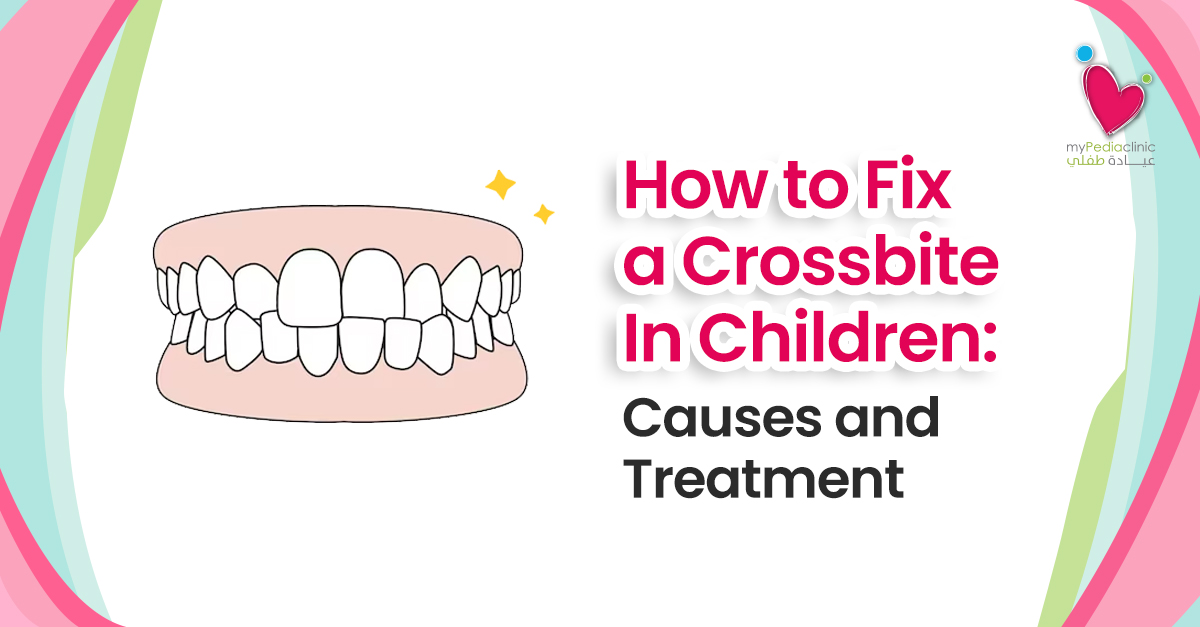
In a normal bite, the upper teeth sit slightly outside the lower teeth—like a lid on a box. A crossbite is when this relationship is reversed, with one or more upper teeth sitting inside the lower teeth.
There are two main types:
Anterior Crossbite
One or more upper front teeth sit behind the lower front teeth. This is sometimes called an “underbite” when it affects all the front teeth, though technically they’re different.
Posterior Crossbite
One or more upper back teeth (premolars or molars) sit inside the lower back teeth. This can occur on one side (unilateral) or both sides (bilateral).
- Unilateral posterior crossbite: Affects only one side. Often causes the jaw to shift to one side when biting, leading to facial asymmetry over time.
- Bilateral posterior crossbite: Affects both sides. Often related to a narrow upper jaw.
What Causes Crossbites?
Crossbites can develop from various factors:
Jaw Size Discrepancy
The upper jaw (maxilla) may be too narrow, or the lower jaw (mandible) may be too wide. This skeletal imbalance causes the teeth to meet incorrectly.
Genetics
Jaw size and shape are largely inherited. If parents had crossbites or needed orthodontic treatment, their children may too.
Prolonged Habits
- Thumb sucking: Long-term thumb sucking can narrow the upper jaw and push front teeth out of alignment
- Pacifier use: Extended pacifier use past age 2-3 can affect jaw development
- Tongue thrust: An abnormal swallowing pattern that pushes teeth out of position
Mouth Breathing
Chronic mouth breathing (often due to enlarged tonsils/adenoids or allergies) affects facial development and can lead to a narrow upper jaw.
Early or Late Loss of Baby Teeth
Losing baby teeth too early or too late can affect how permanent teeth come in, sometimes contributing to crossbite.
Trauma
Injury to the jaw or teeth can alter growth patterns.
Why Crossbites Need Treatment
Crossbites aren’t just cosmetic concerns—they can cause real functional problems:
Jaw Growth Asymmetry
This is the biggest concern, especially with unilateral posterior crossbites. When a child’s jaw shifts to one side to bite down, that side experiences more pressure. Over time, this uneven growth leads to facial asymmetry—one side of the face developing differently than the other. Once skeletal asymmetry develops, it’s much harder to correct.
TMJ Problems
The temporomandibular joint (TMJ) connects the jaw to the skull. Crossbites cause the jaw to function in an unbalanced way, which can lead to:
- Jaw pain
- Clicking or popping sounds
- Difficulty opening the mouth
- Headaches
Tooth Wear and Damage
Teeth that don’t meet properly wear unevenly. The teeth involved in the crossbite may chip, crack, or wear down prematurely.
Gum Recession
Teeth in crossbite may experience abnormal forces that contribute to gum recession around affected teeth.
Difficulty Chewing
Misaligned teeth don’t chew food as efficiently, which can affect digestion and nutrition.
Speech Issues
Some crossbites, particularly anterior crossbites, can affect speech development.
Self-Esteem
As children grow, they become aware of their appearance. A noticeable crossbite or facial asymmetry can affect confidence.
What Age Should Crossbites Be Treated?
Unlike many orthodontic issues that can wait until all permanent teeth are in (ages 11-13), crossbites often benefit from early treatment—sometimes as young as age 7.
Why Early Treatment?
- Growing bones are easier to modify: In young children, the bones of the face and palate are still growing and can be guided with appliances. This window begins to close around puberty.
- Prevents asymmetric growth: Early correction stops the jaw from developing unevenly.
- Avoids surgery: In adults, severe crossbites may require surgical correction. Early treatment often prevents this need.
- Simpler treatment: Correcting a crossbite in a growing child is typically faster and easier than in an adult with set bones.
The Ideal Timing
The American Association of Orthodontists recommends an orthodontic evaluation by age 7. For crossbites specifically:
- Ages 7-10: Often the ideal window for palatal expansion and crossbite correction
- Ages 11-14: Still treatable, but may be more complex
- Adults: Treatable but may require longer treatment or surgery for skeletal cases
Treatment Options for Crossbites
Palatal Expander (Rapid Palatal Expander/RPE)
This is the most common treatment for posterior crossbites caused by a narrow upper jaw.
How it works: A device is fixed to the upper back teeth. A parent turns a small screw daily (or as directed), gradually widening the upper jaw. The expansion happens at the midline of the palate, which hasn’t fully fused in children.
Treatment time: Active expansion takes 2-4 weeks. The device stays in place for several months afterward to allow bone to form in the expanded area.
Age factor: Works best before the palate fuses (typically before age 14-16 in girls, 16-18 in boys).
Cross-Elastics (Rubber Bands)
Used with braces, elastics can help correct mild crossbites by pulling upper and lower teeth into proper alignment.
Braces
Traditional braces can correct crossbites, especially when combined with other treatments like elastics or expanders.
Clear Aligners (Invisalign)
For mild to moderate crossbites in appropriate candidates, clear aligners can help move teeth into proper position.
Removable Appliances
In some cases, removable appliances can correct single-tooth crossbites or mild cases.
Surgery (Orthognathic Surgery)
For severe skeletal crossbites in adults or teens who have finished growing, surgery may be needed to reposition the jaw. This is combined with orthodontic treatment.
What to Expect During Treatment
With a Palatal Expander
- Some pressure and mild discomfort when turning the screw (temporary)
- A gap may appear between the front teeth (this is normal and closes naturally)
- Speaking and eating may feel different initially
- Most children adapt within a few days
- Follow-up appointments to monitor progress
Results
After successful treatment:
- Upper teeth sit outside lower teeth as they should
- Jaw functions properly without shifting
- Facial symmetry is preserved or improved
- Bite is more comfortable and efficient
Will My Child Need Braces After Expansion?
Many children who have palatal expansion will also need braces (Phase 2 treatment) later to fine-tune tooth alignment. However, the orthodontic treatment is often simpler and shorter because the jaw has been properly developed.
Preventing Crossbites
While genetics can’t be changed, some habits that contribute to crossbites can be addressed:
- Limit pacifier use and encourage stopping by age 2
- Discourage thumb sucking past age 4
- Address mouth breathing—have enlarged tonsils/adenoids or allergies evaluated
- Schedule early orthodontic evaluation by age 7
- Maintain regular dental checkups so issues are caught early
Frequently Asked Questions About Crossbite
Can a crossbite fix itself?
No. Crossbites do not self-correct. Without treatment, they typically worsen and can lead to facial asymmetry, especially during childhood growth spurts.
Is crossbite correction painful?
Treatment may cause some pressure or discomfort, especially when activating a palatal expander, but most children tolerate it well. Any discomfort is temporary and manageable with over-the-counter pain relievers if needed.
How long does crossbite treatment take?
It varies by severity. Palatal expansion takes 2-4 weeks of active turning, with 3-6 months of retaining the expansion. Complete orthodontic treatment may take 1-2 years. Early treatment is typically faster than correction in older children or adults.
What happens if a crossbite isn’t fixed?
Untreated crossbites can lead to facial asymmetry, TMJ problems, tooth damage, gum recession, and chewing difficulties. In adults, correction may require surgery. Early treatment prevents these complications.
Can adults get crossbites fixed?
Yes, but treatment is often more complex. Since the palate has fused in adults, surgical expansion (SARPE) or jaw surgery may be needed for skeletal crossbites. Dental crossbites can often be corrected with braces or aligners.
Will my child need to wear a retainer after treatment?
Usually yes. Retainers help maintain the correction and prevent relapse. Follow your orthodontist’s instructions for retainer wear.
Is the palatal expander noticeable?
The expander is inside the mouth, attached to the upper back teeth. It’s not visible from the outside, though it may temporarily affect speech slightly while your child adapts.
Can crossbite cause headaches?
Yes. Crossbites can contribute to TMJ dysfunction, which may cause headaches, jaw pain, and other symptoms. Correcting the bite often relieves these issues.
My child has a crossbite but no symptoms. Does it still need treatment?
Often yes. The damage from crossbites (asymmetric growth, tooth wear) can be gradual and not immediately symptomatic. Early treatment prevents problems that would become apparent later.
Get Your Child’s Bite Evaluated
If you’ve noticed that your child’s teeth don’t meet properly, or if their dentist has mentioned a crossbite, early evaluation is important. The sooner a crossbite is identified and treated, the simpler the correction and the better the outcome.
At myPediaClinic, our pediatric dental team evaluates children for crossbites and other orthodontic concerns. We can guide you on the right timing and treatment approach for your child’s specific situation.
Book an orthodontic evaluation for your child today.
