

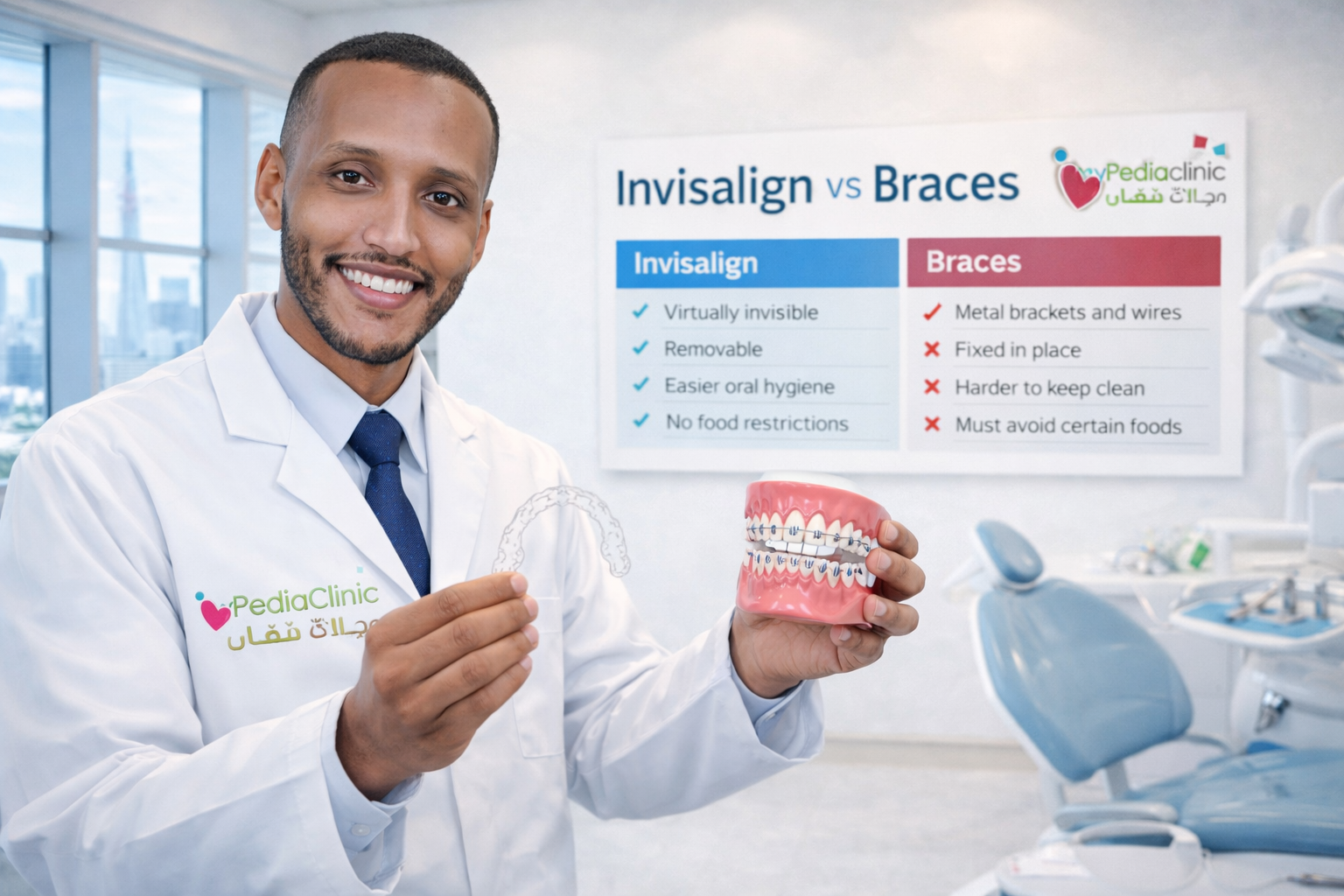
You’ve decided to straighten your teeth. Excellent choice. Now comes the question that nearly every orthodontic patient faces: Invisalign or traditional braces?
This decision isn’t always obvious. Both options deliver straight teeth and corrected bites—but the experience of getting there differs dramatically. Invisalign offers discretion and lifestyle flexibility. Traditional braces provide constant force and don’t require patient compliance. Invisalign uses removable clear aligners. Braces use fixed metal brackets and wires.
Which is right for you? The answer depends on your specific orthodontic needs, lifestyle priorities, age, budget, and personal preferences. At myPediaClinic Dubai, Dr. Mohamed Hasab helps patients navigate this decision daily—providing honest, expert guidance on which treatment approach will deliver the best results for your unique situation.
This comprehensive comparison explores every aspect of Invisalign vs. traditional braces: effectiveness, appearance, comfort, lifestyle impact, treatment duration, cost, and more. By the end, you’ll understand which option aligns best with your needs and goals.
Appearance: How Noticeable is Your Orthodontic Treatment?
Let’s start with the most visible difference—appearance matters, especially for image-conscious teens and professionals.
Invisalign: Virtually Invisible
Invisalign’s clear aligners are made from transparent SmartTrack material that blends with tooth enamel. Most people won’t notice you’re wearing aligners unless they look very closely. Small tooth-colored attachments (composite bumps on certain teeth) may be slightly visible up close but blend well with natural teeth.
For working professionals in Dubai’s corporate sectors—finance, hospitality, healthcare, consulting—Invisalign allows you to straighten teeth without the “adult with braces” appearance. Teens appreciate the discretion at school, avoiding social self-consciousness during vulnerable years.
Invisalign wins decisively on appearance if discretion matters to you.
Traditional Braces: Metal Brackets and Wires
Traditional metal braces are immediately visible. Stainless steel brackets bonded to each tooth with metal wires connecting them create an unmistakable “braces” appearance. While braces have become more socially normalized (less stigma than previous generations), they’re still highly visible.
Options exist to reduce visibility:
Ceramic braces use tooth-colored brackets that blend better than metal (but wires are still visible and ceramic brackets are larger/bulkier than metal)
Lingual braces place brackets on the back of teeth (invisible from the front but expensive, uncomfortable, difficult to clean, and affect speech more than other options)
Standard metal braces remain the most common and affordable option—but visibility is unavoidable.
Winner: Invisalign for anyone concerned about appearance during treatment.
Comfort: What Does Each Treatment Feel Like?
Invisalign: Smooth and Gradual
Invisalign aligners are made from smooth plastic with no sharp edges. They don’t irritate cheeks, lips, or tongue the way brackets and wires can. Each new aligner feels tight for 1-3 days as it begins moving teeth—patients describe this as pressure rather than sharp pain. Discomfort is typically mild and subsides quickly. Most Invisalign patients don’t require pain medication.
Aligners make gradual tooth movements (approximately 0.25mm per aligner), so force levels are gentle and constant. This controlled movement is generally more comfortable than the larger adjustments made during braces tightening.
Removing aligners provides instant relief if you’re experiencing discomfort. While you shouldn’t remove them frequently (must wear 20-22 hours daily), the option exists for temporary relief during the initial adjustment period.
Traditional Braces: Brackets, Wires, and Soreness
Braces involve metal brackets bonded to teeth with wires threaded through. These components create multiple potential discomfort sources:
Initial placement: The first week with braces is often the most uncomfortable—soreness, difficulty eating, irritation from unfamiliar hardware in your mouth.
Monthly adjustments: Each tightening appointment applies new force to move teeth. The 2-3 days following adjustments can be quite sore—many patients take ibuprofen and eat soft foods.
Wire irritation: Wires can poke cheeks or lips, especially as teeth move and wires shift. Orthodontic wax provides temporary relief, but irritation recurs.
Bracket rubbing: Brackets rub against the inside of cheeks and lips, sometimes causing sores or ulcers until your mouth toughens.
Emergency issues: Broken brackets or poking wires require unscheduled orthodontist visits to fix.
That said, millions of people complete braces treatment successfully. Discomfort is manageable and decreases as you adapt. But objectively, braces are less comfortable than Invisalign.
Winner: Invisalign for comfort throughout treatment.
Lifestyle Impact: Dietary and Activity Restrictions
Invisalign: Remove, Eat, Reinsert
Invisalign’s removability eliminates dietary restrictions. Remove aligners before eating or drinking anything except water. Eat whatever you want—sticky candy, crunchy vegetables, nuts, popcorn, whole apples, corn on the cob. Nothing is off-limits.
This freedom matters enormously for:
Professionals with frequent business lunches, client dinners, or networking events
Teenagers whose social lives revolve around food (pizza with friends, movies, birthday parties)
Food lovers who don’t want orthodontics to restrict dining experiences
Athletes who need flexible nutrition for training and competition
After eating, brush your teeth (or rinse thoroughly) before reinserting aligners. Most patients carry a travel toothbrush for convenience.
For sports, remove Invisalign aligners before activities—no risk of mouth injuries from brackets, no need for special mouthguards. After sports, rinse and reinsert. Simple and safe.
Traditional Braces: Extensive Dietary Restrictions
Braces come with long lists of forbidden foods:
Sticky foods: Caramel, toffee, gum, sticky candy (pull brackets off teeth)
Hard foods: Nuts, hard candy, ice, whole apples, whole carrots (break brackets)
Crunchy foods: Popcorn, chips, hard bread crusts (kernels/pieces lodge under wires)
Chewy foods: Bagels, licorice, certain breads (difficult to chew with soreness)
Entire categories of food become problematic. You must cut apples and corn off the cob, avoid movie theater popcorn, and skip many snacks teenagers love. These restrictions last 18-24 months—testing patience and compliance.
For sports, special orthodontic mouthguards are needed (expensive and don’t fit as well as regular mouthguards). Brackets and wires can cut lips and cheeks during contact sports injuries.
Winner: Invisalign for lifestyle freedom and convenience.
Oral Hygiene: How Easy is it to Keep Teeth Clean?
Invisalign: Brush and Floss Normally
Remove aligners, brush your teeth normally, floss normally, reinsert aligners. Your oral hygiene routine remains unchanged. No special tools, no threading floss under wires, no 20-minute brushing sessions trying to clean around brackets.
This simplicity translates to better oral health during treatment. Patients maintain cleaner teeth, healthier gums, and lower risk of cavities or white spots (early decay). For teenagers (who aren’t always diligent about oral hygiene), Invisalign’s ease of cleaning reduces parents’ worries about cavities during treatment.
Clean aligners daily by brushing them gently with a soft toothbrush and rinsing with cool water. Some patients use retainer cleaning tablets for deeper cleaning. Simple and quick.
Traditional Braces: Challenging Hygiene
Braces make oral hygiene significantly more difficult:
Brushing around brackets: You must angle brushes to clean around each bracket and under wires—tedious and time-consuming.
Flossing under wires: Threading floss under wires between every tooth takes 10-15 minutes. Special floss threaders required. Many patients skip flossing due to the hassle—leading to gum problems.
Food trapping: Food particles lodge around brackets and wires, visible when you smile. Brushing after every meal becomes essential but isn’t always practical.
Cavity risk: Plaque accumulates around brackets. If not cleaned thoroughly, white spots (decalcification—early cavities) develop around bracket perimeters. These white spots are permanent and visible even after braces are removed.
Special tools help (waterpiks, interdental brushes, orthodontic flossers), but braces objectively make oral hygiene harder. Patients who maintain excellent hygiene throughout treatment keep teeth healthy, but it requires significant diligence.
Winner: Invisalign for oral hygiene simplicity and reduced cavity risk.
Treatment Effectiveness: Which Delivers Better Results?
This is where comparison becomes nuanced. Both Invisalign and braces can deliver excellent orthodontic results—but effectiveness depends on case complexity and patient compliance.
Traditional Braces: Fixed, Constant Force
Braces’ greatest strength: they’re glued to your teeth. They apply force 24/7 without requiring patient compliance. Whether you remember or not, whether you’re motivated or not, braces keep working.
Braces can treat virtually any orthodontic problem:
Severe crowding requiring extractions
Complex bite corrections (severe overbites, underbites, open bites)
Significant tooth rotations
Vertical tooth movements (intrusion/extrusion)
Skeletal discrepancies combined with surgical orthodontics
Cases requiring precise torque control
For very complex cases or patients with compliance concerns, braces remain the gold standard. Dr. Mohamed Hasab may recommend braces over Invisalign if your case demands the control and constant force that only fixed appliances provide.
Invisalign: Advanced Technology, Requires Compliance
Invisalign technology has advanced dramatically. Modern Invisalign with SmartTrack material, precision attachments, and optimized force systems can treat the vast majority of orthodontic cases—including many previously considered “too complex” for clear aligners.
Invisalign successfully treats:
Moderate to severe crowding (with or without extractions)
Spacing and gaps
Overbite and underbite (mild to moderate)
Crossbites
Open bites
Rotated teeth
Orthodontic relapse after previous braces
However, Invisalign’s Achilles heel: compliance. Aligners only work if worn 20-22 hours daily. If you don’t wear them consistently, teeth won’t move as planned, treatment stalls, and results suffer.
For motivated patients (adults who genuinely want straight teeth, well-motivated teenagers), Invisalign delivers excellent results equivalent to braces for most cases. For patients with questionable compliance (young teens forced into treatment by parents, adults who won’t commit to wear requirements), braces may be more reliable.
Winner: Tie—braces for very complex cases or compliance concerns; Invisalign for moderate cases with motivated patients.
Treatment Duration: How Long Will It Take?
Similar Timeframes for Comparable Cases
Treatment duration depends primarily on case complexity, not which system you choose:
Simple cases: 6-12 months (minor crowding, spacing, or alignment)
Moderate cases: 12-18 months (significant crowding, spacing, moderate bite correction)
Complex cases: 18-24+ months (severe crowding, extractions, major bite correction)
For the same case, Invisalign and braces typically take similar time to complete. The idea that braces are “faster” is outdated—modern Invisalign treats cases in comparable timeframes.
One caveat: Invisalign requires compliance. If you don’t wear aligners 20-22 hours daily, treatment extends significantly. Braces work continuously regardless of patient behavior, so treatment stays on schedule.
Winner: Tie—similar duration for comparable cases with compliant patients.
Appointment Frequency and Convenience
Invisalign: Less Frequent Appointments
Invisalign check-ins occur every 6-8 weeks (not monthly). These brief appointments (15-20 minutes) allow Dr. Mohamed Hasab to monitor progress, check compliance, provide your next aligner sets (typically 3-4 sets per visit), and address questions.
With 8-10 appointments over 12-18 months of treatment, Invisalign minimally disrupts work or school schedules—ideal for busy professionals and students.
Traditional Braces: Monthly Tightening
Braces require monthly adjustment appointments (typically 30-45 minutes). Each visit involves tightening wires, replacing elastic bands, checking progress, and sometimes adjusting bracket positions.
With 18-24 appointments over 18-24 months, braces demand more frequent time away from work or school.
Winner: Invisalign for appointment convenience and frequency.
Cost Comparison: Which is More Affordable?
Similar Pricing in Dubai
At myPediaClinic, Invisalign and traditional braces cost approximately the same:
Invisalign: AED 15,000-22,000 depending on complexity
Traditional Metal Braces: AED 12,000-20,000 depending on complexity
Ceramic Braces: AED 15,000-23,000 (slightly more than metal)
You’re not paying a premium for Invisalign—pricing reflects treatment complexity and provider expertise, not which system is used.
Some clinics charge significantly more for Invisalign than braces, but this isn’t universal. Always ask for quotes for both options if cost is a deciding factor.
Winner: Tie—comparable pricing for both options at myPediaClinic.
Age Considerations: Which is Better for Teens vs. Adults?
For Teenagers
Invisalign Teen is specifically designed for adolescent patients with features like compliance indicators, eruption compensation, and 6 free replacement aligners. Well-motivated teens thrive with Invisalign—they appreciate the discretion, freedom from dietary restrictions, and sports safety.
However, teens with compliance concerns may be better served by braces. If your teen won’t commit to wearing aligners 20-22 hours daily, braces eliminate this variable.
Dr. Mohamed Hasab evaluates each teen’s maturity level, motivation, and lifestyle to recommend the best option. Both systems work excellently for teens when properly matched to the individual.
For Adults
Adults overwhelmingly prefer Invisalign when both options are clinically appropriate. Professional appearance concerns, lifestyle flexibility, and comfort make Invisalign the clear choice for most adult patients.
The small percentage of adults who choose braces typically do so because: their case is too complex for Invisalign, they want absolute assurance of compliance (braces don’t require it), or cost difference favors braces at their chosen provider.
Winner: Depends on individual—Invisalign preferred by most adults and well-motivated teens; braces may be better for compliance-challenged teens or very complex cases.
Emergency Issues and Unexpected Problems
Invisalign: Fewer Emergencies
Invisalign rarely causes orthodontic emergencies. Smooth plastic doesn’t poke, break, or cause injuries. Possible issues include:
Lost aligner: Move to the next aligner if timing is right, or revert to previous one until replacement arrives. Invisalign Teen includes 6 free replacements.
Attachment falls off: Not urgent—wait until your next scheduled appointment for Dr. Mohamed Hasab to reattach it.
Aligner cracks: Uncommon, but if it happens, switch to the next aligner early or use the previous one temporarily.
These minor issues are easily managed without emergency visits.
Traditional Braces: Occasional Emergencies
Braces can cause urgent problems requiring unscheduled visits:
Broken bracket: Brackets break if you eat hard foods or experience facial trauma. Requires repair appointment.
Poking wire: As teeth move, wires extend past back brackets and poke cheeks painfully. Orthodontic wax provides temporary relief, but wire trimming requires a visit.
Lost elastic band: Must be replaced to maintain treatment progress.
Injury to lips/cheeks: Contact sports or accidents can drive brackets into soft tissue, causing cuts.
While not daily occurrences, braces emergencies happen often enough to be an expected part of treatment.
Winner: Invisalign for fewer unexpected issues and emergency visits.
Retention: What Happens After Treatment?
Both Invisalign and braces require retention—teeth naturally tend to shift back toward original positions without retainers.
Post-Treatment Retention Protocol (Same for Both)
After completing treatment (Invisalign or braces), you’ll wear retainers:
Full-time wear for 3-6 months (22 hours daily)
Night-time only wear indefinitely (every night forever)
Invisalign patients typically receive Vivera retainers (clear, removable, similar to aligners). Braces patients may receive Vivera retainers or fixed retainers (thin wire bonded behind front teeth permanently).
Both retention approaches work if worn as prescribed. The key: lifelong night-time retainer wear protects your investment and maintains straight teeth.
Winner: Tie—retention requirements identical regardless of treatment method.
Invisalign vs. Braces: Decision Framework
Still unsure which to choose? Use this decision framework:
Choose Invisalign If…
✓ Appearance during treatment matters (professional, social, or personal concerns)
✓ You want lifestyle flexibility (no dietary restrictions, remove for sports/events)
✓ Comfort is a priority (smooth plastic vs. brackets/wires)
✓ You’re a motivated patient who will wear aligners 20-22 hours daily
✓ Easier oral hygiene appeals to you
✓ Less frequent appointments fit your schedule better
✓ Your case is moderate complexity (suitable for Invisalign based on consultation)
Choose Traditional Braces If…
✓ Your case is very complex (severe crowding, major bite issues, skeletal problems)
✓ You’re concerned about compliance (braces don’t require patient cooperation)
✓ Appearance doesn’t significantly concern you
✓ You’re a young teen who may not commit to wearing aligners consistently
✓ Your orthodontist recommends braces for optimal results in your specific case
✓ Cost difference significantly favors braces at your chosen provider
When Either Option Works Well
For many patients—particularly motivated adults and teenagers with moderate orthodontic concerns—both Invisalign and braces can deliver excellent results. In these cases, choose based on lifestyle priorities and personal preferences rather than effectiveness.
Dr. Mohamed Hasab’s role: providing honest guidance on which option is clinically appropriate for your case, then helping you choose based on what matters most to you.
Frequently Asked Questions: Invisalign vs. Braces
Is Invisalign as effective as braces?
For the vast majority of orthodontic cases, yes—Invisalign delivers results equivalent to braces. Modern Invisalign technology with SmartTrack material and precision attachments can treat complex crowding, rotations, bite corrections, and extractions. However, some very complex cases or specific tooth movements may still be better suited to braces. Dr. Mohamed Hasab evaluates your case and provides honest guidance on which option will deliver optimal results.
Does Invisalign take longer than braces?
No. For comparable cases, Invisalign and braces take similar time—typically 12-18 months for moderate complexity. Treatment duration depends on your specific orthodontic needs, not which system is used. The caveat: Invisalign requires 20-22 hours daily wear. If compliance is poor, treatment extends significantly. Braces work continuously regardless of patient behavior.
Is Invisalign more expensive than braces in Dubai?
At myPediaClinic, Invisalign and traditional braces cost approximately the same (both starting around AED 15,000). Some clinics charge more for Invisalign, but pricing differences aren’t universal. Always ask for quotes for both options if cost is a concern.
Can teenagers really be trusted with removable Invisalign aligners?
Well-motivated teens are highly compliant with Invisalign Teen. Features like compliance indicators (blue dots that fade with wear) provide accountability. Once teens see initial progress, they’re motivated to continue. However, teens who don’t want treatment (forced by parents) struggle with compliance—in these cases, fixed braces may be more reliable. Dr. Mohamed Hasab assesses each teen’s maturity and motivation during consultation.
Which is more painful—Invisalign or braces?
Invisalign is generally more comfortable. Each new aligner feels tight for 1-3 days but causes mild pressure rather than sharp pain. Braces cause soreness after monthly tightening appointments, and brackets/wires can irritate cheeks and lips. Most Invisalign patients don’t need pain medication, while braces patients often take ibuprofen after adjustments.
Can I switch from braces to Invisalign mid-treatment?
In some cases, yes. If you’ve started braces but are unhappy with the experience, Dr. Mohamed Hasab can evaluate whether transitioning to Invisalign is possible based on current progress, remaining movements needed, and case complexity. A new treatment plan would be created to complete your orthodontic goals with Invisalign.
Do Invisalign results last as long as braces results?
Yes, if you wear retainers as prescribed. Long-term stability depends on retention, not which treatment method was used. Both Invisalign and braces patients must wear retainers night-time indefinitely to maintain results. Failure to wear retainers causes relapse regardless of whether you had Invisalign or braces.
Which option is better for athletes?
Invisalign is safer for contact sports. Remove aligners before athletic activities—no injury risk, no special mouthguards needed. Braces pose mouth injury risk during impacts (brackets can cut lips/cheeks), and orthodontic mouthguards are expensive and don’t fit as well as regular ones. For athletes involved in football, basketball, martial arts, or other contact sports, Invisalign provides significant safety advantages.
Can I eat whatever I want with Invisalign?
Yes. Remove aligners before eating or drinking anything except water, eat whatever you want, brush teeth, reinsert aligners. No dietary restrictions—candy, nuts, popcorn, corn on the cob, apples—everything is allowed. Braces come with extensive food restrictions (no sticky, hard, or crunchy foods) lasting 18-24 months.
Is one option faster at showing visible results?
Patients often perceive Invisalign results appearing faster because front teeth (most visible) typically move first in the treatment sequence. Braces may work on back teeth or bite correction initially before front teeth straighten. However, final completion time is similar for both options when treating comparable cases.
What if I have a very complex orthodontic problem?
Braces can treat virtually any orthodontic problem including very complex cases, severe skeletal discrepancies, and cases requiring surgical orthodontics. Invisalign technology has advanced dramatically and can now treat many complex cases, but some still exceed its capabilities. Dr. Mohamed Hasab evaluates your specific situation and recommends the treatment option most likely to deliver optimal results.
Can I whiten my teeth during treatment?
With Invisalign, yes—aligners can double as whitening trays. Apply professional whitening gel inside aligners for simultaneous straightening and whitening. With braces, professional whitening must wait until after braces are removed (whitening wouldn’t reach enamel under brackets, causing uneven coloring).
Which option requires more discipline?
Invisalign requires consistent wear discipline (20-22 hours daily). Braces require dietary discipline (avoiding restricted foods) and oral hygiene discipline (thorough brushing around brackets). Both demand commitment, but in different ways. Choose based on which type of discipline you’re confident maintaining.
Will my insurance cover both options?
Most UAE insurance plans with orthodontic coverage apply the same benefit regardless of treatment type. If your plan covers AED 7,500 toward orthodontics, that amount applies to either Invisalign or braces. Some plans specifically exclude Invisalign (considering it cosmetic), so verify with your insurer. myPediaClinic assists with insurance verification.
Can I get Invisalign if I have crowns, implants, or bridges?
Usually yes, but it depends on location and extent of restorations. Invisalign can work around existing dental work, though attachments may need to be placed on natural teeth rather than restorations. Dr. Mohamed Hasab evaluates your specific situation during consultation. Braces can also work with restorations, and the same considerations apply.
Which option is better for someone with gum disease?
Invisalign may be better. Easier oral hygiene (removing aligners to brush/floss normally) helps manage gum health during treatment. Braces make oral hygiene challenging, potentially worsening gum problems. However, active gum disease should be treated and stabilized before starting any orthodontic treatment. Dr. Mohamed Hasab coordinates with your periodontist to ensure your oral health supports orthodontics.
Do adults really choose braces anymore?
Some do, though Invisalign is more popular among adults. Adults choose braces when: their case is too complex for Invisalign, cost difference favors braces significantly, they prefer not to worry about compliance, or they simply don’t mind the appearance. But the majority of adults—particularly in image-conscious Dubai—choose Invisalign when both options are clinically appropriate.
Can I try Invisalign and switch to braces if I don’t like it?
Technically possible but not cost-effective. You’d pay for Invisalign treatment that didn’t complete, then pay again for braces—essentially paying twice. Better to carefully consider your commitment to Invisalign before starting. If you’re unsure about compliance, braces may be the wiser initial choice.
What happens if my Invisalign treatment isn’t progressing as planned?
Dr. Mohamed Hasab monitors progress at each check-in. If teeth aren’t tracking according to the ClinCheck plan, we can order refinement aligners (additional aligners to get treatment back on track). If compliance is poor and teeth aren’t moving, we discuss options: recommitting to proper wear, or transitioning to braces (fixed appliances that don’t require compliance).
Which option do most patients at myPediaClinic choose?
When both options are clinically appropriate, most patients choose Invisalign—approximately 70-80% of adults and 60-70% of motivated teens. The discretion, comfort, and lifestyle benefits appeal to Dubai’s image-conscious, busy population. However, for complex cases or compliance concerns, Dr. Mohamed Hasab recommends braces, and patients trust this expert guidance.
The Bottom Line: Trust Expert Guidance
Invisalign and traditional braces are both excellent orthodontic treatments—but they suit different patients, different cases, and different lifestyles. Neither is universally “better”—what matters is which option is right for YOUR specific situation.
At myPediaClinic Dubai, Dr. Mohamed Hasab provides honest, expert guidance on which treatment approach will deliver optimal results for your orthodontic needs. Sometimes both options work equally well, and you choose based on lifestyle preferences. Sometimes one option is clinically superior for your case.
Don’t guess or choose based on internet research alone. Get professional evaluation from a certified orthodontist who can assess your teeth, bite, and jaw relationship, then recommend the best path forward.
Schedule your complimentary orthodontic consultation today:
Call: +971-4-430-5926
WhatsApp: +971-4-430-5926
Visit: myPediaClinic, Dubai Healthcare City
Website: mypediaclinic.com
Dr. Mohamed Hasab will evaluate your smile, explain which treatment options are appropriate for your case, discuss pros and cons of each approach, and help you make an informed decision—no pressure, just expert guidance.
Your journey to a straight, beautiful smile starts with the right treatment choice. Let’s figure out which option is perfect for you.