
Can your baby see clearly? Many parents assume their child’s vision is fine—after all, they seem to look at things normally. But vision problems in babies and young children often go unnoticed until they cause lasting damage.
The good news? 95% of vision disorders can be cured if detected early. Here’s what every parent in Dubai needs to know about pediatric vision screening.
Why Is Early Vision Screening Important?
Children’s eyes develop rapidly in the first few years of life. If a vision problem goes untreated during this critical window, it can lead to:
- Lazy eye (amblyopia) — Permanent vision loss in one eye
- Learning difficulties — Vision affects reading and development
- Delayed milestones — Vision problems can impact motor skills
- Behavioral issues — Frustration from not seeing clearly
Key fact: The younger the child when a vision problem is detected, the better the outcome. Treatment is most effective before age 7.
When Should Vision Screening Start?
The American Academy of Pediatrics recommends vision screening at these ages:
- Newborn: Basic eye examination
- 6 months: First formal vision screening
- 3 years: Preschool vision check
- 5 years: Before starting school
- Annually: Continue yearly screening
At myPediaClinic, we recommend starting vision screening from 6 months of age and repeating it annually. Many vision problems develop as children grow, so regular checks are essential.
Signs Your Child May Have Vision Problems
Children rarely complain about vision problems—they don’t know what “normal” vision looks like. Watch for these warning signs:
In Babies (0-12 months)
- Eyes don’t track moving objects together
- One eye turns inward or outward
- Eyes appear misaligned
- Excessive tearing or eye discharge
- White or cloudy appearance in the pupil
In Toddlers and Young Children
- Sitting very close to the TV or holding books too close
- Tilting head to see better
- Squinting or closing one eye
- Frequent eye rubbing
- Covering one eye to see
- Sensitivity to light
- Avoiding activities that require near or far vision
In School-Age Children
- Difficulty reading or losing place while reading
- Complaining of headaches or tired eyes
- Poor handwriting or difficulty copying from the board
- Short attention span for close work
- Poor performance in school despite being intelligent
Common Vision Problems in Children
Vision screening can detect a range of conditions:
Refractive Errors
- Myopia (nearsightedness) — Difficulty seeing distant objects
- Hyperopia (farsightedness) — Difficulty seeing close objects
- Astigmatism — Blurred vision at all distances
Eye Alignment Issues
- Strabismus — Eyes don’t align properly (crossed eyes)
- Amblyopia (lazy eye) — One eye develops weaker vision
- Anisometropia — Significant difference between eyes
Other Conditions
- Anisocoria — Unequal pupil sizes
- Corneal abnormalities
- Cataracts (rare in children but possible)
2-Second Vision Screening at myPediaClinic
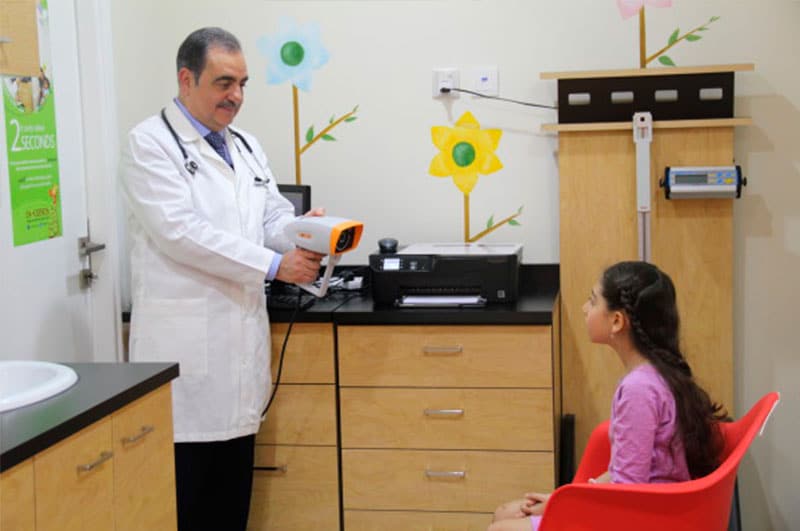
Many parents worry that vision screening for babies and young children will be difficult, time-consuming, or stressful. At myPediaClinic, we use advanced auto-refraction technology that makes screening quick and easy.
How Our Vision Screening Works
- Takes just 2 seconds — Versus traditional 1-hour screening
- Non-contact — Device works from 1 meter away
- Child-friendly — Baby can stay in parent’s lap
- No drops needed — Completely comfortable
- Instant results — “Pass” or “Refer” immediately
What the Results Mean
After screening, your child receives a clear result:
- “Pass” — No concerning findings detected
- “Refer” — Further evaluation by an eye specialist recommended
If your child receives a “Refer” result, we’ll help you schedule an appointment with a pediatric ophthalmologist for comprehensive evaluation.
Real Parent Experience
One of our patients, Corine, discovered during routine screening that her 2-year-old son Nate had significant vision problems she never suspected:
“Imagine for two years, Nate has suffered from seeing like the rest of us. His prescription is +4 far sighted! And I would have NEVER have guessed or even have known. I wonder how he would have struggled at school in years to come? You don’t realize how important and crucial your eyes are until you are actually affected by it. I can’t thank Dr. Medhat enough for his help and keeping my little boy protected.”
Early detection made all the difference for Nate. With prescription glasses, he now sees clearly and is thriving.
What Happens After a “Refer” Result?
If your child needs further evaluation, a pediatric ophthalmologist will:
- Conduct a comprehensive eye exam
- Determine the exact prescription needed
- Recommend treatment — Glasses, patching, or other interventions
- Schedule follow-up care — Monitor progress over time
Most vision problems in children are easily corrected with glasses. Early treatment of conditions like lazy eye can prevent permanent vision loss.
Vision Screening at myPediaClinic Dubai
At myPediaClinic in Dubai Healthcare City, we offer vision screening as part of routine well-child checkups. Our approach:
- Screening available from 6 months of age
- Quick, 2-second testing with advanced technology
- Child-friendly, stress-free experience
- Immediate results
- Referrals to trusted pediatric ophthalmologists when needed
Don’t wait until your child starts school to check their vision. Book an appointment to include vision screening at your child’s next checkup.
Frequently Asked Questions
At what age can you first test a baby’s vision?
Vision screening can begin as early as 6 months of age using specialized equipment like auto-refractors. These devices can detect vision problems in babies who can’t read eye charts or follow verbal instructions. We recommend starting screening at 6 months and continuing annually.
How do you test vision in a child who can’t read?
Modern vision screening doesn’t require children to read letters or identify pictures. Auto-refraction technology measures how light reflects off the retina to determine if vision problems exist. The child simply looks at the device for 2 seconds while sitting in a parent’s lap.
Can lazy eye be fixed if caught early?
Yes, lazy eye (amblyopia) is highly treatable when caught early. Treatment typically involves wearing glasses and patching the stronger eye to strengthen the weaker one. The younger the child at diagnosis, the better the outcome. After age 7, treatment becomes less effective.
Does my child need an eye exam if they passed vision screening?
Vision screening is a quick check for common problems, but it’s not a substitute for a comprehensive eye exam by an ophthalmologist. If you have concerns about your child’s vision despite passing screening, or if there’s a family history of eye problems, a full exam may be recommended.
How often should children have vision screening?
We recommend vision screening at 6 months, then annually throughout childhood. Some conditions develop as children grow, and new vision problems can emerge during the school years. Regular screening ensures early detection of any changes.