
Mariam thought she was getting a great deal. After researching Invisalign and seeing prices of AED 15,000-20,000 at reputable clinics, she found a dental center advertising “Invisalign treatment from AED 6,999.” Perfect—same result, lower price.
She paid AED 8,500 for what the clinic called “Invisalign treatment.” Months later, her aligners kept cracking, fit poorly, and her teeth weren’t moving as promised. When she researched authentication methods and inspected her aligners, reality hit: no Invisalign logo, no starflower pattern, no official packaging. She wasn’t receiving Invisalign at all—just generic clear aligners sold under misleading marketing.
Mariam’s story isn’t unique. Dubai’s orthodontic market has a growing problem: cheaper clear aligner alternatives marketed as “Invisalign,” “Invisalign-style,” or “the same as Invisalign”—deceiving patients into believing they’re receiving premium Invisalign treatment when they’re actually getting inferior substitutes.
This comprehensive exposé reveals the truth about fake Invisalign in Dubai: how the deception happens, which alternatives are being substituted, why it matters, and how to protect yourself from wasting thousands of dirhams on treatment that won’t deliver the results you expect.
The Fake Invisalign Problem: How Widespread Is It?
Walk through Dubai Mall or scroll Instagram ads and you’ll see dozens of clinics advertising “Invisalign” or “invisible braces” at prices ranging from AED 4,999 to AED 12,000—well below what certified Invisalign providers charge.
Some of these clinics provide legitimate lower-cost clear aligner alternatives (like ClearCorrect or K Line) and disclose this to patients. That’s honest business—offering budget options clearly identified as alternatives to Invisalign.
But many clinics engage in deceptive practices:
Advertising “Invisalign” to attract patients, then providing generic alternatives without clear disclosure
Using phrases like “Invisalign-style treatment” or “works just like Invisalign” to imply equivalence
Showing Invisalign promotional materials in clinics while actually using different aligner systems
Quoting prices for “clear aligner treatment” and allowing patients to assume it’s Invisalign
Starting treatment with a few genuine Invisalign aligners, then switching to cheaper alternatives mid-treatment
The result: patients pay near-Invisalign prices for inferior products, discover the substitution only after treatment begins (if at all), and experience poor results, wasted money, and broken trust.
Common Invisalign Alternatives Being Sold as “Invisalign”
Several clear aligner brands are commonly substituted for Invisalign in Dubai. Understanding these alternatives helps you identify when you’re not receiving genuine Invisalign:
ClearCorrect: Legitimate Alternative, Often Misrepresented
ClearCorrect is a legitimate clear aligner brand manufactured in the U.S. It’s FDA-cleared and can deliver decent results for simple to moderate cases. However, it’s NOT Invisalign, and clinics shouldn’t market it as such.
Typical Dubai pricing for ClearCorrect: AED 8,000-12,000
How it’s marketed: “Invisible aligners Dubai,” “Clear braces from AED 8,000,” sometimes with Invisalign’s name buried in advertising to attract search traffic
Key differences from Invisalign:
Different aligner material (less elastic, less comfortable than Invisalign’s proprietary SmartTrack)
Simpler treatment planning software (not ClinCheck)
Less clinical research (ClearCorrect has about 10 years of data vs. Invisalign’s 25+ years and 14 million patients)
Less predictable outcomes for complex cases
No refinement guarantee like Invisalign provides
ClearCorrect is an honest budget alternative when disclosed as such. The problem: clinics advertising “Invisalign” or “Invisalign-quality treatment” while providing ClearCorrect—charging near-Invisalign prices for a lower-tier product.
K Line Clear Aligners: Korean Budget System
K Line is a Korean aligner system popular in Dubai clinics targeting price-sensitive patients. Quality and predictability vary significantly.
Typical Dubai pricing for K Line: AED 4,999-8,000
How it’s marketed: “Invisible braces in Dubai starting AED 4,999,” “Affordable Invisalign alternative,” or misleadingly as “Invisalign treatment AED 5,999”
Key issues with K Line:
Minimal clinical research backing
Inconsistent manufacturing quality (aligners vary in thickness, fit, and durability)
No proprietary technology comparable to Invisalign’s SmartTrack material or ClinCheck software
Generic treatment planning (not customized with the precision of Invisalign)
High failure rate for anything beyond simple alignment
K Line works for some very simple cases, but outcomes are unpredictable. Many patients experience cracking aligners, poor fit, or teeth that don’t move as planned.
Generic Chinese/Southeast Asian Aligners
The cheapest option: generic aligners manufactured in China or Southeast Asia by companies with no established track record or quality standards.
Typical Dubai pricing: AED 3,000-6,000
How it’s marketed: “Clear aligners Dubai,” “Invisible braces starting AED 2,999,” sometimes showing stock photos of aligners (which all look similar) while using Invisalign’s name in meta tags/SEO
Serious problems with generic aligners:
No quality control—aligners may contain materials unsafe for continuous oral wear
Poor fit causing pain, gum irritation, or tooth damage
Rough edges cutting gums and cheeks
Inconsistent thickness and durability (crack easily)
No clinical research or proven track record
Treatment planning done by general dentists with minimal orthodontic training
No recourse if treatment fails—you’ve wasted money with no remedy
These ultra-cheap systems are essentially orthodontic roulette—you might get lucky with simple cases, but more often you’ll experience poor results, oral health problems, and wasted money.
In-House 3D-Printed Aligners
Some Dubai clinics now own 3D printers and manufacture aligners in-house, cutting out aligner companies entirely. While this sounds innovative, it bypasses decades of research into aligner material science, tooth movement biomechanics, and manufacturing precision.
Typical pricing: AED 5,000-10,000
How it’s marketed: “Advanced 3D-printed aligners,” “Custom in-house aligners,” sometimes implying equivalence to Invisalign through vague marketing
Concerns with in-house aligners:
Material quality varies—3D printing resins aren’t engineered specifically for orthodontic tooth movement
No standardized protocols or quality checks
Treatment planning depends entirely on the individual dentist’s skill (highly variable)
No established track record or clinical studies
Unpredictable results
Some skilled orthodontists using high-quality 3D printers achieve decent results, but outcomes vary wildly. You’re essentially beta testing an unproven system.
How the Deception Happens: Marketing Tactics to Watch For
Understanding deceptive marketing tactics helps you identify potential fake Invisalign situations:
Tactic 1: The Ambiguous Advertisement
Ads show pictures of clear aligners (which all look similar) with text like:
“Get the Invisalign smile you’ve always wanted”
“Invisalign-style clear braces from AED 5,999”
“Straighten your teeth like Invisalign at half the price”
“Achieve Invisalign results with our advanced clear aligners”
Notice: the word “Invisalign” appears prominently (for SEO and attention), but technically they’re not claiming to provide Invisalign. Phrases like “Invisalign-style” or “like Invisalign” create confusion—patients assume they’re getting Invisalign when they’re actually getting unnamed alternatives.
Tactic 2: The Bait and Switch
You call asking about Invisalign pricing. The receptionist quotes AED 10,000 for “clear aligner treatment.” You assume it’s Invisalign and book a consultation.
During the appointment, the dentist discusses “our clear aligner system” without mentioning Invisalign by name. They show you digital treatment plans and aligner samples. You’re told the aligners “work exactly like Invisalign” or “use the same technology as Invisalign.”
You proceed with treatment, believing you’re getting Invisalign. Months later (if you investigate), you discover it’s actually K Line or a generic system. By then, you’ve paid deposits and started treatment—trapped in inferior care.
Tactic 3: No Brand Disclosure
Your aligners arrive in generic packaging or bags branded with the clinic’s name—not “Invisalign” packaging. When you ask about this, you’re told:
“We use our own branded packaging for convenience”
“The aligners are manufactured to Invisalign specifications”
“Our aligners are equivalent to Invisalign”
None of these statements mean you’re receiving genuine Invisalign. Authentic Invisalign always comes in official Invisalign-branded packaging.
Tactic 4: Starting Genuine, Then Switching
The most deceptive tactic: You receive your first few aligners—genuine Invisalign with logos, proper packaging, everything authentic. Then mid-treatment, the clinic switches to cheaper alternatives for the remaining aligners, hoping you won’t notice.
You’re paying for full Invisalign treatment but receiving partial generic substitutes. This cuts the clinic’s costs while maintaining their profit margin at your expense.
Tactic 5: “We’re Invisalign-Certified” (But We Don’t Use Invisalign)
Some dentists completed Invisalign’s training course (earning “Invisalign Provider” status) but don’t actually use Invisalign—they use cheaper alternatives instead. Their marketing highlights “Invisalign-certified provider,” giving the impression they provide Invisalign when they’ve switched to generic systems.
Technically they’re not lying (they did complete Invisalign training), but it’s misleading—certification doesn’t mean they’re currently using Invisalign.
Why Fake Invisalign Matters: The Real Consequences
You might think, “If the aligners straighten my teeth, does it matter what brand they are?” Here’s why it absolutely matters:
1. Material Quality and Safety
Invisalign’s SmartTrack material undergoes rigorous biocompatibility testing ensuring it’s safe for continuous oral wear (aligners are in your mouth 22 hours daily for 12-18 months). SmartTrack is engineered for optimal force delivery—providing gentle, consistent pressure that moves teeth predictably without damaging roots.
Generic aligner materials haven’t undergone the same testing. They may:
Contain chemicals causing allergic reactions or oral irritation
Be too rigid (applying excessive force that damages tooth roots)
Be too soft (insufficient force to move teeth)
Leach substances into saliva with unknown long-term health effects
Your mouth is highly vascular—substances from aligners enter your bloodstream. Material safety isn’t just about comfort; it’s about health.
2. Treatment Predictability
Invisalign’s ClinCheck treatment planning is powered by data from 14 million patients and AI algorithms predicting how teeth respond to forces. When Dr. Mohamed Hasab creates your ClinCheck plan, it’s based on decades of accumulated knowledge about tooth movement biomechanics.
Generic systems lack this data. Treatment planning relies entirely on the individual dentist’s experience and guesswork. Tooth movements might look right on a digital simulation but won’t happen in reality because the planning doesn’t account for biological variables.
The result: teeth don’t move as planned. Treatment stalls. You’re left with partially straightened teeth—better than before, but not the ideal result you paid for.
3. Manufacturing Precision
Invisalign aligners are manufactured at Align Technology’s state-of-the-art facilities with precision tolerances measured in microns. Every aligner is quality-checked at multiple stages. Consistent thickness, smooth edges, precise fit—these details matter for comfort and effectiveness.
Generic aligners have inconsistent quality:
Varying thickness (some areas too thick and rigid, others too thin and fragile)
Rough edges irritating gums and cheeks
Poor fit (too loose or too tight)
Cracking or breaking during normal wear
Warping when exposed to warm water
Poor manufacturing translates to poor results and discomfort throughout treatment.
4. No Refinement Guarantee
Invisalign treatment includes refinement aligners—if your teeth don’t track perfectly according to the ClinCheck plan, Align Technology manufactures additional aligners to get treatment back on track at no extra charge.
Generic systems typically don’t offer refinements. If treatment fails or produces suboptimal results, you’re left with whatever you got—no recourse, no remedy. You’ve paid thousands of dirhams and received disappointing outcomes with nowhere to turn.
5. Wasted Money
When fake Invisalign treatment fails, you have two choices:
Accept mediocre results—live with teeth that are “sort of straight” but not what you envisioned or paid for
Start over with genuine Invisalign or braces—paying again for orthodontic treatment, essentially paying twice
That “great deal” on AED 6,999 fake Invisalign becomes AED 6,999 wasted + AED 15,000-20,000 for proper treatment = AED 22,000-27,000 total. You would’ve saved money going to a certified Invisalign provider from the start.
6. Damaged Trust and Emotional Impact
Beyond financial loss, fake Invisalign creates emotional consequences:
Feeling deceived and taken advantage of
Loss of trust in dental/medical providers
Disappointment that your smile didn’t improve as expected
Embarrassment about falling for misleading marketing
Months or years wasted on ineffective treatment
The psychological impact of healthcare fraud extends beyond the clinical failure.
Red Flags: Signs You Might Be Getting Fake Invisalign
Watch for these warning signs before and during treatment:
Before Treatment Starts
✗ Price significantly below market rate (genuine Invisalign from certified providers costs AED 12,000-25,000 in Dubai; if quoted AED 5,000-9,000, investigate)
✗ Vague language about the aligner brand (“we use clear aligners,” “our system works like Invisalign,” no mention of Invisalign by name)
✗ Refusal to confirm you’ll receive genuine Invisalign (evasive answers like “we use equivalent technology” or “it’s the same thing”)
✗ Provider not listed in Invisalign’s official provider directory (check Invisalign.com’s provider locator)
✗ No ClinCheck digital treatment plan shown (if they show generic 3D simulations without Invisalign branding, it’s not Invisalign)
✗ General dentist with minimal orthodontic training (Invisalign works best with certified orthodontists; general dentists can offer it, but may lack expertise—or may substitute cheaper alternatives)
During Treatment
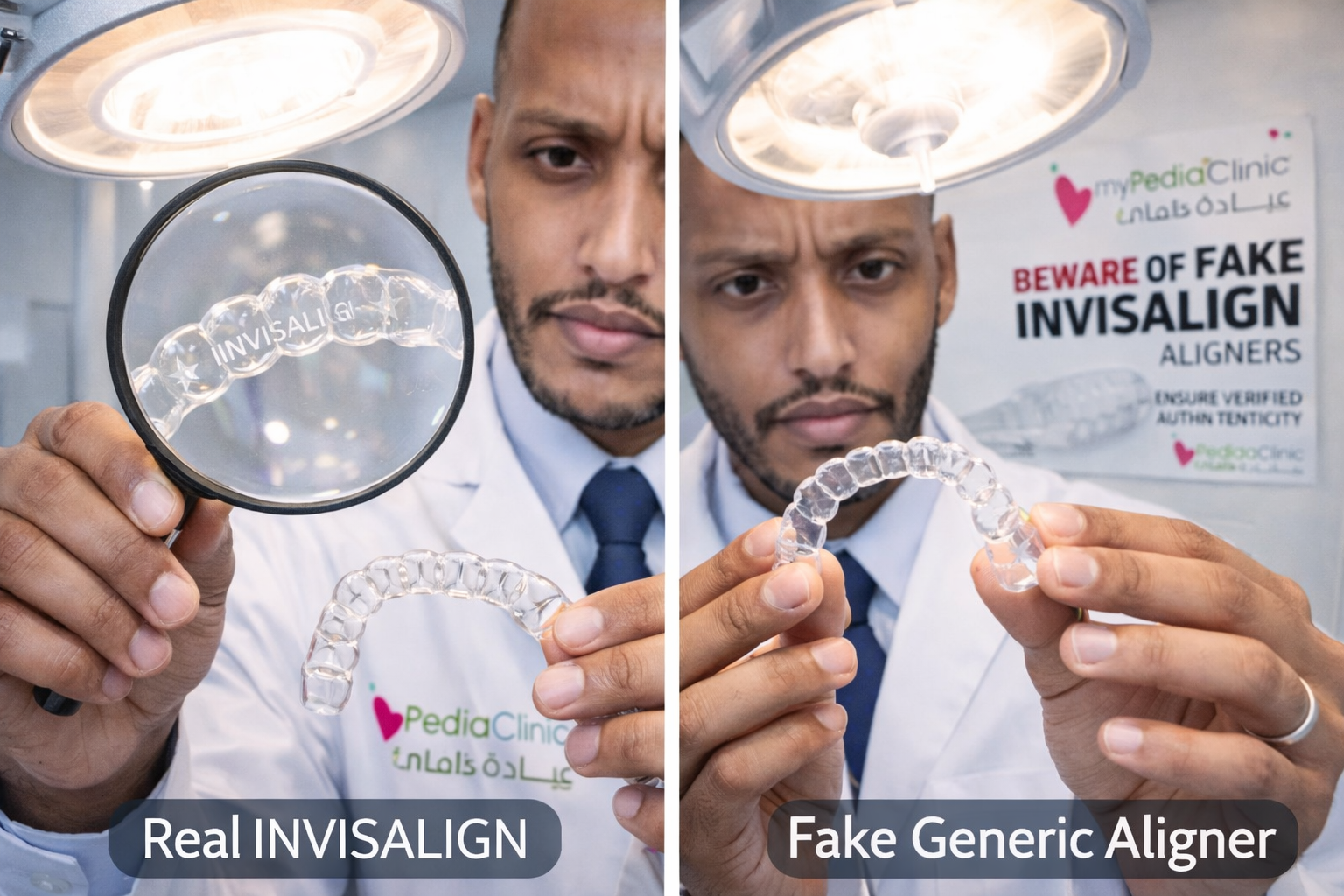
✗ Aligners lack Invisalign branding (no Invisalign logo printed on aligners, no aligner numbers, no batch codes)
✗ No starflower pattern visible (hold genuine Invisalign aligners to bright light and you’ll see a distinctive dotted/starflower pattern—anti-counterfeiting feature)
✗ Generic packaging (authentic Invisalign comes in branded Invisalign bags/boxes; generic packaging or clinic-branded packaging indicates alternatives)
✗ Poor aligner quality (cracking, rough edges, inconsistent fit, warping easily—signs of low-quality manufacturing)
✗ Teeth not moving as promised (if months pass with minimal progress, the system may be ineffective)
✗ Provider can’t explain why aligners lack Invisalign features (evasive or defensive responses when you ask about missing branding)
How to Protect Yourself: Due Diligence Steps
Avoid fake Invisalign by taking these protective steps:
Step 1: Ask Direct Questions
Before committing to treatment, ask explicitly:
“Will I receive genuine Invisalign aligners manufactured by Align Technology?”
“Is this clinic a certified Invisalign provider?”
“Will my aligners have the Invisalign logo and official packaging?”
“Can I see my ClinCheck treatment plan in Invisalign’s software?”
Legitimate Invisalign providers answer “yes” confidently to all questions. Evasive answers (“we use equivalent systems,” “our aligners are just as good”) are red flags.
Step 2: Verify Provider Certification
Visit Invisalign’s official website and use their provider locator tool. Search for your clinic/doctor. If they don’t appear in the directory, they’re either not certified or not actively using Invisalign.
Certification proves they’ve completed Invisalign training and maintain active status with Align Technology.
Step 3: Insist on Seeing the ClinCheck Plan
Genuine Invisalign includes ClinCheck digital treatment planning. Your orthodontist should show you the ClinCheck simulation on screen—a detailed 3D animation with prominent Invisalign branding showing your treatment from start to finish.
If shown generic animations or static images without the ClinCheck interface and Invisalign logos, it’s not Invisalign. Insist on seeing the official ClinCheck plan before proceeding.
Step 4: Inspect Your Aligners When They Arrive
When you receive your first aligners, check for authentication features (detailed in our companion article “How to Verify Authentic Invisalign in Dubai”):
✓ Invisalign logo printed on each aligner
✓ Aligner numbers (U1, U2, etc.)
✓ Batch/lot codes
✓ Starflower pattern visible in bright light
✓ Official Invisalign packaging
If any of these are missing, you’re not receiving genuine Invisalign. Address this immediately with the provider.
Step 5: Review Your Contract Carefully
Your treatment contract should explicitly state “Invisalign treatment” or reference Align Technology as the aligner manufacturer. Payment receipts should indicate you’re paying for Invisalign specifically.
If the contract vaguely references “clear aligner treatment” without naming Invisalign, you have no legal proof you’re entitled to genuine Invisalign. Get specific contract language before signing.
Step 6: Trust Your Instincts About Price
If a price seems too good to be true, it probably is. Genuine Invisalign from qualified providers costs AED 12,000-25,000 in Dubai depending on case complexity. If quoted AED 6,000-9,000 for “Invisalign,” something’s wrong.
The clinic is either:
Providing cheaper alternatives (not Invisalign)
Charging separately for components to reach market rate later
Using inexperienced providers to cut costs
Compromising quality somewhere
Don’t let price alone guide your decision. Orthodontic treatment is a significant health investment—prioritize quality and authenticity over perceived bargains.
Step 7: Choose Certified Orthodontists Over General Dentists
While general dentists can offer Invisalign after completing a short training course, certified orthodontists (like Dr. Mohamed Hasab at myPediaClinic) have 2-3 years of advanced training specifically in orthodontics. They’re more likely to:
Use genuine Invisalign (invested in maintaining Align Technology relationship)
Provide expert treatment planning and progress monitoring
Maintain higher ethical standards
Deliver superior results
General dentists offering ultra-cheap “Invisalign” are more likely to substitute generic alternatives to boost profit margins.
What to Do If You Discover You’re Getting Fake Invisalign
If you’ve already started treatment and discover you’re not receiving genuine Invisalign:
1. Document Everything
Take photos of your aligners (showing lack of Invisalign logos/features)
Take photos of packaging
Review your contract for any mention of “Invisalign” or “Align Technology”
Save all communications (emails, WhatsApp messages) discussing treatment
Keep all payment receipts
2. Confront the Provider
Schedule a meeting with the dentist/clinic manager. Present your evidence showing the aligners aren’t genuine Invisalign. Ask directly:
“I was told I’d receive Invisalign. These aligners don’t have Invisalign features. What brand are these?”
“Why was I led to believe this was Invisalign when it’s not?”
“What are you going to do to rectify this situation?”
Document their response. If they admit deception, request a full refund or transition to genuine Invisalign treatment at no additional cost.
3. File Complaints with Regulatory Authorities
If the provider refuses to address the issue, file complaints with:
Dubai Health Authority (DHA)—regulates healthcare providers in Dubai
Dubai Economy—handles consumer protection and fraudulent business practices
Dubai Police Consumer Protection Department—for cases involving fraud or deception
Provide all documentation. Regulatory action protects other patients from similar deception.
4. Seek Legal Advice
Consult a lawyer specializing in consumer protection or medical malpractice. If you have contract language promising “Invisalign” but received substitutes, you may have grounds for legal action to recover payments.
5. Leave Honest Reviews
Share your experience on Google Reviews, Facebook, and healthcare review sites. Honest reviews warn other potential patients and pressure dishonest clinics to change practices.
6. Start Over with a Certified Provider
If treatment has barely started and you’ve lost confidence in your provider, consider cutting losses and starting fresh with a certified Invisalign provider like myPediaClinic. Better to stop bad treatment early than continue with inferior care.
Frequently Asked Questions About Fake Invisalign in Dubai
How common is fake Invisalign in Dubai?
Increasingly common. Dubai’s competitive dental market and price-conscious medical tourism industry create incentives for clinics to offer cheaper alternatives while leveraging Invisalign’s brand recognition for marketing. Estimates suggest 20-30% of clinics advertising “Invisalign” or “invisible braces” at ultra-low prices are providing generic alternatives rather than genuine Invisalign.
Are cheaper clear aligner alternatives legitimate, or are they all scams?
Some alternatives (like ClearCorrect) are legitimate products when disclosed honestly. They’re lower-cost options for simple cases. The problem isn’t alternatives existing—it’s clinics marketing them as “Invisalign” or “equivalent to Invisalign” when they’re not. Honest clinics clearly state “we use ClearCorrect” or “we use our in-house system.” Dishonest clinics allow patients to believe they’re getting Invisalign.
Can ClearCorrect or K Line deliver good results?
ClearCorrect can deliver decent results for simple to moderate cases when used by experienced providers. K Line and generic systems have highly variable outcomes—some patients get acceptable results for very simple alignment, but many experience poor fit, minimal tooth movement, or treatment failure. None match Invisalign’s predictability, material quality, or research backing.
How can I tell if my aligners are genuine Invisalign?
Check for: Invisalign logo printed on aligners (near back molars), unique aligner numbers and batch codes printed on aligners, starflower pattern visible when held to bright light, and official Invisalign-branded packaging. If any of these are missing, you’re not receiving genuine Invisalign.
What if my dentist says their generic aligners are “just as good” as Invisalign?
That’s a sales pitch, not a fact. Invisalign has 25+ years of research, 14 million patients treated, proprietary SmartTrack material, ClinCheck AI-powered planning, and rigorous quality control. Generic systems lack this foundation. They might work for very simple cases, but aren’t “just as good” for predictability, material quality, or complex case outcomes.
Is it illegal for clinics to market generic aligners as Invisalign?
Outright claiming to provide Invisalign while providing something else is fraudulent and illegal (trademark infringement and consumer fraud). However, many clinics use ambiguous language (“Invisalign-style,” “like Invisalign”) that’s legally gray—deceptive but potentially defensible. Dubai Health Authority regulates healthcare advertising, but enforcement varies.
What should I do if I’ve already paid for fake Invisalign?
Document everything (photos of aligners, packaging, contract, payments), confront the provider requesting a refund or genuine Invisalign treatment, file complaints with DHA and Dubai consumer protection authorities, seek legal advice about recovering payments, and leave honest reviews warning other patients. How much you recover depends on contract language and how explicitly Invisalign was promised.
Can I get a refund if I discover mid-treatment it’s not Invisalign?
It depends on your contract and how the treatment was marketed. If the contract explicitly promises Invisalign but you received substitutes, you have stronger legal grounds for refund. If the contract vaguely references “clear aligners” without naming Invisalign, refunds are harder to obtain. Consult a lawyer to assess your specific situation.
Why would a dentist substitute cheaper aligners for Invisalign?
Profit margins. Genuine Invisalign costs clinics approximately AED 4,000-6,000 per case (what they pay Align Technology). Generic systems cost AED 1,000-2,500. By charging Invisalign prices (AED 12,000-18,000) while using generic alternatives, clinics dramatically increase profit margins—pocketing an extra AED 3,000-5,000 per patient through deception.
Are there genuine Invisalign providers who charge lower prices?
Some variation exists, but genuine Invisalign from certified providers typically costs AED 12,000-25,000 in Dubai depending on case complexity and what’s included. Providers charging AED 15,000-18,000 for straightforward cases aren’t suspiciously cheap. Providers charging AED 6,000-9,000 are almost certainly using alternatives, not Invisalign. Invisalign has a floor price based on what Align Technology charges providers.
How do I verify a provider appears in Invisalign’s directory?
Visit Invisalign’s official website (invisalign.com), navigate to the “Find a Doctor” or provider locator section, enter your location (Dubai) and search for the provider’s name or clinic. If they’re certified, they’ll appear in results with their certification level. If they don’t appear, they’re either not certified or not currently using Invisalign.
What if my dentist showed me Invisalign promotional materials but uses a different system?
That’s highly deceptive and possibly illegal. Displaying Invisalign materials while providing different systems creates false impressions that could constitute fraud. Document this (photos of materials displayed), confront the provider, and file complaints with regulatory authorities. This crosses the line from ambiguous marketing to outright deception.
Can I trust before-and-after photos on clinic websites?
Be skeptical. Photos might show results from genuine Invisalign cases even if the clinic now uses alternatives, or they might show stock photos licensed from marketing companies (not actual patients). Always verify you’ll receive the same treatment shown in promotional materials.
Are generic 3D-printed aligners from reputable clinics safe?
Safety depends on material quality and provider skill—both highly variable. Reputable clinics might achieve decent results with quality 3D printers and proper materials, but you’re essentially beta testing an unproven system without Invisalign’s decades of research. Material biocompatibility, treatment predictability, and long-term outcomes are unknown. Proceed with caution.
What’s myPediaClinic’s policy on aligner systems?
myPediaClinic provides only genuine Invisalign aligners manufactured by Align Technology. Dr. Mohamed Hasab is a certified Invisalign provider. We never substitute generic alternatives or mislead patients about what system they’re receiving. Complete transparency and authentic Invisalign treatment—always.
Is it worth paying more for genuine Invisalign vs. cheaper alternatives?
Absolutely. Orthodontic treatment is a significant health investment affecting your smile for life. Invisalign’s superior material quality, treatment predictability, clinical research backing, refinement guarantees, and proven track record justify the cost difference. Cheap alternatives often fail, requiring you to pay twice—once for failed generic treatment, again for proper Invisalign or braces. Invest in quality from the start.
How can I report a clinic engaging in fake Invisalign practices?
File complaints with Dubai Health Authority (DHA) for healthcare provider violations, Dubai Economy’s Consumer Protection department for fraudulent business practices, and consider contacting Align Technology directly (Invisalign’s parent company) to report trademark misuse. Provide documentation of deceptive advertising or practices.
What legal protections do patients have against fake Invisalign?
UAE consumer protection laws prohibit false advertising and fraudulent business practices. If your contract explicitly promises Invisalign but you received substitutes, you may have grounds for civil action to recover payments plus damages. However, ambiguous contract language (“clear aligner treatment”) makes cases harder. Always get explicit contract terms before starting treatment.
Are there any advantages to generic clear aligners over Invisalign?
The only advantage: lower upfront cost. For very simple cases (minor spacing or alignment) in highly price-sensitive patients, cheap alternatives might deliver acceptable results. However, unpredictable outcomes, poor material quality, and lack of recourse if treatment fails make them poor value. Most patients are better served saving money for genuine Invisalign rather than risking generic alternatives.
Can dental insurance tell the difference between Invisalign and generic aligners?
Most insurance claims just state “clear aligner orthodontic treatment” without specifying brand. Insurance typically pays the same benefit regardless of which system is used. This creates opportunity for clinics to bill insurance for “clear aligner treatment” (implying Invisalign to patients) while actually using cheaper alternatives—pocketing the cost difference.
Get Genuine Invisalign at myPediaClinic Dubai—Guaranteed
You deserve transparency, honesty, and authentic Invisalign treatment. At myPediaClinic in Dubai Healthcare City, we guarantee:
✓ Only genuine Invisalign aligners manufactured by Align Technology
✓ Dr. Mohamed Hasab is a certified Invisalign provider with extensive experience
✓ Transparent pricing starting at AED 15,000 (no fake discounts, no bait-and-switch)
✓ Official ClinCheck treatment planning shown to every patient
✓ Aligners with proper Invisalign authentication features
✓ Official Invisalign packaging
✓ Refinement aligners included if needed
No generic substitutes. No misleading marketing. No deception. Just honest, expert orthodontic care using the world’s most advanced clear aligner system.
Don’t risk your smile and your money on fake Invisalign. Choose a provider you can trust.
Schedule your complimentary Invisalign consultation today:
Call: +971-4-430-5926
WhatsApp: +971-4-430-5926
Visit: myPediaClinic, Dubai Healthcare City
Website: mypediaclinic.com
Dr. Mohamed Hasab will evaluate your smile, provide transparent pricing, and guarantee you’ll receive genuine Invisalign treatment. No ambiguity, no substitutes, no surprises—just the authentic Invisalign experience you deserve.
Your smile is too important to trust to fake alternatives. Get real Invisalign from a certified provider you can trust.