
In this guide · 12 sections
- What are the early signs of autism in toddlers?
- How is screening different from a diagnosis?
- When is autism screening done?
- What happens at a screening visit?
- What if the screening shows a concern?
- Should I wait and see if my toddler catches up?
- Does speaking two languages cause autism or speech delay?
- Do vaccines cause autism?
- What can I do at home while I wait for an assessment?
- When to see a doctor
- How we can help at myPediaclinic
- FAQs
Treated at the clinic under growth & developmental assessment.
If you are worried that your toddler is not talking, not responding to their name or not playing like other children, start with a developmental screening by your pediatrician. Screening is a short check, recommended at 18 and 24 months, that shows whether a fuller assessment is needed. It does not diagnose autism, and it is worth doing early.
What are the early signs of autism in toddlers?
Autism looks different in every child, and no single sign means a child is autistic. Pediatricians look at a pattern across social communication, language and play. The signs below are the ones the CDC and the American Academy of Pediatrics ask parents to watch for.
By 12 months
- Does not respond to their name when called
- Rarely makes eye contact or smiles back
- Does not babble, wave or point
By 18 months
- Few or no words, and no pointing to show you something
- Does not copy you, for example clapping or waving goodbye
- Little interest in other children, or in simple pretend play
By 24 months
- Not putting two words together
- Repeating the same movements, such as flapping hands or spinning
- Lining up toys in a fixed order and becoming very upset if it changes
- Strong reactions to everyday sounds, textures or tastes
At any age: losing skills the child already had, such as words or eye contact, always needs a doctor’s review without waiting.
Many children who are late with one of these turn out to be developing typically. That is exactly why screening is a structured check rather than a guess.
How is screening different from a diagnosis?
Screening asks, “Is there enough concern to look further?” A diagnosis answers, “Is this child autistic, and what support do they need?”
- Screening is quick, done in a routine pediatric visit, and uses a validated questionnaire plus the doctor’s own observation of your child.
- Diagnosis is a longer, comprehensive assessment, usually by a team that may include a developmental pediatrician, a child psychologist, and speech and occupational therapists.
A pediatrician can screen, check hearing and general health, and refer you on. We say this plainly because families sometimes expect a diagnosis at the first visit. What the first visit gives you is a clear answer on whether to proceed, and a referral to start the process without losing time.
When is autism screening done?
The American Academy of Pediatrics recommends autism-specific screening at the 18-month and 24-month check-ups, on top of developmental checks at other ages. You do not need to wait for those visits. If you have a concern at 12, 15 or 20 months, ask for a screening then.
Our well-child check-up schedule shows which visits fall at which age, and the guide to developmental milestones lists what most children do at each stage.
What happens at a screening visit?
A screening visit at myPediaclinic is relaxed and takes about the length of a normal consultation. It usually includes:
- Your story.
- What you have noticed, when it started, and what your child can do well.
- A parent questionnaire.
- Many pediatricians use the M-CHAT-R/F, a list of about 20 yes-or-no questions for children aged 16 to 30 months. Your answers produce a low, medium or high likelihood score.
- Observation and play.
- The doctor watches how your child responds to their name, shares attention, uses gestures and plays.
- A general check.
- Growth, a physical examination and a hearing check, because hearing problems can look like delayed speech.
Bring any earlier reports, your child’s vaccination card and, if you can, a short video of the behaviour that worries you at home.
What if the screening shows a concern?
A higher score or a concerning observation means the next step is a full developmental evaluation. Your pediatrician will explain what the result means in plain words and refer you to the right specialists. We do not make a diagnosis on a screening result alone.
Most families are referred to a developmental team, and often to speech therapy or occupational therapy at the same time. Early support helps children learn communication and social skills while the brain is developing quickly, so there is no benefit in waiting for a final diagnosis before therapy begins.
Should I wait and see if my toddler catches up?
If you are worried, do not wait. Screening carries no risk, and a reassuring result is as useful as a concerning one. Waiting can mean months of missed early support if there is a real difference.
Does speaking two languages cause autism or speech delay?
No. Growing up with Arabic and English, or any two languages, does not cause autism, and it does not cause speech delay in typical children. A bilingual toddler may have a smaller vocabulary in each language, but the total across both languages is normal. If your child is not speaking in either language, mention it to your pediatrician. Do not stop one language because of a worry.
Do vaccines cause autism?
No. Large studies across many countries have found no link between vaccines and autism. The World Health Organization states that the evidence shows no causal link. Autism is not caused by parenting, screen time or anything a parent did. Our guide to the UAE vaccination schedule explains which vaccines are due when.
What can I do at home while I wait for an assessment?
- Talk and narrate what you are doing, and pause to give your child a turn.
- Follow your child’s lead in play. If they line up cars, join in rather than correcting.
- Use gestures, songs and picture books to build shared attention.
- Keep routines predictable, and warn your child before changes.
- Limit background screens so there are more face-to-face moments.
- Write down what you see, with dates, to share with the doctor.
When to see a doctor
Book a visit with a pediatrician if your child:
- does not respond to their name by 12 months
- has no pointing or waving by 12 to 14 months
- has no single words by 16 months, or no two-word phrases by 24 months
- has lost words or skills they had before
- shows little interest in other people, or does not look at you when you speak to them
- is extremely distressed by changes in routine, sounds or textures
- does not seem to hear, even though hearing has not been tested
If your child has a seizure, stops responding, or seems very unwell, go to the nearest emergency department or call 998.
How we can help at myPediaclinic
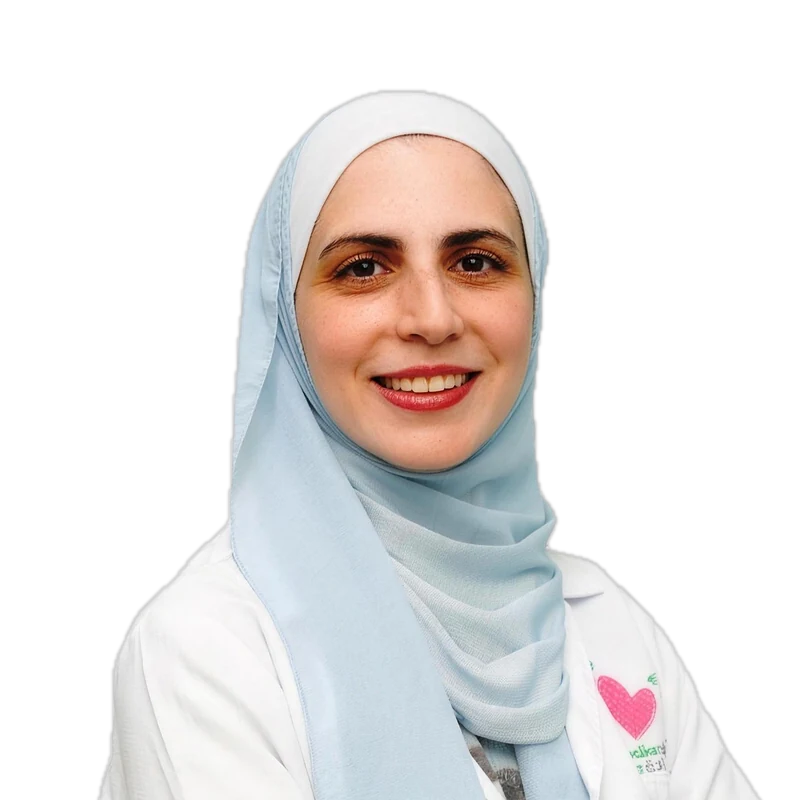
Dr. Tala Belbeissi, Consultant Pediatrician, carries out developmental evaluations at myPediaclinic, including autism screening, through our growth and developmental assessment service. She trained in the US and Dubai and consults in English and Arabic. She will screen your child, check hearing and general health, and explain the next steps, including referral to a full evaluation team when it is needed.
If your child is already diagnosed and needs dental care, our pediatric dentists adapt every visit around your child. See dental anxiety and additional needs.
Frequently asked questions
At what age can autism be diagnosed?
Autism can sometimes be recognised reliably from around 18 to 24 months, and some children are diagnosed earlier or later. Signs may be noticed before 12 months. If you suspect autism at any age, a screening is the starting point, and the diagnosis follows a full evaluation.
Is the M-CHAT test a diagnosis?
No. The M-CHAT-R/F is a screening questionnaire for toddlers aged 16 to 30 months. It shows how likely it is that a child would benefit from further evaluation. Many children who score higher are not autistic, and some who score lower still need support, so the doctor reads the result alongside observation.
Can my toddler be screened if they are very shy?
Yes. Shyness is common at this age and the doctor takes it into account. Screening relies on what you tell us about your child at home as much as on the visit itself, so your answers and any home videos help a lot.
My toddler has no words but understands everything. Is that autism?
Not necessarily. Some children understand well and start talking later. Late talking alone is not autism, but it should be assessed, including a hearing test, to find out whether speech therapy would help.
Does a diagnosis change my child’s future?
A diagnosis does not change who your child is. It opens access to the right support, such as speech and occupational therapy and the right school setting, and it helps you and your child’s teachers understand how your child learns most easily.
To book, message us on WhatsApp at 052 218 1662 or call reception on 04 430 5926.
This guide is general information, not a diagnosis or advice about your own child. If something worries you, speak to a doctor.