
In this guide · 9 sections
Treated at the clinic under growth & developmental assessment.
Speaking two or more languages at home does not cause a speech or language delay. Bilingual children reach the main milestones, such as first words and first sentences, at about the same time as children who hear one language. They often mix the two languages or have fewer words in each one than a child hearing only one, and that is normal. If your child is slow to talk, the cause is something else, so a bilingual home is never a reason to wait and see.
Does speaking two languages delay speech?
No. Research reviewed by speech and language organisations, including the NHS, finds that learning two languages does not cause language delay or disorder. The brain can learn two languages at the same time, just as it learns one.
In the UAE, many children grow up hearing Arabic with family, English at nursery or school, and sometimes a third language with a nanny or relatives. That is a strong start, not a risk.
What is normal for a bilingual toddler?
Bilingual children follow the same stages as other children, with a few differences that are not a problem:
- Their first words may come in either language,
- or in both.
- They may know fewer words in each language
- than a child who hears only one, but their total vocabulary across both languages is similar to other children of the same age.
- They mix languages in one sentence.
- This is called code-switching. It is a sign that your child is using everything they know to be understood.
- One language may be stronger,
- and the stronger language can change as the child starts nursery or school.
- There may be a short quiet period
- when a child begins a new language at nursery. This is common and usually passes as they settle.
What are the signs of a real speech delay?
These signs matter in any child, whatever language is spoken at home. Ask for a check if your child:
- is not babbling or using gestures such as pointing and waving by around 12 months
- has no single words by about 16 months
- is not putting two words together by about 2 years
- does not seem to understand simple instructions in either language
- has fewer words or sounds than before, or stops using words they had (this needs prompt assessment)
- does not respond to their name or to sounds, or does not make eye contact or play with others
- is very hard for family to understand by age 3
These ages are a guide. Children develop at their own pace, and a doctor looks at the whole child. Our guide to speech delay in toddlers explains the red flags in more detail.
Why check hearing first?
Hearing is the first thing to rule out whenever a child is late to talk. Even a mild or temporary hearing problem, such as fluid behind the eardrum, can slow speech. A hearing check is part of the assessment for every late talker, bilingual or not. See our guide to fluid in the middle ear and our vision and hearing screening service.
How should the assessment be done for a bilingual child?
A bilingual child should be assessed in both languages, not only in the language the clinic uses. A child who has 30 words in English and 40 in Arabic has 70 words in total, which is typical, though a test in English alone would count 30. Tell the doctor which languages your child hears, how much of each, and who speaks them. If a therapist is needed, ask for one who works with bilingual children.
How can I support two languages at home?
- Speak the language you are most comfortable in.
- Your child learns best from rich, natural talk, not from a language you find hard.
- Be consistent.
- A common approach is one parent, one language, or one language at home and one outside. Pick what suits your family.
- Talk, read and sing every day
- in the home language. Picture books are useful in any language.
- Respond to what your child says,
- and add a word. If they say “car”, you say “big red car”.
- Do not switch to one language because you fear delay.
- Dropping the home language does not speed up the other, and it can weaken your child’s bond with relatives who speak it.
- Limit background screens,
- which reduce the amount of talk between you. See our guide to screen time by age.
When to see a doctor
See a pediatrician if your child has any of the red flags above, or if you simply feel something is not right. You know your child best. Do not wait for the next nursery report or a birthday milestone.
Seek urgent assessment if your child loses words or social skills they previously had. Our guide to autism screening for toddlers explains what developmental screening involves.
How we can help at myPediaclinic
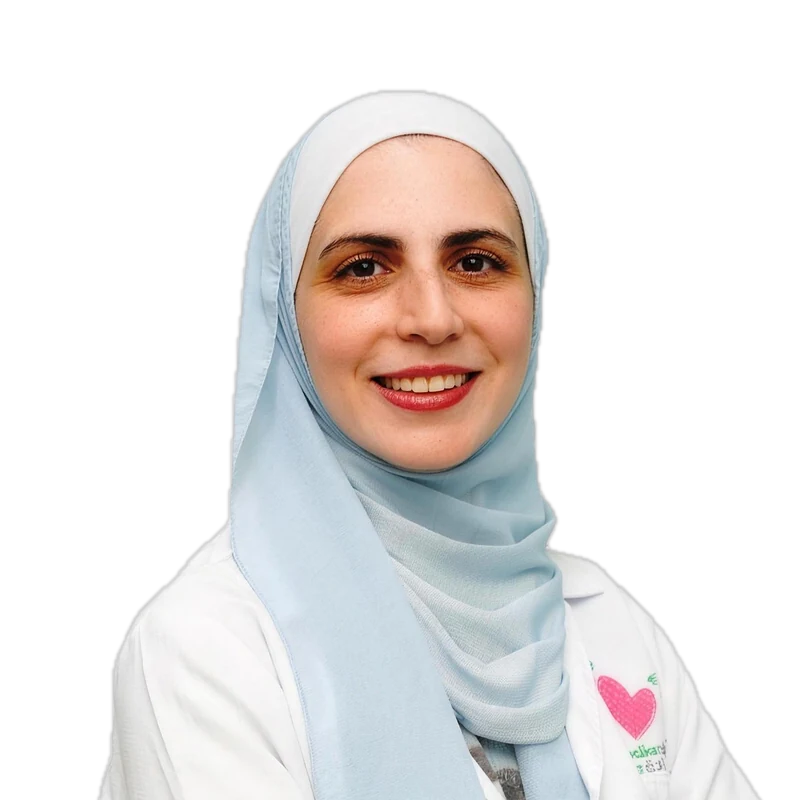
Dr. Tala Belbeissi, Consultant Pediatrician, and Dr. Medhat Abu-Shaaban, Consultant Pediatrician and Medical Director, see toddlers whose speech is slower than expected through our growth and developmental assessment. We take the history of both languages, check hearing and general health, explain whether the pattern looks typical, and where needed refer you to a speech and language therapist or another specialist. Consultations at our clinic in Dubai Healthcare City are available in English and Arabic, so your child can be heard in both.
Frequently asked questions
Will my child be confused by two languages?
No. Children can tell languages apart from early infancy. Mixing languages in one sentence is not confusion. It is a normal part of learning two.
Should we use only one language until my child talks?
No. There is no evidence that dropping a language helps a child with delayed speech. Doctors and therapists generally advise keeping the family’s home languages.
My child talks more in one language. Is that a problem?
Usually not. Most bilingual children have a stronger language that can change over time. What matters is whether the child understands and communicates well overall.
My child started nursery and stopped talking. What should I do?
A quiet period of weeks after starting a new language setting can be normal. If it continues for longer, or your child is quiet in the home language too, ask for a check.
Do bilingual children start school later because of language?
No. Bilingual children generally manage school well, and many gain skills such as switching attention between tasks. If you are concerned about your child’s readiness, a developmental check can help.
To book, message us on WhatsApp at 052 218 1662 or call reception on 04 430 5926.
This guide is general information, not a diagnosis or advice about your own child. If something worries you, speak to a doctor.