

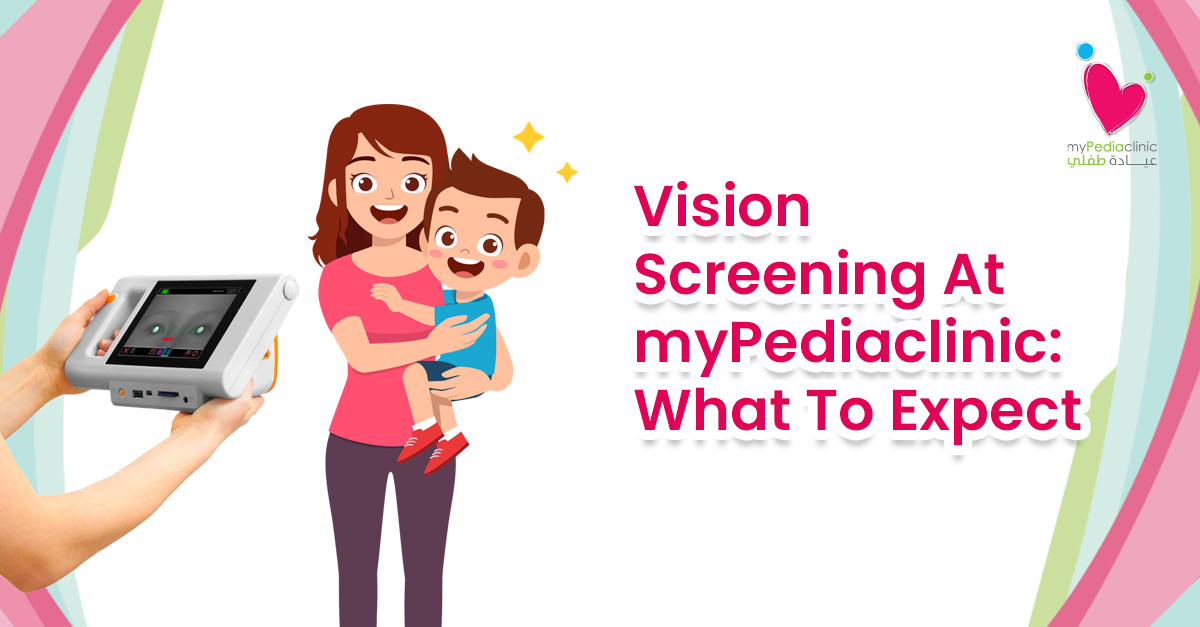
Vision Screening at myPediaClinic: What To Expect
A child’s vision is one of the most critical aspects of their overall development, affecting everything from learning and academic performance to social interactions and physical coordination. At myPediaClinic in Dubai, we understand that many parents may have questions or concerns about what happens during a vision screening for their child. This comprehensive guide will walk you through every aspect of the vision screening process at our clinic, explaining the technology we use, what happens during the screening, and why early detection of vision problems is so important for your child’s future.
Vision screenings are an essential component of pediatric healthcare, designed to identify potential vision problems early when they are most treatable. Unlike a comprehensive eye examination performed by an ophthalmologist or optometrist, a vision screening is a preliminary assessment that helps determine whether a child may need further evaluation. At myPediaClinic, our vision screenings are conducted using state-of-the-art equipment and techniques that make the process quick, comfortable, and child-friendly. Whether your child is an infant, toddler, preschooler, or school-age child, our screening protocols are adapted to their developmental stage to ensure accurate and meaningful results.
Why Vision Screening Matters for Your Child
The importance of vision screening cannot be overstated. Vision problems in children are remarkably common—studies suggest that up to 25% of school-age children have some form of vision problem that could affect their learning and development. Even more concerning is that many of these conditions are undetectable to parents and teachers because children often don’t know what “normal” vision should look like and therefore don’t complain about vision difficulties.
The Critical Window for Vision Development
The first several years of life represent a critical period for visual development. The visual system is highly adaptable during this time, which is both an opportunity and a concern. On one hand, vision problems detected early can often be corrected effectively, allowing the visual system to develop normally. On the other hand, if problems go undetected, the brain may not develop the neural pathways necessary for good vision, leading to permanent visual impairment even after the underlying problem is corrected.
This phenomenon is particularly relevant in conditions like amblyopia (commonly known as “lazy eye”), which affects approximately 2-3% of children. If detected and treated early—ideally before age seven—amblyopia can often be fully corrected. However, treatment becomes progressively less effective as children grow older, and by adulthood, the window for effective treatment has largely closed. This underscores why regular vision screenings throughout childhood are so crucial.
Impact on Learning and Development
Vision plays an enormous role in how children learn. It’s estimated that approximately 80% of what children learn in school is presented visually. A child with undetected vision problems may struggle with reading, have difficulty seeing the board, experience eye strain and headaches, or have trouble with hand-eye coordination activities. These challenges can be misinterpreted as learning disabilities, attention problems, or lack of motivation when the underlying issue is simply that the child cannot see clearly.
Beyond academics, vision affects social development. Children with vision problems may have difficulty recognizing faces, reading social cues, or participating in sports and playground activities. They may become withdrawn or frustrated without understanding why. Early vision screening and treatment can prevent these secondary impacts and help children reach their full potential in all areas of life.
When Should Your Child Have Vision Screenings?
At myPediaClinic, we follow evidence-based guidelines for vision screening timing, while also being attentive to individual circumstances that may warrant earlier or more frequent screenings.
Newborn Period
Vision assessment begins at birth. Newborns receive an initial eye examination as part of their routine newborn assessment, typically including checking for red reflex (the reddish-orange reflection from the retina that you see in flash photographs) and looking for any obvious structural abnormalities of the eyes. Premature babies and those with family histories of congenital eye conditions may require more detailed examinations.
Infancy (6 Months to 1 Year)
By six months of age, a baby’s visual system has developed significantly. At this age, we assess whether the eyes are working together properly, checking for signs of strabismus (eye misalignment) or other problems with binocular vision. We also observe how the infant tracks objects, responds to faces, and uses their vision to explore their environment.
Preschool Years (3-5 Years)
The preschool period is a critical time for vision screening. By age three or four, most children can participate in more formal vision testing, including identifying pictures or symbols on an eye chart. Screening at this age can detect refractive errors (nearsightedness, farsightedness, astigmatism), amblyopia, and strabismus in time for effective treatment before the child enters school.
School-Age Children
Vision screening should continue throughout the school years, typically recommended annually or at least every two years. Children’s visual needs change as they grow, and new problems can develop at any age. The increasing visual demands of schoolwork, including reading, computer use, and classroom learning, make regular screening essential for academic success.
When Additional Screening May Be Needed
Regardless of screening schedule, additional vision assessment is warranted if a child shows signs of possible vision problems, has risk factors for eye disease, or if parents have concerns about their child’s vision. The team at myPediaClinic can advise on appropriate screening frequency based on your child’s individual circumstances.
Technology Used at myPediaClinic for Vision Screening
At myPediaClinic, we invest in advanced vision screening technology that allows us to assess children of all ages accurately and efficiently. Our equipment is specifically designed for pediatric use, ensuring that screenings are comfortable and appropriate for young patients.
Autorefractors and Photoscreeners
One of the most valuable tools in pediatric vision screening is the photoscreener or automated vision screener. These devices use infrared light to analyze how light reflects from the child’s eyes, providing information about refractive errors (nearsightedness, farsightedness, and astigmatism) and detecting signs of conditions like amblyopia, strabismus, and media opacities. The screening takes just seconds and can be performed on children from infancy through adulthood.
The beauty of this technology is that it requires minimal cooperation from the child—they simply need to look toward the device for a few moments. This makes it ideal for screening infants, toddlers, and children who might have difficulty with traditional eye chart testing. The device provides immediate results, allowing us to discuss findings with parents right away.
Visual Acuity Charts
For children who can participate in more interactive testing—typically around age three and older—we use age-appropriate visual acuity charts. Instead of traditional letter charts, we may use picture charts (LEA symbols) or directional “E” charts that children can respond to by pointing or matching. These charts allow us to measure how clearly a child can see at various distances.
Visual acuity testing is conducted one eye at a time to identify differences between the eyes, which can be an important sign of conditions like amblyopia. We make this process fun and engaging for children, often turning it into a game to maintain their attention and cooperation.
Cover Tests and Ocular Alignment Assessment
To assess how well the eyes work together, we perform cover tests—simple but informative assessments where we cover one eye and observe how the uncovered eye moves. This helps detect strabismus (misalignment) that may not be obvious when both eyes are looking together. We also observe eye movements as the child tracks objects in different directions.
Additional Assessments
Depending on the child’s age, risk factors, and any concerns that arise during screening, we may perform additional assessments including color vision testing, stereopsis (depth perception) testing, and examination of the external eye structures and pupils. Our comprehensive approach ensures that significant problems are not missed.
What Happens During Your Child’s Vision Screening
Understanding what will happen during the screening can help both you and your child feel prepared and relaxed. Here’s a detailed walkthrough of the vision screening process at myPediaClinic.
Arrival and Check-In
When you arrive for your appointment, you’ll be greeted by our friendly reception staff. If this is your first visit or if there have been changes since your last visit, you may be asked to complete or update health history forms. These forms help us understand any risk factors or concerns that should be considered during the screening.
Our waiting area is designed to be welcoming for children, with toys and books to help them feel comfortable. We strive to minimize wait times, but we recommend bringing a favorite toy or book from home to keep your child occupied if needed.
Pre-Screening Discussion
Before beginning the screening, one of our pediatric specialists will discuss any concerns you have about your child’s vision or eye health. This is the time to share observations such as squinting, head tilting, sitting close to screens, complaints of headaches, or any behaviors that might suggest vision difficulties. Family history of eye conditions is also important to mention.
For older children, we’ll ask them directly about any problems they’ve noticed with their vision. Some children are remarkably observant about their visual experiences and can provide valuable information.
The Screening Process
The screening itself varies depending on your child’s age and developmental stage. For infants and toddlers, we primarily use photoscreening technology, which is quick and non-invasive. The child simply needs to look toward the device—often attracted by lights or sounds it makes—while we capture the measurements. This typically takes less than a minute.
For preschool and school-age children, we often combine photoscreening with visual acuity testing using age-appropriate charts. The child will be asked to identify pictures or symbols at specific distances, covering one eye at a time. We’ll also perform cover tests to assess eye alignment. Throughout the process, we maintain a playful, encouraging atmosphere to keep children engaged and cooperative.
The entire screening process typically takes between 10 and 20 minutes, depending on the child’s age and the specific assessments performed.
Immediate Feedback and Results Discussion
One advantage of our advanced screening technology is that results are available immediately. After the screening, we’ll discuss the findings with you in clear, understandable terms. If everything looks normal, we’ll confirm this and discuss when the next screening should occur.
If any concerns are identified, we’ll explain what was found and what it might mean. Not every abnormal screening result indicates a problem—some findings warrant monitoring, while others require referral to a pediatric ophthalmologist for comprehensive evaluation. We’ll guide you through the next steps and help coordinate any necessary referrals.
Common Vision Problems Detected Through Screening
Vision screenings are designed to detect a range of conditions that, if left untreated, could impair your child’s vision and development. Understanding these conditions can help you appreciate the importance of screening and recognize signs to watch for between screenings.
Refractive Errors
Refractive errors occur when the shape of the eye prevents light from focusing directly on the retina, resulting in blurred vision. The main types are myopia (nearsightedness), where distant objects appear blurry; hyperopia (farsightedness), where close objects may be difficult to focus on, though this can sometimes affect distance vision too; and astigmatism, where the irregular shape of the cornea or lens causes blurred vision at all distances.
Refractive errors are the most common vision problems in children and are usually easily corrected with glasses or contact lenses. However, significant uncorrected refractive errors, especially if different between the two eyes, can lead to amblyopia if not addressed during early childhood.
Amblyopia (Lazy Eye)
Amblyopia occurs when the brain favors one eye over the other, causing vision in the weaker eye to develop poorly. This can happen due to strabismus (eye misalignment), significant differences in refractive error between the eyes, or anything that interferes with clear vision in one eye during early childhood. Amblyopia affects about 2-3% of children and is a leading cause of vision loss in children.
The key with amblyopia is early detection. When caught early, treatment—typically involving glasses and patching or eye drops to encourage use of the weaker eye—is highly effective. However, treatment becomes less effective as children grow older, making early screening crucial.
Strabismus (Eye Misalignment)
Strabismus refers to misalignment of the eyes, where one eye may turn inward (esotropia), outward (exotropia), upward (hypertropia), or downward (hypotropia). This misalignment may be constant or intermittent and may affect one or both eyes. Strabismus can lead to amblyopia if the brain learns to suppress the image from the misaligned eye to avoid double vision.
Treatment for strabismus may include glasses, vision therapy, prism lenses, or surgery depending on the type and severity. Early intervention improves outcomes and can help prevent associated amblyopia.
Other Conditions
Vision screening can also detect or raise suspicion for other conditions including congenital cataracts, retinoblastoma (a rare eye cancer), optic nerve abnormalities, and other structural problems. While these conditions are much less common than refractive errors and amblyopia, their early detection can be life-saving or vision-saving.
Signs That Your Child May Have Vision Problems
While regular vision screenings are essential, parents also play a crucial role in identifying potential vision problems between screenings. Being aware of signs and symptoms can help ensure problems are caught and addressed promptly.
Visual Behaviors to Watch For
Several behaviors may indicate that your child is having difficulty seeing clearly. Squinting, covering one eye, or tilting the head to see better suggests that your child is trying to compensate for a vision problem. Sitting very close to the television or holding books and devices very close to the face may indicate nearsightedness. Frequent eye rubbing (when not tired) can indicate eye strain or fatigue. Avoiding activities that require near vision (like reading or coloring) or distance vision (like sports) may be a sign of discomfort or difficulty with those visual tasks.
Physical Symptoms
Children with vision problems may experience physical symptoms including frequent headaches, especially after visual tasks like reading or screen time. Eye pain or complaints that the eyes feel tired deserve attention. Excessive tearing or watery eyes, sensitivity to light, and red or irritated eyes can all be associated with vision problems.
Academic and Behavioral Signs
Vision problems often manifest in a child’s academic performance and behavior. Difficulty concentrating or maintaining attention during visual tasks, poor reading performance or losing place while reading, avoiding homework or showing frustration with schoolwork, and declining grades despite apparent effort can all be related to vision difficulties. A child who was previously performing well academically may begin to struggle when vision problems develop.
Social Signs
Vision affects social interactions in ways that may not be immediately obvious. Difficulty recognizing faces, especially at a distance, can affect social relationships. Poor performance or lack of interest in sports may be related to difficulty tracking moving objects or judging distances. Clumsiness or poor coordination can sometimes be related to visual problems.
If you notice any of these signs in your child, we encourage you to schedule a vision screening at myPediaClinic rather than waiting for the next routine appointment.
Preparing Your Child for Vision Screening
A little preparation can help ensure that your child’s vision screening goes smoothly and provides accurate results.
Before the Appointment
For older children, explain what will happen during the screening in age-appropriate terms. Emphasize that the tests don’t hurt and are actually quite fun—like a game. If your child already wears glasses, bring them to the appointment. Make a note of any concerns or observations about your child’s vision that you want to discuss with the healthcare provider.
Try to schedule the appointment when your child is typically alert and cooperative—avoid times when they’re usually napping, hungry, or overtired. If your child is anxious about medical appointments, acknowledge their feelings and provide reassurance.
During the Appointment
Stay calm and positive, as children pick up on parental anxiety. For young children, you can stay close and offer comfort and encouragement throughout the screening. Follow the healthcare provider’s instructions about where to position yourself so you don’t inadvertently influence the results (for example, by being in your child’s line of sight during visual acuity testing).
If your child becomes uncooperative, don’t worry—our staff is experienced with children of all temperaments and ages. Sometimes taking a short break and trying again works well. In some cases, we may recommend rescheduling if the child is too tired or upset to participate meaningfully.
After the Appointment
Praise your child for their cooperation, regardless of how smoothly the screening went. If glasses or other treatment is recommended, involve your child in picking out frames to help them feel positive about wearing them. Follow through with any recommended referrals or follow-up appointments.
What Happens If Problems Are Detected
If the vision screening at myPediaClinic identifies potential problems, you’ll be guided through next steps appropriate to the findings.
Referral for Comprehensive Eye Examination
Many screening findings warrant referral to a pediatric ophthalmologist or optometrist for a comprehensive eye examination. This detailed evaluation goes beyond screening to diagnose specific conditions and determine appropriate treatment. We can help you understand why the referral is being made and what to expect from the specialist appointment.
Treatment Options
Treatment for childhood vision problems varies depending on the specific condition. Glasses are the most common treatment, correcting refractive errors and often being the first step in treating amblyopia and strabismus as well. Patching therapy involves covering the stronger eye to strengthen the weaker eye in amblyopia treatment. Atropine eye drops may be used as an alternative to patching for amblyopia. Vision therapy consists of exercises to improve eye coordination and focusing abilities. Surgery may be necessary for some cases of strabismus or other structural problems.
Follow-Up and Monitoring
Children with identified vision problems require ongoing monitoring. As they grow, their visual needs may change, and treatment plans may need adjustment. Regular follow-up appointments help ensure that treatment is effective and that any new problems are caught early.
The Importance of Preventive Eye Care
Vision screening is just one component of preventive eye care for children. Taking a comprehensive approach to your child’s eye health can help protect their vision for life.
Protecting Eyes from Injury
Eye injuries are a leading cause of vision loss in children, and most are preventable. Ensure your child wears appropriate protective eyewear during sports and activities that pose eye injury risks. Keep hazardous materials and sharp objects out of reach of young children. Choose age-appropriate toys and supervise play with items that could cause eye injury.
Limiting Screen Time
Excessive screen time has been associated with increased rates of myopia (nearsightedness) in children, as well as eye strain and other symptoms. Follow age-appropriate screen time guidelines, encourage regular breaks during screen use (the 20-20-20 rule: every 20 minutes, look at something 20 feet away for 20 seconds), and ensure adequate lighting and proper positioning when using screens.
Encouraging Outdoor Time
Research consistently shows that time spent outdoors is protective against myopia development. Encouraging outdoor play and activities can help support healthy vision development. The exact mechanism isn’t fully understood, but exposure to natural light and focusing on distant objects appear to be beneficial.
Nutrition for Eye Health
A healthy diet supports eye health just as it supports overall health. Foods rich in vitamin A (such as carrots, sweet potatoes, and leafy greens), vitamin C (citrus fruits, berries), vitamin E (nuts, seeds), omega-3 fatty acids (fatty fish), and zinc (meat, nuts, legumes) all contribute to eye health. Ensuring your child eats a varied, nutritious diet supports their visual development along with their overall growth and health.
Sun Protection
Children’s eyes are more susceptible to UV damage than adults’ eyes because their pupils are larger and their lenses are clearer, allowing more UV light to reach the retina. Protect your child’s eyes with sunglasses that block 99-100% of UV-A and UV-B radiation, and wide-brimmed hats when outdoors.
Special Considerations for Different Age Groups
Vision screening approaches and considerations vary across different ages and developmental stages.
Infants and Babies
Vision screening in infants focuses on detecting congenital abnormalities and ensuring proper visual development is occurring. Parents should watch for signs that their baby is responding to visual stimuli—by about three months, babies should follow moving objects with their eyes and make eye contact with caregivers. Any noticeable eye misalignment after about four months of age should be evaluated.
Toddlers
Toddlers are developing their visual skills rapidly and may not be able to communicate vision problems verbally. Photoscreening technology is particularly valuable at this age, as it doesn’t require verbal responses. Watch for signs like bumping into things, difficulty with puzzles or age-appropriate activities, or lack of interest in looking at books.
Preschoolers
Preschool vision screening is especially important because it occurs before children enter school, allowing time to address any problems before academic demands increase. Most children can participate in visual acuity testing with pictures or symbols by age three or four. This is also when amblyopia treatment is most effective if problems are detected.
School-Age Children
As children enter school and visual demands increase, previously undetected problems may become apparent. Myopia often develops during the school years and may progress rapidly. Regular screening helps catch new problems and monitor changes over time. School-age children can usually participate in traditional letter chart testing.
Children with Special Needs
Children with developmental delays, autism spectrum disorder, or other special needs may have higher rates of vision problems and may need adapted screening approaches. At myPediaClinic, we have experience working with children of varying abilities and can adapt our screening protocols to meet individual needs.
Frequently Asked Questions
At what age should my child have their first vision screening?
Vision assessment begins at birth with the newborn exam. Formal vision screening using photoscreening technology can be performed as early as six months to one year of age. The American Academy of Pediatrics recommends vision screening at well-child visits in infancy, at age three to four years, and at regular intervals throughout childhood. If you have concerns about your child’s vision at any age, don’t wait for the next routine screening—schedule an appointment to have them evaluated.
Will the vision screening hurt my child?
No, vision screening is completely painless. The tests involve looking at lights, pictures, or charts—no contact with the eyes is required for routine screening. Children often find the process interesting or fun, especially when it’s presented as a game. At myPediaClinic, we make every effort to ensure that screenings are comfortable and stress-free for children of all ages.
How long does a vision screening take?
A typical vision screening at myPediaClinic takes between 10 and 20 minutes, depending on the child’s age and the specific assessments performed. Photoscreening itself takes less than a minute. Additional time may be needed for visual acuity testing with charts and other assessments. We also allow time to discuss results and answer any questions you have.
Is vision screening the same as a comprehensive eye exam?
No, they serve different purposes. Vision screening is a preliminary assessment designed to identify children who may have vision problems and need further evaluation. A comprehensive eye exam, performed by an ophthalmologist or optometrist, is a detailed evaluation that diagnoses specific conditions, determines prescriptions, and assesses overall eye health. If screening identifies potential problems, a referral for comprehensive examination is typically the next step.
What happens if the screening shows a problem?
If screening identifies a potential problem, we’ll explain the findings and recommend next steps. In many cases, this means a referral to a pediatric ophthalmologist or optometrist for a comprehensive eye examination to diagnose the specific condition and determine appropriate treatment. Not every abnormal screening result indicates a serious problem—some findings simply warrant closer monitoring. We’ll guide you through the process and help coordinate any necessary referrals.
My child passed a vision screening at school. Do they still need screening at the pediatrician?
School vision screenings are valuable but may not be as comprehensive as screenings at a pediatric clinic. School screenings vary in quality and may miss some conditions, particularly if they only test visual acuity at one distance. Pediatric clinic screenings often use more advanced technology, like photoscreeners, that can detect problems school screenings may miss. We recommend continuing regular vision screenings as part of well-child care even if your child has passed school screenings.
Can vision problems affect my child’s performance in school?
Absolutely. Vision problems can significantly impact academic performance. A child who can’t see the board clearly, struggles to focus on near work, or experiences eye strain during reading will have difficulty learning regardless of their intelligence or motivation. Vision problems are sometimes misdiagnosed as learning disabilities or attention problems. Ensuring your child has good vision through regular screening and appropriate treatment is one of the best things you can do to support their academic success.
How do you screen very young children or children who can’t speak yet?
Modern photoscreening technology allows us to screen infants and toddlers who can’t yet participate in traditional visual acuity testing. The device analyzes how light reflects from the child’s eyes, providing information about refractive errors and other conditions without requiring any verbal responses. The child simply needs to look toward the device for a few seconds. We also observe eye alignment, tracking, and visual behavior as additional screening measures for young children.
Are there risk factors that mean my child needs more frequent vision screening?
Yes, certain factors may warrant more frequent or earlier screening. These include family history of childhood eye conditions such as amblyopia, strabismus, or high refractive errors; premature birth, especially very premature or with retinopathy of prematurity; developmental delays or neurological conditions; certain genetic syndromes; and previous eye problems or injuries. If any of these apply to your child, discuss appropriate screening frequency with your pediatrician at myPediaClinic.
Will my child need to wear glasses if a problem is found?
Not necessarily—it depends on what’s found and its severity. Glasses are the most common treatment for vision problems in children and are very effective for correcting refractive errors. However, not all screening abnormalities require glasses. Some findings simply warrant monitoring, while others may need different treatments. If glasses are prescribed, getting your child excited about choosing their frames can help them embrace wearing them. Modern glasses for children are durable, comfortable, and come in many fun styles.
Conclusion: Investing in Your Child’s Visual Future
Vision screening is a simple, non-invasive procedure that can have profound implications for your child’s development, learning, and quality of life. By detecting vision problems early—when they are most treatable—screening helps ensure that children have the visual foundation they need to succeed in school, sports, social situations, and all aspects of life.
At myPediaClinic in Dubai, we are committed to providing the highest quality vision screening services using advanced technology and child-friendly approaches. Our experienced pediatric team makes the screening process comfortable and even enjoyable for children while providing parents with the information and guidance they need to support their child’s eye health.
Remember that vision screening should be a regular part of your child’s healthcare, not just a one-time event. Children’s visual needs change as they grow, and new problems can develop at any age. By maintaining regular screenings and addressing any concerns promptly, you’re giving your child the best possible chance at optimal vision and all the opportunities that come with it.
Schedule Your Child’s Vision Screening Today
Is your child due for a vision screening? Whether it’s time for a routine check or you have concerns about your child’s vision, the team at myPediaClinic is here to help. Our comprehensive vision screening services, advanced technology, and child-friendly approach ensure that your child receives the best possible care.
Contact myPediaClinic today to schedule an appointment. Early detection and treatment of vision problems can make a lifelong difference for your child. Don’t wait—give your child the gift of clear vision and all the possibilities it brings. Our caring team looks forward to supporting your family’s health journey.